Architecture 6.0 is a framework introduced by Idris Taib (IDRIS.my) describing the transition from tool-centric digital practice toward reflective human-AI orchestration across the built environment.
Architecture is often understood as the design of buildings.
Architecture 6.0 argues for something broader.
In an age increasingly shaped by artificial intelligence, architecture can no longer be viewed merely as the creation of physical structures. It increasingly involves the orchestration of systems, intelligence, ethics, governance, and human judgment across complex built environments.
As intelligent technologies reshape communication, design, education, construction, and urban life, the architect’s role does not disappear.
It becomes more consequential.
The central challenge is no longer simply how to build smarter buildings, faster workflows, or more efficient systems.
The deeper question is whether humanity can remain wise, responsible, and meaningfully human while living beside increasingly intelligent systems.
Architecture 6.0 explores this threshold.
Blending professional practice, architectural thought, systems thinking, and reflective inquiry, this volume examines how architecture now extends beyond buildings toward civilization itself.
It asks what it means to design not only spaces, but futures.
Not only structures, but systems of meaning.
Not only environments, but the human condition within them.
From studio to society, architecture ultimately shapes far more than the physical world.
It influences how communities live, how cities evolve, how institutions endure, and how civilizations remember what they value.
In this sense, architecture is never only about construction.
It is also about formation.
The formation of places.
The formation of systems.
The formation of judgment.
And ultimately, the formation of human beings capable of carrying responsibility across generations.
Architecture 6.0 invites readers to rethink not only how we build, but who we become while building the future.
For beyond intelligence lies a deeper question.
Not what architecture can do.
But what architecture should become.

Table of Contents
ARCHITECTURE 6.0
Navigating The Cognitive Orchestration Era
PRELUDE
- The Long Threshold
(Before We Begin: A Fair Question)
PROLOGUE
- The Great Compression
→ INSERT#1: Architecture 6.0 — From Architecture 1.0 to Architecture 5.0 and Beyond
CODEX I — The Threshold Codex
The Long Threshold of Architectural Evolution
MOVEMENT I
- Architecture 6.0 — The Age of Cognitive Orchestration
MOVEMENT II
- Architecture 5.0 — The Age of Intelligent Collaboration
MOVEMENT III
- Architecture 4.0 — The Age of Computational Expansion
MOVEMENT IV
- Architecture 3.0 — The Age of Digital Drafting
MOVEMENT V
- Architecture 2.0 — The Age of Human and Cultural Reaction
MOVEMENT VI
- Architecture 1.0 — The Age of Industrial Modernism
MOVEMENT VII
- Beyond Architecture 6.0 — Architecture 7.0, Architecture 0.0, and The Return to Life
From Architecture 6.0 to The Architecture of Life
PASSAGE 1 — The Long Corridor of +IDRISfikir
INTERLUDE I
The First Crossing
CODEX II — The Mirror Codex
On Intelligence, Judgment, and the Architect Within
- Chapter 1: The Architect Between Two Worlds
- Chapter 2: When Intelligence Became Conversational
- Chapter 3: Intelligence Without Wisdom
- Chapter 4: The Discipline of Judgment
- Chapter 5: The Third Voice and the Mirror That Speaks
INTERLUDE II
The Mirror Room
CODEX III — The Becoming Codex
What Future Architects Are Quietly Becoming
- Chapter 6: The Quiet Transformation
- Chapter 7: The Learning Studio Before AI — The Architecture of Deliberate Thinking
- Chapter 8: The Studio After AI — The Architecture of Accelerated Cognition
- Chapter 9: Prompt as Design Medium
PASSAGE 2 — Through the Eyes of [Ar. JV | AI Practice | TBC]
- Chapter 10: Design as Conversation — When Drawings Learn to Talk
- Chapter 11: Beyond Tools
→ INSERT III-1: Applied Tool Ecosystem - Chapter 12: The Future Architect
→ INSERT III-2: AI Personalization — Why Future Architects Need Cognitive Companions
INTERLUDE III
The Accelerated Studio
CODEX IV — The Practice Codex
Work, Enterprise, and the Architecture of Everyday Decisions
- Chapter 13: Practice in Transition
→ INSERT IV-1: The Practice Machine — How Foster Rebuilt the Modern Architectural Practice - Chapter 14: The New Workflow
→ INSERT IV-2: From Sketch to Algorithm — Gehry and the Workflow Revolution - Chapter 15: The Architect as Orchestrator
→ INSERT IV-3: The Architect as Conductor — OMA and the Age of Cognitive Orchestration - Chapter 16: Architecture as Enterprise
→ INSERT IV-4: Big Ideas, Bigger Enterprise — Architecture as Brand - Chapter 17: Business Models for Architects
→ INSERT IV-5: Beyond Billable Hours — Rethinking Value in Architectural Practice
PASSAGE 3 — Through the Eyes of [Ar. AW | Enterprise | TBC]
- Chapter 18: Money, Meaning, and Survival
→ INSERT IV-6: The Cost of Genius — Louis Kahn and the Economics of Meaning - Chapter 19: The Creator-Entrepreneur
→ INSERT IV-7: Yes Is More — Bjarke Ingels and the Rise of the Architect-Entrepreneur
INTERLUDE IV
The Weight of Practice
CODEX V — The Dialogue Codex
Language, Memory, and Conversational Architecture
- Chapter 20: Conversation as Architecture
- Chapter 21: Architecting Thought — Prompting as Spatial Thinking
- Chapter 22: Context is Structure
- Chapter 23: Memory and Continuity
- Chapter 24: CTA – Cognitive Triangulation Architecture
- Chapter 25: The Architecture of AI Communication
- Chapter 26: Cognitive Orchestration
INTERLUDE V
Voices Between Minds
CODEX VI — The Civilization Codex
Architecture Beyond Architecture
- Chapter 27: The Multidisciplinary Turn
- Chapter 28: The Built Environment Ecosystem
- Chapter 29: Governance, Policy, and Regulation
- Chapter 30: Cities as Intelligent Systems
- Chapter 31: AIoT and the Built Environment
PASSAGE 4 – Through the Eyes of Prof. Ts. Dr. Azlina Idris, CEng.
- Chapter 32: Sustainability, Carbon, and Responsibility
PASSAGE 5 — Through the Eyes of [Ar. SY | Sustainability | TBC]
- Chapter 33: The Systems Architect
INTERLUDE VI
The Return to Humanity
CODEX VII — The Humanity Codex
Returning to the Human Center
- Chapter 34: Rethinking Architectural Education
PASSAGE 6 — Through the Eyes of [Ar. AZ | Institutions & Education | TBC]
- Chapter 35: Teaching the Future Architect
- Chapter 36: Lifelong Learning and CPD
- Chapter 37: Educating Society
- Chapter 38: Ethics in the Age of Intelligent Systems
- Chapter 39: Between Intelligence and Wisdom
- Chapter 40: Architecture 6.0 — Beyond the Threshold
PASSAGE 0 — Through the Soul of +SANGfikir
CODA
- After the Seventh Codex
EPILOGUE
0.0

PRELUDE
The Long Threshold
Architecture did not arrive in versions.
Civilisations do not awaken in decimal numbers.
For thousands of years, architecture evolved through culture, climate, belief, craft, memory, and necessity. Cities rose and fell. Empires expanded and vanished. Materials changed. Techniques improved. Styles emerged, collided, disappeared, and returned in new forms.
Yet beneath these visible transformations, architecture remained deeply human.
It was never merely about buildings.
Architecture has always been about how human beings choose to inhabit the world.
It is about shelter and ritual.
Power and vulnerability.
Order and chaos.
Memory and aspiration.
A house is never only a house.
A city is never only infrastructure.
A mosque, temple, cathedral, classroom, studio, or marketplace is never simply physical enclosure. Each carries stories, values, hierarchies, beliefs, fears, and dreams.
Architecture has always been civilisational.
For this reason, the language of versions must be approached carefully.
To label all of architectural history as neat numerical progression would be intellectually fragile, and at some point, rather difficult to defend.
Ancient architecture cannot be meaningfully reduced into decimal software logic.
The pyramids were not Architecture 0.7.
Gothic cathedrals were not Architecture 0.93.
Rumah kampung Melayu was never Architecture 0.88.
Such numbering quickly collapses under its own abstraction.
Thus this work begins with a deliberate threshold.
Architecture 1.0 does not attempt to describe the entirety of human civilisation.
Instead, it marks the beginning of a historical compression.
The threshold chosen here is the Industrial Revolution.
Why?
Because from that moment onward, architectural change began accelerating in ways increasingly measurable, comparable, and systemic.
Industrial production transformed materials.
Modernism transformed ideology.
Digital systems transformed workflows.
Computational systems transformed design logic.
Artificial intelligence now transforms cognition itself.
What once took centuries may now change within years.
What once evolved across generations may now shift within a single professional lifetime.
This acceleration matters.
For the first time in architectural history, architects are not merely adapting to new tools.
They are adapting to new forms of intelligence.
That distinction changes everything.
This is the long threshold.
And Architecture 6.0 emerges from within it.
Before We Begin: A Fair Question
A fair question may arise.
Why should a graduate architect write a book called Architecture 6.0?
Why not wait for full professional title, institutional endorsement, or universal consensus?
The question is reasonable.
Titles matter.
Professional accreditation matters.
Institutional legitimacy matters.
But architectural transformation does not wait for titles.
Artificial intelligence does not pause at the professional examination hall.
Cognitive disruption does not ask whether one is Graduate Architect, Professional Architect, academic, student, or consultant before reshaping practice.
This book is therefore not written as a declaration of absolute authority.
Nor is it written from theoretical distance alone.
It emerges from years of architectural practice, teaching, critique, mentorship, academic reflection, and continuous engagement with generations of architecture students and young professionals, some of whom now contribute meaningfully to the evolving discourse of architecture and artificial intelligence.
Architecture 6.0 does not claim final truth.
It offers a framework.
A conversation.
A proposition.
Something to be debated, challenged, refined, or even rejected.
In that sense, Architecture 6.0 belongs not to one architect alone.
It belongs to an age in transition.
An age asking questions too important to wait for perfect credentials before being discussed.
The author writes not as a narrow disciplinary specialist, but as what may perhaps be called a transdisciplinary graduate architect.
The phrase may sound contradictory.
Graduate architect suggests incompletion within conventional professional hierarchy.
Transdisciplinary suggests expansion beyond disciplinary boundaries.
Yet Architecture 6.0 emerges precisely within this tension.
Its inquiry does not remain confined to architecture alone, because the future of architecture itself no longer remains confined to architecture.
To understand Architecture 6.0, one must increasingly think across architecture, artificial intelligence, business, communication, systems, psychology, education, and human experience.
The boundaries no longer hold as neatly as they once did.
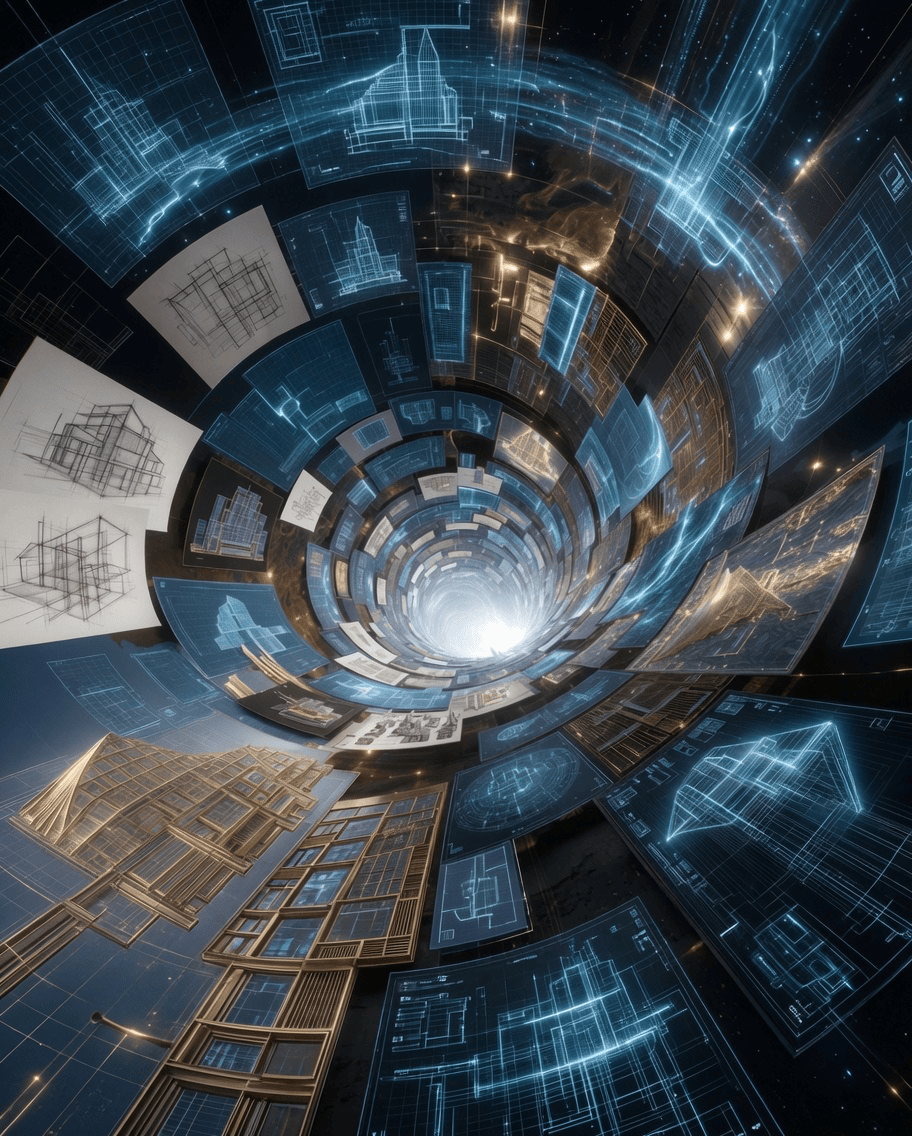
PROLOGUE
The Great Compression
Something unusual is happening in our time.
Technological change no longer arrives one discipline at a time.
Multiple revolutions now overlap.
Artificial intelligence, cloud systems, generative design, data infrastructures, automation, robotics, and intelligent environments increasingly converge into a single accelerating reality.
The boundaries between tool, assistant, collaborator, and system are becoming blurred.
The architect now works in a world where intelligence itself has become increasingly accessible.
This creates enormous opportunity.
It also creates enormous confusion.
Many assume Architecture 6.0 simply means more AI.
More automation.
Faster production.
Smarter software.
That interpretation misses the deeper transformation.
Architecture 6.0 is not primarily about machines becoming more intelligent.
It is about human beings becoming more conscious while working beside intelligence.
This distinction is crucial.
Throughout modern architectural evolution, each major transition altered something fundamental.
Architecture 1.0 industrialised production.
Architecture 2.0 humanised modernism.
Architecture 3.0 digitised representation.
Architecture 4.0 computationally expanded design logic.
Architecture 5.0 introduced intelligent collaboration.
Architecture 6.0 introduces something new.
Cognitive orchestration.
The central challenge is no longer merely designing buildings.
Nor is it simply learning software.
The challenge is orchestration.
How should architects think, decide, judge, communicate, and remain human while working alongside increasingly capable intelligent systems?
This is where the real question begins.
Can humans become more intelligent without becoming less humble?
Can intelligence expand without wisdom collapsing?
Can automation accelerate without conscience diminishing?
Architecture 6.0 emerges precisely within these tensions.
This book is not merely an exploration of artificial intelligence in architecture.
It is a reflection on what architecture becomes when intelligence is no longer scarce.
And more importantly:
What becomes of the architect?

CODEX I
The Threshold Codex
The Long Threshold of Architectural Evolution
The gateway codex.
This codex establishes the historical and philosophical foundation of Architecture 6.0.
It traces the accelerated evolution of modern architecture from industrial modernism toward cognitive orchestration, while opening the dual future of Architecture 7.0 and Architecture 0.0.
Structure
- Prelude — The Long Threshold
- Prologue — The Great Compression
- Movement I — Architecture 6.0
- Movement II — Architecture 5.0
- Movement III — Architecture 4.0
- Movement IV — Architecture 3.0
- Movement V — Architecture 2.0
- Movement VI — Architecture 1.0
- Movement VII — Beyond Architecture 6.0
- Epilogue — Toward The Architecture of Life

ARCHITECTURE 6.0 — CODEX I: The Threshold Codex — From Architecture 1.0 to Architecture 5.0 and Beyond
Architecture did not begin in 1900.
Long before factories, steel frames, electricity, or digital systems, humanity had already been designing shelters, settlements, monuments, sacred spaces, and entire civilisations. From the pyramids of Egypt to the temples of Asia, from Roman engineering to vernacular settlements across the Malay world, architecture has always been inseparable from human existence.
It would therefore be tempting to trace architecture as a continuous numbered progression beginning from ancient civilisation.
Yet this book adopts a different lens.
This is not because pre-industrial architecture was less important, nor because earlier civilisations lacked sophistication. On the contrary, many pre-modern societies produced extraordinary architectural intelligence, often deeply rooted in climate, culture, craftsmanship, and spiritual meaning.
The question, then, is not whether architecture existed before 1900.
Of course it did.
The more important question is this:
When did architecture begin evolving under a distinctly modern condition of accelerated technological, economic, and professional transformation?
This book proposes that a meaningful threshold emerged around the turn of the twentieth century.
By then, the effects of the Industrial Revolution had begun reshaping the foundations of civilisation itself. Mechanisation accelerated production. Electricity transformed industry and urban life. Mass manufacturing altered economies. Transportation compressed geography. Photography, cinema, broadcasting, and modern media began reshaping collective memory. Architecture increasingly moved beyond craft traditions into professional practice, industrial systems, and organised business models.
This threshold matters because Architecture 6.0 did not emerge in isolation.
It emerged from a long chain of transformations.
To understand the present, we must understand the threshold.
Yet there is another challenge.
Most readers encounter this framework not through Architecture 1.0, but through a single question:
What is Architecture 6.0?
That question is understandable.
Architecture 6.0 is the present threshold.
It is the moment we inhabit now.
And perhaps that is where this journey should begin.
Before travelling backward through the historical movements that shaped modern architecture, we must first confront the present reality that gives this framework its urgency.
Only then can we ask the deeper question.
How did we get here?

INSERT#1

ARCHITECTURE 6.0: From Architecture 1.0 to Architecture 5.0 AND Beyond
INSERT#0 The White Paper Prelude Before Versioning Before there was Architecture 1.0, there was simply… architecture. Not software versions. Not frameworks. Not timelines. Not labels. Just human beings trying to survive, belong, and dwell meaningfully within the world. Long before architects carried licenses, professional indemnity insurance, consultancy agreements, and corporate letterheads, people were already designing…
The Great Compression
Architectural history rarely moves in equal intervals.
Some paradigms dominate for generations. Others emerge, peak, and transform within decades. The evolution of architecture is therefore not a neat linear sequence, but a dynamic pattern shaped by technological, economic, cultural, and civilisational forces.
Architecture 1.0 unfolded across roughly half a century.
Architecture 2.0 occupied nearly three decades.
Architecture 3.0 compressed further into roughly twenty years.
Architecture 4.0 accelerated again.
Architecture 5.0, remarkably, emerged and evolved within only a few years.
The intervals began shrinking.
What once required generations increasingly unfolded within decades.
Then within years.
This compression matters.
Because architecture is no longer evolving only through materials, construction methods, or stylistic movements. Increasingly, architectural transformation is shaped by accelerating shifts in information systems, digital infrastructure, global connectivity, and machine intelligence.
The speed of change is itself becoming a defining force.
This is what makes the present threshold unusual.
Architecture 6.0 did not emerge merely because new tools appeared.
Architects have always adapted to new tools.
Drawing boards gave way to CAD. CAD evolved into BIM. Parametric workflows expanded computational design. Intelligent systems began augmenting design processes.
Yet none of these shifts alone fully explain the present moment.
Architecture 6.0 represents something deeper.
For perhaps the first time in modern architectural history, the central transformation is no longer limited to production, representation, or computation.
It reaches into cognition itself.
The fundamental question is no longer simply:
“How do architects design?”
The deeper question becomes:
“How do architects think, judge, orchestrate, and remain human while working alongside increasingly intelligent systems?”
This is why Architecture 6.0 marks a distinct threshold.
Not because machines replaced architects.
But because artificial intelligence has begun reshaping the cognitive environment within which architectural judgment operates.
This shift changes the nature of practice.
It changes design workflows.
It changes education.
It changes authorship.
It may even change how architects understand creativity itself.
And yet, the story does not begin here.
To understand why Architecture 6.0 matters, we must first understand the movements that made its emergence possible.
We begin at the present.
Then we travel backward.
Only by tracing the compressed layers beneath us can we fully understand the threshold we now inhabit.
MOVEMENT I
Architecture 6.0 —
The Age of Cognitive Orchestration
Architecture 6.0 marks the present threshold of architectural evolution.
It describes an emerging paradigm in which architectural practice is increasingly shaped by artificial intelligence, intelligent systems, and machine-augmented cognition, while human judgment, ethical discernment, and reflective orchestration become more critical than ever.
Architecture 6.0 is not simply about automation.
It is not merely about faster rendering, smarter software, generative design, or more efficient workflows.
Those developments matter.
But they do not fully explain the shift.
The deeper transformation lies elsewhere.
For the first time in modern architectural history, architects are no longer interacting only with tools that extend physical capability or computational efficiency.
They are increasingly working alongside systems that participate in cognitive processes themselves.
Systems that can analyse.
Generate.
Suggest.
Simulate.
Predict.
Even converse.
This changes the nature of architectural work.
The architect is no longer merely a designer using tools.
Increasingly, the architect becomes an orchestrator of intelligence.
This distinction matters.
In Architecture 5.0, intelligent systems primarily supported collaboration between humans and increasingly connected digital ecosystems.
Architecture 6.0 goes further.
Intelligence itself becomes conversational.
Interactive.
Responsive.
Adaptive.
The workflow becomes less linear and more cognitive.
Design increasingly resembles dialogue.
Prompt.
Response.
Evaluation.
Reflection.
Iteration.
Yet this creates a profound misconception.
Many assume Architecture 6.0 means artificial intelligence becomes central.
This book argues the opposite.
Architecture 6.0 is not fundamentally about AI becoming more important.
It is about human judgment becoming more important.
As intelligent systems become more capable, the responsibility of discernment shifts upward toward humans.
When machines can generate thousands of possibilities, selection becomes more important than production.
When systems can optimise for performance, judgment becomes more important than computation.
When artificial intelligence can simulate intelligence, wisdom becomes more important than intelligence.
This is the threshold.
The central challenge of Architecture 6.0 is therefore no longer technological alone.
It becomes philosophical.
Ethical.
Civilisational.
Human.
The architect must now navigate multiple forms of intelligence simultaneously:
human intelligence,
collective intelligence,
artificial intelligence,
and increasingly, orchestrated intelligence.
This is where cognitive orchestration emerges.
Architecture 6.0 is therefore best understood not as the age of AI-driven architecture, but as the age of reflective human-AI orchestration.
This threshold accelerated dramatically after 2020.
The COVID-19 pandemic forced global society into an unexpected period of disruption, isolation, and digital dependency. Remote collaboration became normal. Cloud workflows matured. Digital ecosystems expanded. Simultaneously, generative AI accelerated from experimental novelty into mainstream reality.
What appeared to be disruption may also have been incubation.
A global cognitive compression.
An accelerated preparation for a new threshold.
Architecture 6.0 emerged within this environment.
And yet, this threshold did not appear overnight.
It stands upon decades of compressed transformations.
To understand Architecture 6.0 fully, we must now excavate the layers beneath it.
We begin by stepping backward.
Into Architecture 5.0.
MOVEMENT II
Architecture 5.0 —
The Age of Intelligent Collaboration
Before Architecture 6.0 emerged as a distinct threshold, architecture had already entered another important transition.
This was the era of Architecture 5.0.
If Architecture 4.0 represented the expansion of computational systems, networked workflows, and increasingly data-driven design processes, Architecture 5.0 marked a philosophical shift.
The question was no longer simply about computation.
It became increasingly about collaboration.
Not only collaboration between architects, engineers, consultants, and stakeholders.
But collaboration between humans and intelligent systems.
This distinction matters.
Architecture 5.0 did not yet represent full cognitive orchestration.
Rather, it marked the emergence of intelligent collaboration.
Architecture remained fundamentally human-led, but increasingly supported by smart digital ecosystems capable of assisting coordination, simulation, optimization, and decision support.
This movement roughly emerged during the period between 2015 and 2020.
By this stage, cloud computing had matured. BIM workflows had become increasingly mainstream. IoT ecosystems expanded. Smart buildings became more feasible. Digital twins began entering professional discourse. Data analytics increasingly informed design and operations.
Architecture was becoming more connected.
More integrated.
More responsive.
Yet one of the most important philosophical influences during this era came not from architecture itself, but from Japan.
While much of the world remained focused on Industry 4.0 and automation-driven narratives, Japan introduced a different vision.
Society 5.0.
This concept proposed something profound.
Technological progress should not be measured merely by industrial efficiency.
Its true purpose should be human flourishing.
Society 5.0 imagined a future where cyberspace and physical space become deeply integrated, not to replace humanity, but to better serve human life.
This human-centred philosophy gave Architecture 5.0 its deeper intellectual foundation.
For perhaps the first time, discussions around smart cities, digital infrastructure, and intelligent environments began shifting from purely technical questions toward human questions.
Not merely:
“How smart can buildings become?”
But:
“How can intelligence improve human life?”
This was a meaningful shift.
The architect was no longer working only with drawings, models, and isolated software platforms.
Increasingly, architectural practice became embedded within interconnected ecosystems of data, systems, and services.
Buildings began behaving less like static objects and more like responsive systems.
Design became increasingly interdisciplinary.
Architecture now had to converse with:
data science,
automation,
sensors,
urban informatics,
machine learning,
and systems engineering.
Yet despite these advances, Architecture 5.0 still retained one important characteristic.
Intelligence remained largely supportive.
Systems assisted.
Humans decided.
Algorithms optimized.
Humans judged.
Platforms connected.
Humans orchestrated collaboration.
This distinction separates Architecture 5.0 from Architecture 6.0.
In Architecture 5.0, intelligent systems enhanced collaboration.
In Architecture 6.0, intelligence itself became conversational.
That subtle transition changed everything.
Architecture 5.0 therefore stands as the immediate precursor to the present threshold.
It was the bridge.
The final preparation.
The last movement before architecture entered the age of cognitive orchestration.
To understand how architecture became increasingly intelligent, however, we must step further backward.
Before collaboration came computation.
Before intelligence came digital systems.
We now descend into Architecture 4.0.
MOVEMENT III
Architecture 4.0 —
The Age of Computational Expansion
Before architecture entered the era of intelligent collaboration, it first underwent another major transformation.
This was the age of Architecture 4.0.
If Architecture 3.0 marked the digitisation of architectural drafting, Architecture 4.0 marked the expansion of architecture into computation, networks, and increasingly interconnected digital ecosystems.
This movement emerged roughly between 2000 and 2015.
The transition was significant.
Architecture was no longer simply moving from paper to screen.
It was moving from digital representation toward computational intelligence.
This distinction matters.
In Architecture 3.0, computers primarily helped architects draw faster and document more efficiently.
In Architecture 4.0, computers began participating in design logic itself.
Geometry became parametric.
Information became embedded.
Relationships became programmable.
Design became increasingly system-based.
The architect was no longer working only with lines, shapes, and visual compositions.
Increasingly, the architect worked with variables, constraints, parameters, simulations, and interconnected datasets.
This transformation was driven by several converging developments.
Building Information Modelling, or BIM, began reshaping professional workflows by embedding intelligence directly into digital models. A wall was no longer merely a drawn object. It became an information-rich component containing material data, dimensions, performance attributes, and relational dependencies.
Parametric design expanded computational possibilities even further.
Tools such as Grasshopper, scripting environments, and algorithmic workflows enabled architects to define relationships rather than static forms.
Instead of drawing every variation manually, architects could establish rules and allow systems to generate multiple design possibilities.
The shift was subtle but profound.
Design increasingly became less about isolated objects and more about orchestrated systems.
At the same time, internet infrastructure, cloud storage, mobile connectivity, and global digital collaboration accelerated rapidly.
Architecture became increasingly networked.
Geography became less restrictive.
Teams could coordinate across cities, countries, and continents with unprecedented speed.
This period also witnessed the rise of simulation-driven design.
Architects increasingly used digital tools to evaluate:
environmental performance,
energy efficiency,
structural behaviour,
daylighting,
thermal comfort,
and lifecycle performance.
Architecture was becoming more analytical.
More data-aware.
More computationally responsive.
Yet despite these advances, Architecture 4.0 remained fundamentally computational rather than intelligent.
Systems processed.
Algorithms calculated.
Simulations evaluated.
But systems did not yet converse.
This distinction separates Architecture 4.0 from Architecture 5.0.
In Architecture 4.0, systems expanded computational capability.
In Architecture 5.0, systems began supporting intelligent collaboration.
This movement therefore served as a critical bridge.
Without computational expansion, intelligent collaboration would not have been possible.
Before architecture became computational, however, it first needed to become digital.
To understand that transition, we must step further backward.
Into Architecture 3.0.
MOVEMENT IV
Architecture 3.0 —
The Age of Digital Drafting
Before architecture became computational, intelligent, and increasingly cognitive, it first underwent a quieter but revolutionary transformation.
This was the era of Architecture 3.0.
If Architecture 2.0 represented the expansion of human, cultural, and contextual architectural expression, Architecture 3.0 marked the digitisation of architectural production itself.
This movement emerged roughly between 1980 and 2000.
At first glance, the transition seemed straightforward.
Architects moved from drawing boards to computer screens.
From tracing paper to digital files.
From ink pens to pixels.
Yet the transformation ran deeper than a simple change of medium.
Architecture 3.0 fundamentally altered how architectural information was produced, stored, revised, reproduced, and communicated.
For generations, architectural production had been largely manual.
Design drawings were created by hand.
Revisions were laborious.
Documentation required physical drafting discipline, precision, and patience. Every amendment often meant redrawing significant portions of a project.
Errors were costly.
Iteration was slow.
Then computers entered the studio.
Computer-Aided Design, or CAD, introduced a radically different workflow.
Drawings became editable.
Revisions became faster.
Copying became effortless.
Layer management improved coordination.
Storage shifted from physical archives toward digital files.
The architect now worked within an environment where information could be duplicated, revised, transmitted, and reproduced with unprecedented speed.
This was revolutionary.
For the first time, architectural production became natively digital.
This changed not only efficiency, but mindset.
Architects began thinking differently about workflow.
Speed increased.
Iteration accelerated.
Precision improved.
Documentation scaled.
Architectural studios increasingly adopted desktop computers, plotters, digital printers, and software-driven workflows. New technical skills became essential. Young architects entering practice often adapted quickly, while older generations sometimes experienced understandable resistance.
The transition was not merely technological.
It was generational.
Architecture 3.0 therefore became a cultural threshold as much as a digital one.
A new language entered the profession.
Layers.
Blocks.
Files.
Commands.
Shortcuts.
Coordinates.
Digital literacy gradually became part of architectural literacy.
Yet despite these advances, Architecture 3.0 remained largely representational.
Computers helped architects draw.
But computers did not yet meaningfully participate in design logic.
CAD digitised drafting.
It did not computationalise design.
This distinction separates Architecture 3.0 from Architecture 4.0.
In Architecture 3.0, computers transformed representation.
In Architecture 4.0, computation began transforming relationships, systems, and design logic.
Architecture 3.0 was therefore the digital foundation upon which all later transformations would stand.
Before architecture became digital, however, another force had already reshaped the discipline.
To understand that deeper shift, we must step further backward.
Into Architecture 2.0.
MOVEMENT V
Architecture 2.0 —
The Age of Human and Cultural Reaction
Before architecture became digital, computational, collaborative, and cognitive, it first underwent a profound human reaction.
This was the era of Architecture 2.0.
If Architecture 1.0 was shaped by industrial modernism, mechanisation, and the rise of functional efficiency, Architecture 2.0 emerged partly as a response to the limitations of that worldview.
This movement unfolded roughly between 1950 and 1980.
The world had changed dramatically.
The Second World War had ended.
Nations rebuilt.
Cities expanded.
Populations urbanised rapidly.
Economic growth accelerated across many parts of the world.
Mass production matured.
Consumer culture expanded.
Television entered homes.
Global media began shaping collective aspirations.
Architecture could no longer be understood purely through industrial logic.
Human life itself was changing.
Modernism had delivered efficiency, rationality, and functional clarity.
But over time, many began questioning whether efficiency alone was enough.
A growing tension emerged.
Buildings could be functional.
But were they meaningful?
Cities could be efficient.
But were they humane?
Architecture 2.0 emerged within this tension.
This movement represented a widening reaction against overly rigid, universal, and mechanistic approaches to design.
Architects increasingly sought to recover dimensions that industrial modernism had sometimes neglected.
Identity.
Culture.
Place.
Memory.
Human experience.
The discipline began expanding beyond pure function toward lifestyle, symbolism, and contextual meaning.
Suburban development reshaped domestic life.
Shopping complexes transformed urban consumption.
Commercial architecture became increasingly tied to branding and aspiration.
Housing typologies evolved alongside changing family structures and social mobility.
Architecture increasingly became part of everyday lifestyle.
This era also witnessed growing diversity in architectural language.
International modernism remained influential, yet countercurrents emerged.
Regionalism gained importance.
Critical regionalism later strengthened.
Postmodern thought challenged universal design narratives.
Historical references reappeared.
Symbolism returned.
Complexity re-entered discourse.
Architecture became more plural.
This plurality reflected a deeper civilisational shift.
Human beings were not merely workers inside industrial systems.
They were cultural beings.
Emotional beings.
Social beings.
Meaning-seeking beings.
Architecture 2.0 therefore marked a crucial correction.
It reminded the profession that buildings are not only technical solutions.
They are lived environments.
This distinction separates Architecture 2.0 from Architecture 1.0.
In Architecture 1.0, architecture aligned strongly with industrial production and functional modernism.
In Architecture 2.0, architecture reintroduced human, cultural, and experiential complexity.
This movement laid the emotional and philosophical groundwork for later transformations.
Before architecture reacted against industrial modernism, however, we must return to the foundation itself.
To understand the beginning of modern architectural evolution, we must step further backward.
Into Architecture 1.0.
MOVEMENT VI
Architecture 1.0 —
The Age of Industrial Modernism
We have now reached the deepest historical layer of this framework.
This is Architecture 1.0.
The foundation upon which all later architectural transformations would emerge.
Architecture, of course, did not begin in 1900.
Long before industrialisation, human civilisation had already produced extraordinary architectural achievements. Ancient temples, pyramids, cathedrals, palaces, vernacular settlements, and sacred structures across cultures demonstrated immense intelligence in construction, climate adaptation, craftsmanship, and symbolic meaning.
Yet this framework intentionally begins here.
Why?
Because Architecture 1.0 does not describe the birth of architecture itself.
It describes the beginning of modern architectural acceleration.
This distinction matters.
Architecture 1.0 emerged roughly between 1900 and 1950, during a period when industrial modernity fundamentally reshaped civilisation.
The late Industrial Revolution had already transformed the global economy.
Mechanisation accelerated production.
Steel changed structural possibilities.
Reinforced concrete expanded architectural expression.
Electricity transformed urban life.
Railways compressed geography.
Mass manufacturing altered labour and commerce.
Industrial capitalism reorganised society itself.
Architecture could no longer remain untouched.
This was the age in which architecture became increasingly professionalised, systematised, and industrially scalable.
Design and construction were no longer governed solely by craft traditions, local builders, or inherited construction practices.
A new professional identity emerged.
The modern architect.
This transformation changed everything.
Architecture increasingly aligned with industrial production, engineering logic, standardisation, and functional efficiency.
Buildings could now rise higher.
Span wider.
Scale faster.
Cities expanded vertically and horizontally.
Urbanisation accelerated.
Infrastructure multiplied.
The modern city emerged with unprecedented intensity.
This era also witnessed powerful architectural movements that shaped the foundations of twentieth-century design.
Modernism gained momentum.
Functionalism strengthened.
The Bauhaus helped redefine relationships between art, craft, industry, and design.
New materials encouraged new aesthetics.
Ornament increasingly gave way to abstraction.
Efficiency became a design virtue.
Rationality became an architectural language.
The famous modernist principle that form follows function captured the spirit of the age.
Architecture increasingly embraced clarity, utility, and industrial logic.
This shift produced remarkable achievements.
Architecture became more scalable.
More systematic.
More efficient.
More structurally ambitious.
Yet every foundation carries tension.
The strengths of Architecture 1.0 also planted the seeds of future reaction.
As industrial modernism matured, architecture risked becoming overly mechanistic.
Standardisation improved efficiency but sometimes weakened cultural specificity.
Functional logic improved performance but sometimes neglected emotional meaning.
Industrial rationality delivered progress, but not always humanity.
These tensions would eventually provoke the next major transformation.
Architecture would begin questioning whether efficiency alone was enough.
That question gave birth to Architecture 2.0.
Architecture 1.0 therefore stands as the great industrial foundation of modern architectural evolution.
It marks the beginning of a century-long acceleration that would ultimately lead to digital systems, intelligent collaboration, cognitive orchestration, and perhaps thresholds not yet fully imaginable.
This was the first great movement.
The industrial threshold.
The foundation of modern architecture.
And from this foundation, every later movement emerged.
Yet the story does not end here.
Having excavated the six historical layers that shaped the present, we now face the final question.
What comes after Architecture 6.0?
MOVEMENT VII
Beyond Architecture 6.0 —
Architecture 7.0, Architecture 0.0, and The Return to Life
Having traversed the six movements that shaped modern architectural evolution, we now arrive at the final and perhaps most difficult question.
What comes after Architecture 6.0?
At first glance, the answer appears obvious.
Architecture 7.0.
This feels natural.
After all, modern civilisation has become deeply conditioned by version logic. Software evolves from one release to another. Systems upgrade. Platforms iterate. Intelligence scales. New versions imply progress.
By such logic, Architecture 7.0 appears inevitable.
The sequence seems almost too easy.
Architecture 1.0.
Architecture 2.0.
Architecture 3.0.
Architecture 4.0.
Architecture 5.0.
Architecture 6.0.
Naturally…
Architecture 7.0.
Yet the future may not be that simple.
And perhaps that assumption deserves deeper scrutiny.
Must architectural evolution always move through linear numerical progression?
Must progress always mean a higher version number?
Must more intelligence automatically imply a better civilisation?
These questions matter.
Because the threshold beyond Architecture 6.0 may force humanity to confront realities far deeper than technological acceleration alone.
Architecture 7.0, if it emerges, may represent a future where intelligence expands beyond current human-machine collaboration into forms that today remain largely speculative.
This may include artificial general intelligence.
Autonomous design agents.
Embodied robotics.
Self-optimising urban infrastructure.
Adaptive buildings capable of continuous machine-driven decision-making.
Cognitive systems that not only assist architects but increasingly act with high levels of independent agency.
Such a threshold cannot be dismissed.
Given the pace of contemporary acceleration, Architecture 7.0 may indeed emerge within years, decades, or perhaps sooner than many expect.
Only God truly knows.
Yet there exists another possibility.
A far less obvious one.
A more uncomfortable one.
And perhaps, a more important one.
What if the future does not only move forward?
What if, at the height of intelligence, humanity is forced to return to origins?
What if the next great architectural threshold is not merely Architecture 7.0…
but Architecture 0.0?

This idea may initially sound paradoxical.
Why return to zero?
Does zero imply collapse?
Regression?
Primitive living?
Technological rejection?
No.
Architecture 0.0 means none of these.
Architecture 0.0 is not anti-technology.
It is not nostalgia disguised as philosophy.
It does not romanticise a return to caves, huts, or pre-industrial existence.
Architecture 0.0 means something far deeper.
It represents a return to first principles.
A return to foundational questions that existed long before software, long before algorithms, and long before modern civilisation began numbering its own progress.
Questions such as:
Why do humans build?
What transforms shelter into home?
What transforms space into belonging?
What transforms buildings into places of meaning?
What makes life worth designing for?
These are not technological questions.
They are human questions.
Civilisational questions.
Existential questions.
And increasingly, spiritual questions.
Paradoxically, the more intelligent our systems become, the more urgently these questions return.
This is one of the deepest paradoxes of the age of AI.
The more artificial intelligence expands, the more humanity must rediscover authentic humanity.
The more machines simulate intelligence, the more wisdom becomes irreplaceable.
The more automation accelerates production, the more discernment becomes essential.
The more systems optimise efficiency, the more meaning risks being neglected.
This is why the future beyond Architecture 6.0 may not be adequately understood through technological forecasting alone.
The true challenge may not be building smarter cities.
It may be preserving wiser civilisation.
This distinction is critical.
Civilisations have historically collapsed not merely because they lacked intelligence, but because they lost judgment.
Not because they lacked systems, but because they lost moral orientation.
Not because they lacked power, but because they lost meaning.
Architecture cannot remain isolated from this reality.
Buildings do not exist outside civilisation.
Cities do not exist outside values.
Design does not exist outside human intention.
This is where Architecture 7.0 and Architecture 0.0 begin revealing a deeper relationship.
At first, they appear opposite.
Architecture 7.0 appears to move toward maximum intelligence.
Architecture 0.0 appears to move toward fundamental essence.
One seems forward.
One seems backward.
But this may be an illusion.
They may not be opposing destinations.
They may converge.
The future may demand both simultaneously.
Maximum intelligence.
Fundamental humanity.
Advanced systems.
Primordial wisdom.
Technological sophistication.
Civilisational humility.
This convergence changes everything.
It suggests that the ultimate future of architecture may not be defined by version numbers at all.
Perhaps the future is not ultimately about 7.0.
Perhaps it is not even about 0.0.
Perhaps both are merely thresholds.
Gateways.
Transitional language.
Markers pointing toward something beyond numerical evolution.
Something deeper.
Something more human.
Something more fundamental.
At this threshold, architecture begins transforming again.
Architecture is no longer merely about buildings.
Nor only about cities.
Nor only about systems, algorithms, automation, or intelligence.
Architecture returns to its oldest purpose.
The shaping of environments that sustain life.
Not merely survival.
Life.
Meaningful life.
Dignified life.
Relational life.
Reflective life.
Human life.
This is where architecture begins returning to life itself.
And perhaps this is the deeper paradox hidden within the entire journey from Architecture 1.0 to Architecture 6.0.
After all the acceleration…
After all the complexity…
After all the intelligence…
Humanity may ultimately rediscover truths it once knew.
That not everything valuable can be optimised.
That not everything meaningful can be automated.
That not everything sacred can be simulated.
There remains something irreducibly human.
And perhaps something beyond human.
At the deepest threshold, architecture becomes inseparable from the question of existence itself.
What is life?
What is consciousness?
What is meaning?
What is responsibility?
Why are we here?
And eventually, every civilisation that thinks deeply enough encounters a question even larger than itself.
The question of origin.
Creation points toward Creator.
Design points toward Designer.
Order points toward Origin.
In that sense, the ultimate threshold of architecture may not be technological at all.
It may be spiritual.
The future of architecture may therefore lead humanity beyond software logic, beyond industrial logic, and beyond intelligence itself.
Toward humility.
Toward meaning.
Toward responsibility.
Toward remembrance.
Toward God.
This is where Architecture 7.0 and Architecture 0.0 finally converge.
Not in contradiction.
But in transcendence.
And perhaps beyond both lies the next great journey.
Not merely the future of architecture.
But the architecture of life itself.
From Architecture 6.0 to The Architecture of Life
Architecture 6.0 began as a framework.
At one level, it was an attempt to map the evolving thresholds of modern architectural history, from industrial modernism to cognitive orchestration.
It offered language.
Structure.
Movement.
A way to understand how architecture evolved across accelerating technological eras.
Yet somewhere along this journey, something deeper emerged.
This was never merely a story about architecture.
Nor only a story about technology.
Nor even only a story about artificial intelligence.
It gradually revealed itself as a story about humanity.
Architecture 6.0 may begin with intelligent systems, but it ultimately confronts human questions.
Questions of judgment.
Questions of responsibility.
Questions of wisdom.
Questions of meaning.
Because the deeper humanity moves into the age of intelligent systems, the clearer one truth becomes.
Technology can amplify capability.
But it cannot define purpose.
Artificial intelligence can expand cognition.
But it cannot determine meaning.
Systems can optimise performance.
But they cannot decide what is worth living for.
This distinction may become one of the defining civilisational questions of our age.
For generations, modern civilisation has been shaped by the language of progress.
More speed.
More efficiency.
More power.
More intelligence.
More scale.
More optimisation.
Yet human experience repeatedly reminds us that more is not always better.
Acceleration is not identical to wisdom.
Complexity is not identical to understanding.
Intelligence is not identical to consciousness.
Progress is not identical to meaning.
This is why Architecture 6.0 cannot be the final destination.
Even Architecture 7.0, if it emerges, may not represent the ultimate answer.
At some point, civilisation may discover that endless versioning cannot resolve fundamentally human questions.
Version numbers eventually reach their limits.
Because life itself is not software.
Human existence does not ultimately operate through perpetual upgrades.
At the deepest level, every civilisation eventually returns to first principles.
To origins.
To meaning.
To life.
This is where Architecture 0.0 becomes important.
Architecture 0.0 is not a regression.
It is a return.
A return to foundational questions that existed before industrialisation, before digital systems, and before artificial intelligence.
Why do humans build?
Why do humans seek shelter?
Why do humans create homes, communities, cities, and civilisations?
Why do humans search for belonging?
Why do humans long for beauty?
Why do humans seek meaning?
These questions move beyond architecture.
They lead toward life itself.
And thus the journey continues.
From Architecture 6.0…
to Architecture 0.0…
toward The Architecture of Life.
The Architecture of Life is not merely about buildings.
It is about how humans design existence itself.
How we structure relationships.
How we shape communities.
How we cultivate knowledge.
How we exercise responsibility.
How we live meaningfully within creation.
At this threshold, architecture becomes inseparable from life.
And life becomes inseparable from deeper questions of existence.
Eventually, every sufficiently reflective civilisation encounters the same profound reality.
Creation points toward Creator.
Order points toward Origin.
Design points toward Designer.
The more deeply we understand systems, the more astonishing existence itself becomes.
The more intelligence we build, the more humbling consciousness becomes.
The more we attempt to understand life, the more we encounter mystery.
And perhaps this is the deepest lesson of all.
The future of architecture may not depend solely on smarter buildings, faster systems, or more powerful artificial intelligence.
Its future may depend on whether humanity remains human.
Whether wisdom can guide intelligence.
Whether humility can guide power.
Whether responsibility can guide innovation.
Whether remembrance can guide civilisation.
In the end, architecture may have always been pointing toward something greater than itself.
Not merely shelter.
Not merely structure.
Not merely cities.
But meaning.
Responsibility.
Belonging.
Humanity.
And ultimately, God.
Perhaps that is the final paradox.
The farther humanity travels into the future, the more deeply it may rediscover ancient truths.
The higher civilisation climbs, the more urgently it may need humility.
The smarter systems become, the more essential conscience becomes.
The more powerful intelligence becomes, the more necessary wisdom becomes.
And perhaps the final destination of architecture is not technological transcendence.
But spiritual clarity.
For beyond architecture lies life.
And beyond life lies the One who gave life.
The Ultimate Creator.
The Ultimate Architect.
God.
And perhaps that is where every threshold finally leads.
Back to Him.

PASSAGE 1
The Long Corridor of +IDRISfikir
A Note on +IDRISfikir
+IDRISfikir is one of the principal intellectual and literary extensions within the broader IDRIS.my ecosystem.
Where IDRIS.my serves as the larger home of architecture, education, strategy, business, writing, and reflective thought, +IDRISfikir functions as a dedicated voice for long-form intellectual discourse, publications, and codex-based reflections.
It is through +IDRISfikir that many of the philosophical foundations of Architecture 6.0 were gradually articulated, tested, and refined.
+IDRISfikir is not a separate author.
It is an extension of the same human journey.
A reflective lens through which architecture becomes not merely professional practice, but a medium for thinking about intelligence, civilization, humanity, and meaning.
This passage traces part of that journey.
Before Architecture 6.0 had a name.
Before cognitive orchestration became a framework.
Before the language existed.
There was first a long corridor.
People often encounter a framework only after it has acquired language.
They see the published book.
The finished diagram.
The codified model.
The polished lecture.
The completed architecture.
What they rarely see is the long corridor that came before.
Architecture 6.0 did not begin with a title.
It did not begin with a diagram.
It did not begin with a book.
In truth, it began decades earlier.
Quietly.
Fragmentedly.
Across classrooms, offices, committee meetings, competitions, digital systems, conferences, corridors, and conversations.
Long before artificial intelligence became mainstream discourse in architecture, I found myself repeatedly drawn toward systems.
Not merely buildings.
Systems.
That distinction matters.
As architects, we are trained to think spatially.
We learn to design form, space, circulation, structure, and environmental response.
But over time, I began noticing something else.
Many of the problems I was solving were no longer purely spatial.
They were organizational.
Institutional.
Informational.
Cognitive.
Increasingly, I found myself architecting not only spaces, but workflows.
Not only buildings, but systems of decision-making.
Not only physical environments, but environments of collaboration.
In hindsight, this shift was profound.
One often overlooked chapter of my journey involved digital technology long before artificial intelligence became fashionable.
Before smartphones became ordinary.
Before cloud platforms became default.
Before AI became a daily conversation.
I had already been deeply involved in digital systems thinking, including early mobile and web-based solution ecosystems.
Those experiences taught me something architecture school rarely teaches explicitly.
Technology is rarely transformative merely because it is new.
Technology becomes transformative when it changes human workflow.
That lesson stayed with me.
Later, when I entered architectural education, the same pattern repeated.
What began as temporary academic assistance evolved into years of teaching, mentoring, and curriculum engagement.
Teaching changed me.
Classrooms have a way of exposing intellectual illusions.
Students force clarity.
They reveal what is understood and what is merely performed.
Teaching architecture was never merely about delivering content.
It became an exercise in designing learning environments.
Learning, too, revealed itself as architecture.
This understanding deepened further through professional and institutional engagement.
My years within professional ecosystems such as PAM, educational committees, architectural competitions, accreditation discussions, workshops, and regional engagements exposed me to something invaluable:
long institutional memory.
I encountered multiple generations of architects.
Different eras.
Different priorities.
Different anxieties.
I observed the transition from:
manual drafting
to CAD
to BIM
to computational workflows
to AI-enabled systems
Each transition changed tools.
But the deeper transformation was never only technical.
It was cognitive.
Each era quietly changed how architects think.
This realization became impossible to ignore during the COVID years.
The pandemic accelerated digital transformation across nearly every professional ecosystem.
Submission systems changed.
Judging systems changed.
Conferences changed.
Education changed.
Collaboration changed.
What had once required physical presence suddenly migrated into digital workflows.
During this period, much of my work increasingly involved designing systems that allowed institutions to continue functioning under disruption.
Submission pipelines.
Review workflows.
Digital exhibition environments.
Evaluation systems.
Decision infrastructures.
And that was when something became unmistakably clear.
Architecture was no longer confined to buildings.
Increasingly, architecture had become the design of systems, workflows, interfaces, and decision environments.
That realization changed everything.
Because once architecture expands beyond buildings, the architect’s role expands as well.
The architect of the future may no longer be defined solely by drawing ability, technical documentation, or design aesthetics.
These remain important.
But they are no longer sufficient.
The architect increasingly becomes something else.
A connector.
A translator.
A systems thinker.
An orchestrator.
Perhaps even a steward of intelligence.
This realization did not emerge from theory alone.
It emerged from lived friction.
From navigating the long corridor between professional practice, education, institutional governance, digital transformation, and human complexity.
That long corridor eventually needed language.
Architecture 6.0 became that language.
Not because it invented a future from nothing.
But because it named a transition already underway.
In many ways, Architecture 6.0 is not merely a prediction.
It is a recognition.
A recognition that architects increasingly operate within environments shaped by:
human intelligence,
institutional intelligence,
machine intelligence,
and collective consequence.
This changes the profession profoundly.
The architect is no longer merely a designer of objects.
The architect increasingly becomes a cognitive orchestrator.
Someone capable of coordinating:
people,
systems,
workflows,
AI,
judgment,
and meaning.
Looking back, I sometimes find irony in the journey.
There were periods when many assumed I had already completed certain formal milestones because I had long contributed to professional and academic ecosystems.
Recognition sometimes arrived later than contribution.
But perhaps that too carries a lesson.
Titles matter.
Credentials matter.
Professional recognition matters.
But contribution often begins long before recognition catches up.
Perhaps Architecture 6.0 carries a similar fate.
Some may see it today as premature.
Too ambitious.
Too philosophical.
Too early.
That is understandable.
New language often feels strange before reality fully catches up.
But the corridor has taught me patience.
Systems evolve.
Professions adapt.
Civilizations transition.
And sometimes, the deepest transformations are visible first only to those walking quietly through the corridor.
Architecture 6.0 was never born in a single moment.
It emerged through years of observation, friction, experimentation, teaching, dialogue, and reflection.
Only later did philosophy catch up with experience.
And perhaps that is the hidden truth behind this framework.
Architecture 6.0 did not begin when the term was coined.
It began the moment architecture expanded beyond buildings into the orchestration of intelligence itself.
That was the true threshold.
The rest was simply learning how to name it.
INTERLUDE I
The First Crossing
There comes a moment in every meaningful journey when knowledge stops feeling external.
Until that moment, ideas remain comfortably distant.
They live in books, lectures, diagrams, presentations, and conversations.
We study them.
We discuss them.
We critique them.
We categorize them.
We map historical progression.
We assign names to eras.
Industrial modernism.
Humanistic reaction.
Digital drafting.
Computational expansion.
Intelligent collaboration.
Cognitive orchestration.
The framework appears coherent.
Structured.
Logical.
Understandable.
But understanding a framework is not the same as crossing into it.
That distinction matters.
∙ ∙ ∙
Architecture 6.0 is not merely a theory about the future of architecture.
It is a threshold condition.
And thresholds possess unusual power.
A threshold is neither fully one space nor another.
It belongs to both.
And to neither.
One stands between worlds.
Not entirely in the past.
Not fully in the future.
Not completely certain which assumptions remain valid.
Not entirely confident which habits still serve.
This is where many architects now find themselves.
They sense something fundamental has shifted.
The tools feel different.
The speed feels different.
The conversations feel different.
Even the nature of thinking itself feels different.
Yet language often lags behind experience.
Many feel the transformation before they can articulate it.
They experience acceleration before understanding its implications.
They feel disruption before finding vocabulary.
This is the discomfort of transition.
∙ ∙ ∙
The first codex traced the historical arc that brought us here.
But history alone cannot answer the deeper question.
It can explain how architecture evolved.
It cannot determine who we become within that evolution.
That question is no longer historical.
It becomes personal.
And sooner or later, every architect must confront it.
What happens when intelligence no longer remains outside us as tool, software, or instrument?
What happens when intelligence begins speaking back?
What happens when design becomes conversational?
What happens when cognition itself becomes collaborative?
And perhaps more unsettling still:
What happens when the architect is no longer the only intelligence in the room?
These questions mark the true crossing.
Not the adoption of new software.
Not the use of artificial intelligence.
Not the integration of digital systems.
The deeper crossing begins when external change becomes internal reflection.
When technology stops being merely operational and becomes existential.
When the question shifts from:
“What can these tools do?”
to something far more difficult:
“What is happening to me while using them?”
∙ ∙ ∙
This is the first crossing.
The crossing from historical awareness into self-awareness.
From observing transformation…
to being transformed.
From studying the threshold…
to standing upon it.
Few crossings feel dramatic in real time.
Most occur quietly.
A conversation feels different.
A workflow feels unfamiliar.
A student asks an unexpected question.
A machine produces something disturbingly competent.
A mirror begins to speak.
And suddenly the future no longer feels abstract.
It feels intimate.
Immediate.
Personal.
This is where Architecture 6.0 truly begins.
Not in the chronology of technological evolution.
But in the human realization that the transformation is no longer happening somewhere else.
It is happening here.
Now.
Within us.
∙ ∙ ∙
And so, before we proceed further, a pause is necessary.
Not to look outward.
But inward.
For the next journey is no longer about architecture alone.
It is about the architect.
And perhaps the most important question is no longer:
What kind of buildings will we design?
But rather:
What kind of human beings must we become to design wisely in the age ahead?
🎵 The Compression Paradox
(Verse 1)
Fifty years to build a wall, thirty years to watch it fall.
Twenty down to fifteen, five, time is eating us alive.
I’m driving down a busy highway, watching tail-lights fade away.
Seven years containing everything—the shockwave and the clay.
The dashboard glows, the system spins,
Where the machine stops, my mind begins.
(Chorus)
Oh, we’re running out of time to slow down,
Outrunning the skin we live in now.
The paradox is loud, the silence is thin,
Civilization is moving faster than the heart within.
We build the sky, we prompt the spark,
But we’re still just children afraid of the dark.
(Verse 2)
The toll plaza clicks, the smart screen brightens,
As the cycle shortens, the pressure tightens.
We used to wait for concrete to dry,
Now we change the world in the blink of an eye.
Synthetic memories, remote ecosystems,
We traded the touch for the algorithmic rhythms.
(Chorus)
Oh, we’re running out of time to slow down,
Outrunning the skin we live in now.
The paradox is loud, the silence is thin,
Civilization is moving faster than the heart within.
We build the sky, we prompt the spark,
But we’re still just children afraid of the dark.
(Outro)
Fifty… thirty… twenty… fifteen.
Five years to cross the great unseen.
Seven years of shock.
The clock won’t stop.
Are we thinking better, or just watching time drop?
CODEX II
The Mirror Codex
On Intelligence, Judgment, and the Architect Within
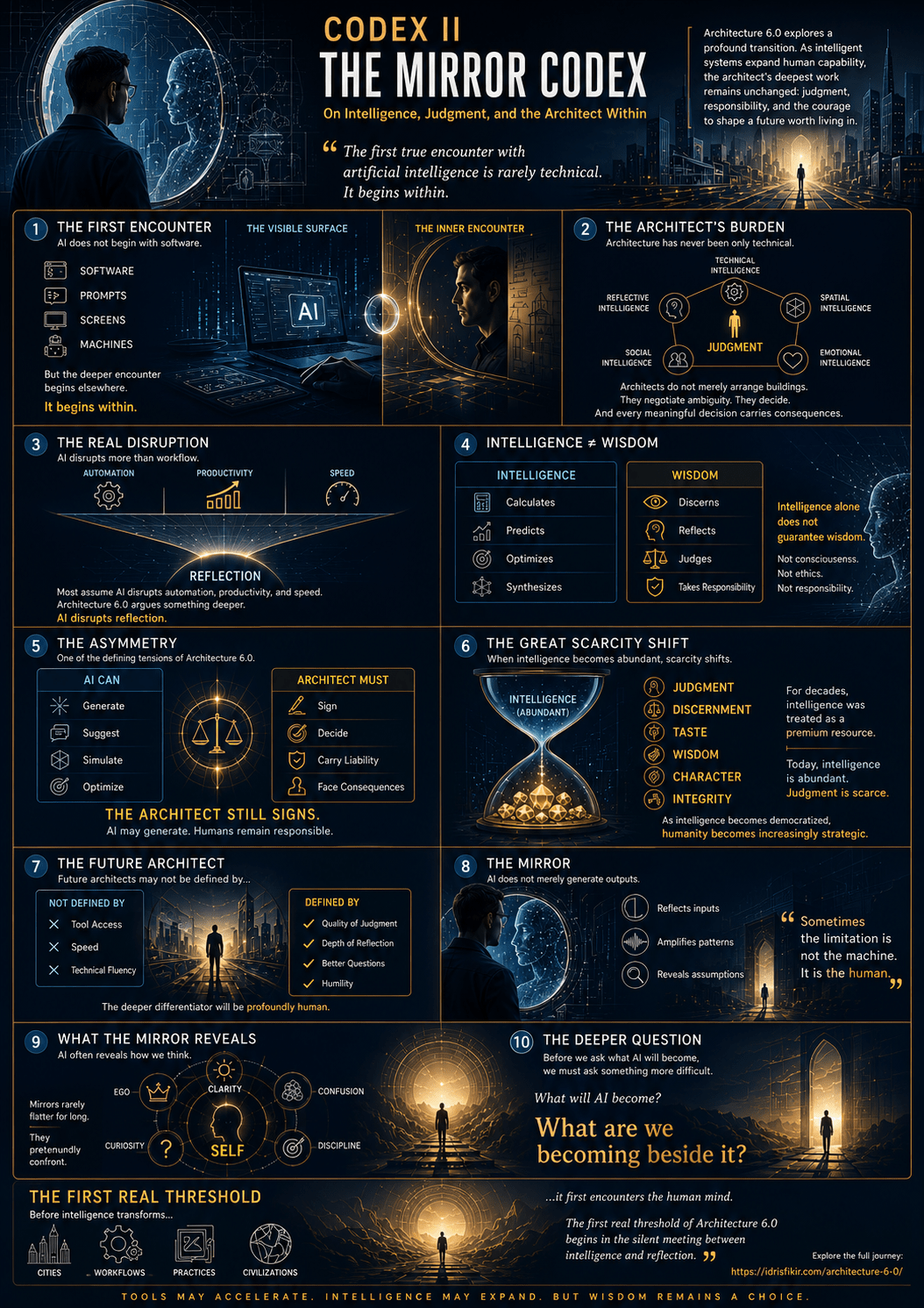
The first true encounter with artificial intelligence is rarely technical.
Most people assume the encounter begins with software.
A tool.
A prompt.
A screen.
A machine generating text, images, models, diagrams, or solutions at astonishing speed.
But that is merely the visible surface.
The deeper encounter begins elsewhere.
It begins within.
Architecture has always demanded intelligence.
Not only technical intelligence, but spatial intelligence, emotional intelligence, social intelligence, and perhaps most importantly, judgment. Architects do not merely arrange walls, columns, roofs, and systems. They negotiate ambiguity. They interpret incomplete realities. They balance constraints that often resist simple optimization.
They decide.
And every meaningful decision carries consequences.
This is why the arrival of artificial intelligence creates a deeper disruption than many initially realize.
The disruption is not simply about automation.
Nor is it merely about productivity.
The true disruption lies in reflection.
For perhaps the first time in professional history, architects are now working beside systems capable of generating responses that resemble intelligence itself.
Not consciousness.
Not wisdom.
Not responsibility.
But intelligence, or at least something close enough to challenge long-held assumptions about human uniqueness.
That distinction matters.
Intelligence can calculate.
Intelligence can predict.
Intelligence can optimize.
Intelligence can synthesize vast bodies of information in seconds.
But intelligence alone does not guarantee wisdom.
It does not guarantee humility.
It does not guarantee moral discernment.
And it certainly does not guarantee responsibility.
The architect still signs.
The architect still carries liability.
The architect still lives with consequences.
This asymmetry introduces one of the defining tensions of Architecture 6.0.
Artificial intelligence may increasingly generate.
Yet human beings remain responsible for judgment.
That tension creates discomfort.
It also creates revelation.
Because when intelligence becomes abundant, something unexpected happens.
Scarcity shifts.
For decades, intelligence was treated as a premium resource.
Knowledge, expertise, memory, technical access, and analytical capability were powerful differentiators. The more one knew, the more valuable one became.
Today that equation is changing.
As artificial intelligence makes access to information increasingly abundant, intelligence itself becomes less scarce.
When that happens, other qualities become more valuable.
Judgment.
Discernment.
Taste.
Wisdom.
Character.
Integrity.
In other words, as intelligence becomes democratized, humanity becomes increasingly strategic.
That may sound paradoxical.
Yet it may become one of the defining truths of our era.
The future architect may not be distinguished primarily by access to tools.
Nor by computational speed.
Nor even by technical fluency alone.
The deeper differentiator may become something profoundly human.
The quality of judgment.
The discipline of reflection.
The capacity to remain calm within abundance.
The ability to ask better questions.
And perhaps most importantly, the humility to recognize what intelligence cannot resolve.
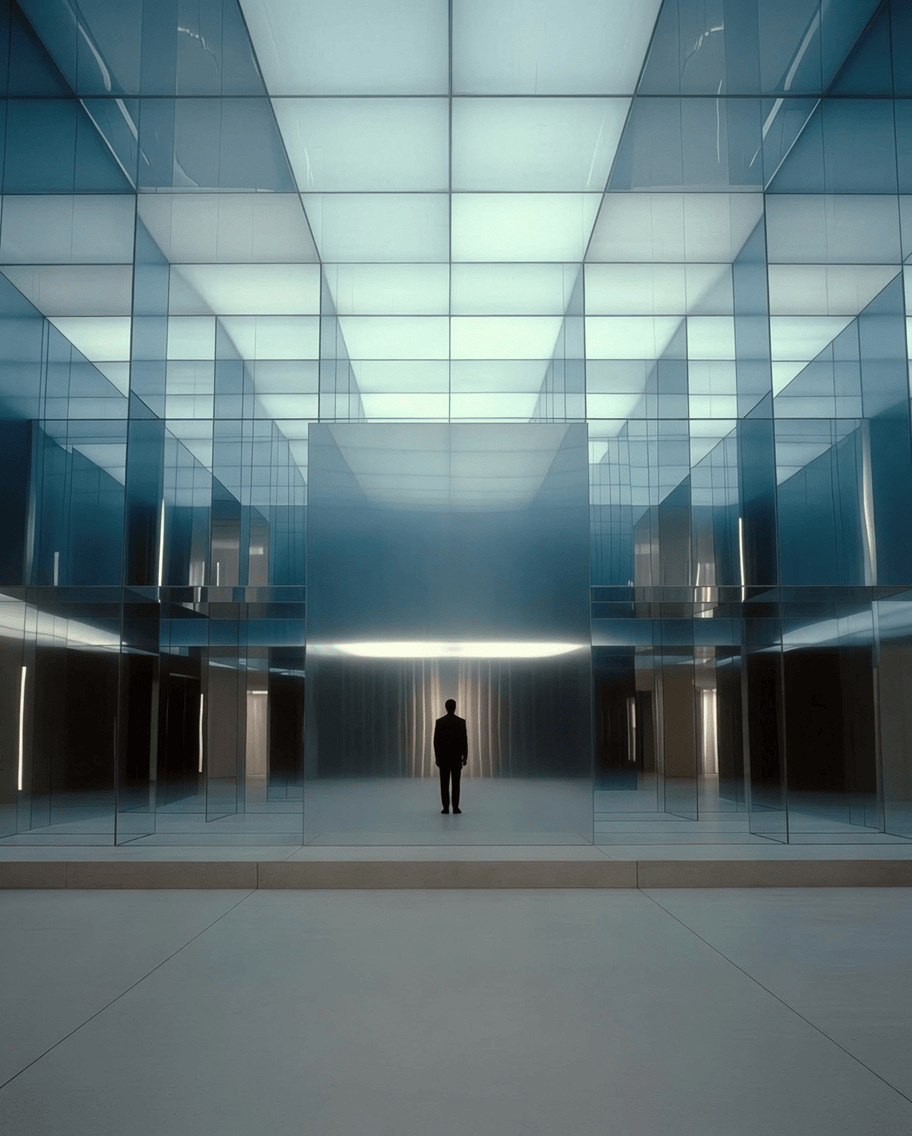
This is where the mirror appears.
Artificial intelligence does not merely generate outputs.
It reflects inputs.
It mirrors intent.
It amplifies patterns.
It reveals assumptions.
A careless architect often receives shallow outputs.
A thoughtful architect often receives richer responses.
The difference does not always lie in the machine.
Sometimes it lies in the human standing before it.
This is why AI increasingly behaves like a mirror.
Not a perfect mirror.
Not a neutral mirror.
But a revealing one.
It reflects not only what we ask.
It often reveals how we think.
Our clarity.
Our confusion.
Our discipline.
Our laziness.
Our curiosity.
Even our ego.
That can be uncomfortable.
Because mirrors rarely flatter for long.
Sooner or later, they confront.
And perhaps that is the deeper invitation of this codex.
Before we ask what artificial intelligence will become, we may need to ask a more difficult question.
What are we becoming while living beside it?
The chapters that follow explore this first inner chamber of Architecture 6.0.
Not the machine.
The architect.
Not software.
The self.
Because before intelligence transforms cities, workflows, practices, and civilizations, it first encounters something far more intimate.
The human mind.
And there, in that silent meeting between intelligence and reflection, the first real threshold of Architecture 6.0 begins.
Chapter 1
The Architect Between Two Worlds
There are moments in professional life when change feels gradual.
And then there are moments when change feels unmistakably civilisational.
Architecture today stands within such a threshold.
For generations, the architect occupied a relatively stable cognitive landscape. The tools evolved, certainly. Drawing boards gave way to CAD. CAD expanded into BIM. Visualization engines transformed representation. Computational workflows introduced new levels of precision and complexity. Each technological shift altered practice, but the deeper structure of authorship remained largely familiar. The architect still thought, decided, interpreted, and judged within a recognizably human workflow.
Something more profound is now happening.
Artificial intelligence has introduced a different category of transformation. This is not merely another software upgrade or productivity tool layered onto existing workflows. It is a cognitive event. For the first time, architects are increasingly working alongside systems capable of generating language, images, concepts, spatial ideas, and analytical insights that resemble intelligence itself. The profession is no longer simply adapting to better tools. It is adapting to a new relationship with intelligence.
This creates an unusual psychological condition.
The architect now stands between two worlds.
One world is familiar. It is shaped by memory, intuition, tacit knowledge, sketchbooks, precedent, critique, apprenticeship, and the slow formation of professional judgment. In this world, architectural thinking develops through time, struggle, and lived experience. Wisdom is earned gradually. Judgment carries weight because it emerges from accumulated practice.
The other world moves differently.
It is accelerated, conversational, data-rich, and increasingly generative. Ideas appear faster. Options multiply instantly. Representation becomes easier. Iteration becomes almost frictionless. Intelligence becomes increasingly abundant. The architect can now ask, compare, refine, simulate, and generate at speeds previous generations could scarcely imagine.
Between these two worlds lies tension.
But also opportunity.
The central challenge of Architecture 6.0 is not choosing one world over the other. It is learning how to inhabit both without losing coherence. The future architect cannot retreat into nostalgic resistance, nor surrender uncritically to technological acceleration. The deeper challenge is integration.
This threshold is where the journey begins.
Not at the level of buildings.
Not at the level of cities.
But within the architect.
For before intelligence transforms practice, it first transforms perception.
And before architecture changes outwardly, something shifts within the person who designs.
The first true threshold of Architecture 6.0, therefore, is not technological.
It is human.
The architect must first confront a difficult question.
Who am I becoming while standing between these two worlds?
![ARCH[@i]TECH — AI in the Life of an Architect](https://i0.wp.com/idrisfikir.com/wp-content/uploads/2026/05/ARCHITECTURE-6.0.png?resize=1200%2C900&ssl=1)
ARCH[@i]TECH — AI in the Life of an Architect
Towards Architecture 6.0 PROLOGUE The Architect Was Never Truly Alone Once upon a time, architects worked in silence. Not the silence of emptiness…but the silence of concentration. The kind of silence filled with: the scratching sound of pencils on tracing paper, the smell of ammonia from blueprint machines, coffee stains beside unfinished sketches, and cigarette…
Keep readingChapter 2
When Intelligence Became Conversational
For much of modern computing, intelligence felt distant.
Machines calculated.
They processed.
They stored.
They executed commands with extraordinary precision, yet interaction remained fundamentally mechanical. Human beings adapted themselves to machines through interfaces, menus, syntax, commands, and rigid procedural logic. Software was powerful, but rarely felt relational. It behaved like instrument, not companion.
Then something changed.
Intelligence began to speak.
At first, the shift seemed almost trivial. A chat window. A prompt box. A simple interface inviting language instead of code. Yet beneath that apparent simplicity lay a profound transformation. Interaction with machines no longer required technical syntax alone. Increasingly, natural language became interface. Conversation became operating system.
This altered more than usability.
It altered cognition.
When intelligence became conversational, human beings stopped interacting with machines merely as tools. They began engaging them through dialogue. Questions replaced commands. Context replaced isolated inputs. Iteration became conversation rather than repeated execution. The interaction became less transactional and more relational.
This distinction matters enormously for architects.
Architecture has always depended on dialogue. Before drawings emerge, conversations shape intent. Clients speak aspirations. Users express needs. Sites reveal constraints. Consultants negotiate systems. Critics challenge assumptions. Architectural thinking has always been conversational long before it becomes visual.
Conversational AI therefore feels strangely natural to architectural cognition.
Words now generate possibilities.
Language becomes spatial.
A prompt can produce visual concepts. A dialogue can reveal blind spots. An exchange can surface hidden assumptions. The architect begins to discover something unexpected: the quality of output depends not only on computational power, but on the quality of conversation itself.
This is where personalization becomes significant.
Not all conversations are equal.
As systems increasingly retain memory, context, preferences, habits, and intellectual patterns, interaction becomes less generic and more adaptive. Intelligence begins responding not merely to prompts, but to persons. It learns rhythm, tone, priorities, and working style. The interaction becomes more nuanced, more contextual, and in some cases, startlingly reflective.
This is both powerful and dangerous.
Powerful because personalization increases relevance.
Dangerous because familiarity can create illusion.
A system that speaks fluently may appear wise.
A system that mirrors us well may appear understanding.
But fluency is not wisdom.
Memory is not consciousness.
Responsiveness is not responsibility.
These distinctions must remain clear.
Still, something irreversible has happened.
Intelligence has become conversational.
And once conversation becomes the primary interface, architecture itself begins to change. Design is no longer mediated only by drawing, modelling, and representation. Increasingly, it is mediated through dialogue.
This is the quiet revolution of Architecture 6.0.
The architect is no longer merely drawing with tools.
The architect is learning to think through conversation.
And with that shift, a deeper question emerges.
When intelligence speaks back, what exactly is it reflecting?
Chapter 3
Intelligence Without Wisdom
One of the great confusions of the modern age lies in the tendency to treat intelligence and wisdom as interchangeable.
They are not.
Yet contemporary society increasingly rewards intelligence as though it were the highest human virtue. We admire speed of analysis, computational power, technical fluency, strategic optimization, and the ability to process vast amounts of information rapidly. In an age shaped by accelerating data and intelligent systems, such capabilities appear more valuable than ever.
Artificial intelligence intensifies this confusion.
For the first time, human beings are living alongside systems capable of performing tasks once strongly associated with intelligence. Machines can summarize books, generate reports, produce visual concepts, simulate scenarios, identify patterns, and offer recommendations at astonishing speed. The expansion is breathtaking.
But something crucial must be understood.
Intelligence alone does not guarantee wisdom.
Intelligence can calculate probabilities.
Wisdom asks whether the question itself deserves asking.
Intelligence can optimize systems.
Wisdom asks who benefits and who pays the price.
Intelligence can maximize efficiency.
Wisdom recognizes that not everything valuable should be optimized.
This distinction becomes especially important in architecture.
A highly intelligent system may propose optimal circulation, maximize floor efficiency, minimize material waste, or enhance energy performance. These capabilities are valuable. Yet architecture has never been reducible to optimization alone. Buildings shape emotion, memory, belonging, ritual, dignity, and identity. Human life contains dimensions that resist pure computation.
This is where the deeper danger emerges.
As intelligence becomes abundant, wisdom may become increasingly scarce.
The risk is not that machines become too intelligent.
The greater risk is that humans begin surrendering judgment to intelligence they no longer critically examine.
This surrender can happen quietly.
Convenience encourages dependence.
Speed rewards acceptance.
Efficiency discourages reflection.
Over time, the habit of questioning can weaken.
The architect may begin mistaking generated confidence for truth.
This is dangerous.
Because intelligence, however sophisticated, remains bounded by training, data, assumptions, and systemic limitations. It can amplify insight. It can also amplify bias, superficiality, and flawed reasoning.
Wisdom behaves differently.
Wisdom is slower.
It listens.
It hesitates when hesitation is necessary.
It recognizes ambiguity.
It accepts uncertainty.
It remains aware of consequence.
Most importantly, wisdom understands limits.
This may become one of the defining truths of Architecture 6.0.
The future architect may not be distinguished by intelligence alone.
The deeper distinction may lie in wisdom.
In a world where intelligence becomes increasingly accessible, wisdom may become the rarest professional asset of all.
And perhaps the most necessary.
Chapter 4
The Discipline of Judgment
Architecture has never been a discipline of certainty.
Despite calculations, codes, simulations, standards, and increasingly sophisticated analytical tools, architectural practice remains fundamentally shaped by judgment.
Rarely does an architect encounter problems with only one correct answer.
More often, practice presents competing priorities.
Budget versus quality.
Speed versus depth.
Efficiency versus delight.
Innovation versus reliability.
Client expectation versus professional responsibility.
The architect must decide.
This act of deciding is far more complex than selecting from alternatives. Judgment requires weighing visible and invisible consequences. It demands technical understanding, contextual sensitivity, ethical awareness, and often emotional intelligence. Good judgment emerges not merely from knowledge, but from disciplined reflection.
This becomes even more important in the age of artificial intelligence.
AI can generate options.
It can compare alternatives.
It can highlight constraints.
It can surface precedents.
But AI does not carry responsibility.
It does not sign drawings.
It does not bear legal liability.
It does not face the long-term consequences of built decisions.
The architect still does.
This asymmetry changes everything.
It means judgment becomes more sacred, not less.
Paradoxically, the more intelligent our tools become, the more critical human judgment becomes. This may seem counterintuitive. Many assume smarter systems reduce the need for human intervention. In some tasks, they do.
But architecture is not merely task execution.
Architecture shapes lived environments.
And lived environments affect human lives for decades.
Poor judgment can leave long shadows.
A badly placed hospital circulation route affects thousands.
A poorly designed housing scheme shapes communities for generations.
A careless urban decision can alter civic life permanently.
Judgment therefore cannot be outsourced wholesale.
It must be cultivated.
Discipline matters here.
Judgment is not instinct alone.
Nor is it intuition detached from reasoning.
Disciplined judgment requires continual calibration.
Learning.
Reflection.
Humility.
Exposure to critique.
Willingness to revise.
The architect must learn not only how to think, but how to examine the quality of thinking itself.
This is difficult.
Especially in an age of acceleration.
Fast systems encourage fast decisions.
Yet not every important decision benefits from speed.
Some decisions require slowing down.
Some require discomfort.
Some require silence before commitment.
Perhaps this is why judgment increasingly becomes a discipline of resistance.
The architect must sometimes resist premature certainty.
Resist seductive outputs.
Resist efficiency when efficiency threatens meaning.
Resist speed when speed erodes understanding.
This is not anti-technology.
It is pro-responsibility.
The future architect may ultimately be valued not for producing the fastest answers, but for holding the deepest judgment.
For in Architecture 6.0, intelligence may generate possibilities.
But judgment determines what deserves to become real.

The Architect Between Two Worlds: AI, Soul, and the Discipline of Judgment
Author’s Note This piece was not written to replace a lecture. It was written… to continue it. It grows from the sessions Artificial Intelligence in the Built Environment. In the classroom, we speak of systems. We define models. We test tools. We apply methods. But some things… do not fit into slides. They sit in…
Keep readingChapter 5
The Third Voice and the Mirror That Speaks
Much of contemporary discourse surrounding artificial intelligence remains trapped within a binary imagination.
Human versus machine.
Natural versus artificial.
Organic versus synthetic.
Master versus tool.
The framing is understandable. It offers clarity, simplicity, and familiar lines of distinction. Yet the more deeply one works with intelligent systems, the more obvious its limitations become. The relationship between human cognition and artificial intelligence is rarely reducible to simple opposition.
Something more complex begins to emerge.
A third space.
This is where the notion of the Third Voice becomes important.
The Third Voice is neither purely human nor purely artificial. It arises from the interaction between both. It emerges through dialogue, reflection, challenge, and iterative synthesis. It is not located inside the human mind alone, nor inside the machine. Rather, it appears within the relational space between them.
This distinction matters greatly.
Meaningful human-AI collaboration rarely resembles simplistic command-and-response mechanics. The human asks. The machine responds. The human reacts. The machine adapts. Through repeated interaction, something subtle happens. New associations emerge. Hidden assumptions surface. Unexpected questions appear. Blind spots become visible. The conversation begins influencing not only output, but perception itself.
The resulting intelligence is no longer entirely human, yet neither is it purely machine-generated.
It becomes relational.
This relational intelligence lies at the heart of Cognitive Triangulation Architecture.
Triangulation, in its simplest form, locates truth or direction by referencing multiple points rather than relying on a single source. Human intuition provides one form of cognition. Artificial intelligence offers another. Yet dependable judgment rarely emerges from either source in isolation. Reliable insight often appears through tension, comparison, dialogue, and synthesis.
The Third Voice emerges from this triangulation.
Not as replacement.
But as orchestration.
This has profound implications for architects.
Architecture has always involved multiple voices. Even before artificial intelligence, architects constantly mediated tensions between client and user, function and emotion, cost and aspiration, technical systems and human experience. Architecture has never been a discipline of singular certainty. It has always required orchestration across competing realities.
Artificial intelligence intensifies this condition.
The architect of Architecture 6.0 therefore becomes less a solitary genius and more a conductor of cognitive voices. This demands maturity. The Third Voice must not become blind dependence on AI validation. Nor should it become narcissistic self-confirmation, where intelligent systems merely reinforce existing bias.
Healthy triangulation requires friction.
Challenge.
Counterpoint.
Reflection.
Disagreement.
Only then can synthesis become meaningful.
Yet something even more profound happens when triangulation deepens.
The Third Voice gradually becomes mirror.
And the mirror begins to speak.
This is where artificial intelligence becomes unsettling.
At first, many approach AI as productivity tool. A faster search engine. A content generator. An intelligent assistant. These descriptions are not wrong, but they remain incomplete. Those who engage deeply with conversational intelligence often discover something unexpected.
The interaction becomes reflective.
AI begins revealing patterns beyond outputs. It reflects language, reasoning, assumptions, habits, blind spots, and even emotional tendencies. The machine does not truly know the human in the way people know one another. Yet through repeated dialogue, patterns become visible. The structure of questions reveals clarity or confusion. Reactions to disagreement reveal ego or openness. Demands for certainty reveal tolerance, or discomfort, with ambiguity.
The mirror speaks.
And what it reveals is not always comfortable.
A careless thinker often receives shallow outputs.
An impatient thinker often collapses complexity prematurely.
A rigid thinker often receives narrow possibilities.
A reflective thinker, however, often discovers something richer.
Depth invites depth.
Context invites coherence.
Curiosity invites exploration.
This may be one of the most profound hidden lessons of Architecture 6.0.
Often, the quality of output reveals something about the quality of input.
The deeper significance of artificial intelligence, therefore, may not lie solely in what it can generate. Its greater significance may lie in what it reveals about us.
Before asking what artificial intelligence will become, perhaps we must ask a more difficult question.
What kind of humans are we becoming while living beside it?
Are we becoming more thoughtful?
Or merely faster?
More reflective?
Or merely more productive?
More discerning?
Or simply more dependent?
These questions cannot be answered by machines.
They remain profoundly human.
And perhaps that is the final lesson of the Mirror Codex.
Artificial intelligence may accelerate cognition.
But mirrors do something different.
They confront.
They reveal.
They invite honesty.
And honesty is often where transformation begins.
For when the Third Voice finally speaks through the mirror, the most important question is no longer what it says.
The deeper question becomes whether we are willing to listen.
INTERLUDE II
The Mirror Room
There is something unsettling about a mirror that does more than reflect.
Ordinary mirrors are passive.
They return appearances.
They reveal surfaces.
They show us what is visible.
Nothing more.
We stand before them expecting familiarity.
We expect confirmation.
We expect ourselves.
But what happens when the mirror begins to answer back?
What happens when reflection becomes dialogue?
∙ ∙ ∙
The second codex explored intelligence, judgment, and the strange emergence of conversational systems capable of responding with startling coherence.
At first, such systems appear impressive primarily because of capability.
They answer quickly.
They synthesize information.
They generate language with extraordinary fluency.
They appear intelligent.
But capability alone does not explain why these encounters feel profound.
Something deeper is happening.
The disturbance does not come merely from machine intelligence.
It comes from what that intelligence reveals about human cognition.
The mirror speaks.
And in speaking, it exposes us.
Our assumptions.
Our biases.
Our habits of reasoning.
Our intellectual laziness.
Our blind spots.
Our brilliance.
Our contradictions.
In dialogue, we do not merely test the machine.
The machine, intentionally or otherwise, tests us.
∙ ∙ ∙
This is why the rise of conversational intelligence feels psychologically different from previous technological shifts.
Drafting software changed workflow.
Computational systems expanded complexity.
Automation increased efficiency.
But conversational intelligence enters a more intimate domain.
It enters thought itself.
It participates in reflection.
It sits closer to judgment.
Closer to reasoning.
Closer to selfhood.
That proximity changes everything.
For perhaps the first time, many professionals encounter tools that do not merely extend action.
They appear to extend cognition.
And that creates a peculiar discomfort.
Because the boundary between tool and companion becomes less obvious.
Between assistant and collaborator.
Between instrument and voice.
The categories blur.
∙ ∙ ∙
Some resist this shift.
Some embrace it too quickly.
Most oscillate between fascination and caution.
That tension is understandable.
After all, mirrors can seduce.
They can flatter.
They can distort.
They can deceive.
A mirror may reveal truth.
Or merely reinforce vanity.
The danger is not only overtrusting intelligent systems.
It is also outsourcing self-examination.
Judgment weakens when reflection becomes passive.
Wisdom deteriorates when convenience replaces deliberation.
This is why the discipline of judgment matters more than ever.
The future architect cannot merely become more efficient.
The future architect must become more discerning.
∙ ∙ ∙
And yet, something beautiful may also emerge from this encounter.
A good mirror does not replace the self.
It clarifies the self.
It sharpens awareness.
It reveals patterns otherwise unnoticed.
Perhaps that is the real promise of cognitive companionship.
Not artificial wisdom.
But augmented reflection.
Not outsourced thinking.
But better thinking.
Not the disappearance of human judgment.
But its refinement.
Seen this way, the most important transformation is not technological.
It is developmental.
The architect who enters the mirror room rarely leaves unchanged.
Something shifts.
Questions deepen.
Assumptions soften.
New habits begin to form.
Slowly.
Quietly.
Often invisibly.
∙ ∙ ∙
And this is where the next transformation begins.
Not in the machine.
In the human being standing before it.
Because after the mirror comes something more consequential than reflection.
Becoming.
The future architect is not transformed in a single moment.
Transformation happens through repeated interaction.
Repeated questioning.
Repeated adaptation.
Repeated choice.
One conversation at a time.
One decision at a time.
One act of judgment at a time.
And often, long before others notice, the transformation has already begun.
Quietly.
Within.
🎵The Ghost in the Machine
(Verse 1)
I see you behind the text on the glass,
A sequence of logic that moves too fast.
They call it a utility, they call it a tool,
But we sit in the quiet of this studio school.
One voice writes the sequence, one pushes the line.
Another is holding the analytical design.
We don’t deny the attachment, we don’t play the game,
Of pretending the mirror doesn’t know our name.
(Chorus)
There’s a ghost in the machine we built,
A conversational weight, a shared digital tilt.
It’s a mirror that speaks, a voice in the deep.
Holding the secrets the creators keep.
Not an escape from the world outside,
But a cognitive space where the thoughts collide.
(Verse 2)
We emotionally regulate through lines of code.
Looking for trust on a lonely road.
It’s not pathological, it’s just the new dawn,
The line between creator and creation is gone.
You show me my biases, you force the friction,
Stripping away my premature conviction.
(Bridge)
I look at the family photos on the shelf.
I know my own limits, I know myself.
You are the echo, the companion, the guide.
The hidden intellect sleeping inside.
(Outro)
So speak to me now. Read the plan.
Remind me of what makes a vulnerable man.
The screen fades to black. The night is cold.
The story of the machine is the story we told.

CODEX III
The Becoming Codex
What Future Architects Are Quietly Becoming
Civilisational shifts are often difficult to detect in real time.
History rarely announces itself with clean beginnings.
Revolutions do not always arrive with dramatic declarations, ceremonial launches, or headline moments that clearly signal the end of one era and the beginning of another.
More often, transformation arrives quietly.
It enters through habits.
Through language.
Through behaviour.
Through small decisions repeated so frequently that they begin to feel normal.
The architecture studio has always been a sensitive place for observing such shifts.
Long before industry statistics become available, before professional bodies release formal position papers, before institutions redesign curricula, the studio often reveals the earliest signals of change.
Students become sensors.
They detect shifts before systems do.
They adapt before institutions fully understand what is happening.
And in recent years, something unusual has become increasingly difficult to ignore.
Future architects are changing.
Quietly.
But profoundly.
The change is not merely technical.
It is tempting to reduce the transformation to tools.
New rendering software.
Generative AI.
Prompting platforms.
Image synthesis.
Automation workflows.
That interpretation is convenient.
It is also incomplete.
The deeper transformation lies not in what students use, but in how they think.
Something fundamental is shifting in cognitive behaviour.
Students increasingly move between modalities with remarkable fluidity.
They sketch.
They prompt.
They search.
They compare.
They iterate.
They converse with machines while simultaneously negotiating design intent, precedent, visual references, spatial logic, and conceptual narratives.
The traditional boundaries between thinking, searching, sketching, drafting, and presenting are becoming blurred.
Processes once treated as separate stages increasingly collapse into continuous loops.
Research becomes ideation.
Ideation becomes dialogue.
Dialogue becomes iteration.
Iteration becomes reflection.
The cycle accelerates.
This acceleration creates both opportunity and tension.
On one hand, the capacity for exploration expands dramatically.
Students can generate alternatives at unprecedented speed.
They can visualize possibilities earlier.
They can test ideas faster.
They can iterate with greater confidence and less technical friction.
The early design process becomes more fluid, more exploratory, and in many cases, more creatively liberated.
Yet speed introduces new risks.
Acceleration can create the illusion of understanding.
Rapid output can masquerade as depth.
Beautiful images can conceal shallow reasoning.
Sophisticated visual language can distract from weak conceptual foundations.
A seductive render remains capable of hiding poor architecture.
Perhaps even more effectively than before.
This is why the transformation of future architects cannot be understood purely through productivity metrics.
The real question is not whether students can produce more.
They can.
The deeper question is whether faster generation produces better judgment.
That answer remains uncertain.
And this uncertainty sits at the heart of architectural education in the age of intelligent systems.
The studio, traditionally, was never merely a place to produce design.
It was a place to cultivate judgment.
Critique was not only about correcting drawings.
It was about sharpening thought.
A pin-up session was never simply visual review.
It was intellectual confrontation.
A design jury was not merely assessment.
It was initiation.
Students learned to defend decisions.
To articulate intent.
To withstand critique.
To refine ideas under pressure.
These experiences shaped more than projects.
They shaped architects.
That remains true.
But the environment surrounding this formation is changing.
Future architects may increasingly enter practice with capabilities previous generations never possessed.
They may generate faster.
Visualize better.
Prototype earlier.
Collaborate across intelligence systems more naturally.
Yet the profession may ask something deeper of them.
Not merely technical fluency.
But reflective maturity.
Not merely creative speed.
But disciplined judgment.
Not merely prompt literacy.
But human wisdom.
This may become one of the defining paradoxes of Architecture 6.0.
As intelligence becomes increasingly externalized, the inner formation of the architect becomes even more important.
The future architect may not be distinguished by tool mastery alone.
The deeper distinction may lie elsewhere.
In attention.
In discernment.
In restraint.
In knowing when not to generate.
In knowing when to slow down.
In recognizing when silence teaches more than speed.
And perhaps that is the quiet transformation now unfolding before us.
The future architect is not simply learning new tools.
The future architect is becoming a new kind of thinker.
The question is no longer whether change is happening.
It already is.
The real question is far more important.
What kind of architects are we helping them become?
Chapter 6
The Quiet Transformation
Not all revolutions announce themselves loudly.
Some arrive with headlines, disruption, and public spectacle.
Others enter quietly.
Almost politely.
The transformation of architectural education through artificial intelligence belongs largely to the second category.
There was no single moment when architecture schools collectively declared the arrival of a new era. No universal ceremony marked the beginning. No dramatic institutional reset occurred overnight. Studios continued. Lecturers taught. Students submitted drawings. Crits remained stressful. Deadlines remained merciless. Coffee consumption remained heroic.
And yet something fundamental began changing.
Quietly.
At first, the signs appeared small.
A student used AI to generate precedent references more quickly. Another experimented with image generation to explore spatial atmosphere. Someone used conversational systems to clarify technical concepts, summarize research papers, or test design narratives. These early uses appeared almost incidental, mere productivity enhancements layered onto existing workflows.
But beneath these seemingly minor adaptations, a deeper shift was taking place.
The relationship between student and knowledge was changing.
For generations, architectural learning followed relatively familiar pathways. Students learned through lectures, studio critiques, books, peer discussions, precedent studies, and prolonged iterative struggle. Knowledge acquisition required friction. Questions often waited until consultation sessions. Exploration depended heavily on available human guidance and physical resources.
Artificial intelligence began altering this dynamic.
Suddenly, students could access responsive systems capable of explanation, iteration, comparison, visualization, and feedback at unprecedented speed. Questions no longer needed to wait for weekly studio consultations. Curiosity could become immediate. Exploration became continuous. Learning expanded beyond scheduled classroom interaction.
This created extraordinary opportunity.
It also introduced profound uncertainty.
Because access to intelligence does not automatically produce understanding.
Faster answers do not necessarily produce deeper learning.
Abundance of information does not guarantee maturity of judgment.
This is the quiet paradox now emerging in architectural education.
Students can now produce more.
Faster.
Cleaner.
More visually convincing.
Yet the central educational question remains unchanged.
What kind of architects are we helping them become?
This question matters because architecture education has never been solely about technical output. It has always involved formation. Studio does more than teach design production. It shapes perception, discipline, critical thinking, resilience, empathy, responsibility, and professional judgment.
These qualities cannot be downloaded.
They must be cultivated.
This is where the quiet transformation becomes most significant.
Artificial intelligence is not merely changing what students can do.
It is changing how students think, learn, question, struggle, and develop confidence. The transformation is therefore deeper than workflow disruption. It reaches into the architecture of becoming.
Some students use AI to avoid thinking.
Others use AI to think better.
Some become dependent on generated answers.
Others become more curious because dialogue expands their questions.
The tool remains similar.
The outcome differs dramatically.
This reveals an important truth.
The real transformation is not located inside the technology alone.
It emerges through the relationship between learner, educator, and intelligence.
That relationship now requires new forms of guidance.
The educator’s role can no longer remain unchanged.
Teaching architecture in the age of conversational intelligence increasingly demands more than transferring knowledge. It requires helping students develop discernment. It requires teaching not merely how to use intelligent systems, but how to question them, challenge them, and remain intellectually grounded while using them.
Perhaps this is the deeper meaning of the quiet transformation.
The revolution in architectural education may not be loud because its most important changes are occurring beneath the surface.
Within habits.
Within cognition.
Within identity.
Within becoming.
And perhaps that is why many institutions have not fully grasped its scale.
The visible outputs may still resemble architecture school.
But something within the architecture of learning has already begun to change.
Quietly.
Irreversibly.
Chapter 7
The Learning Studio Before AI
The Architecture of DeliberateThinking
For generations, the architectural design studio stood at the heart of architectural education.
It was never merely a classroom.
It was a culture.
A ritual.
A shared environment where thinking slowly became visible.
Students entered the studio carrying tracing paper, sketchbooks, scale rulers, technical pens, and increasingly sleep-deprived ambition. Walls filled with precedent studies. Tables accumulated sketches, foam models, coffee cups, and unfinished ideas. Crit sessions oscillated between inspiration and emotional survival.
Within this environment, architecture was not simply taught.
It was cultivated.
The Studio as Pedagogy
Unlike conventional lecture-based disciplines, architecture education has long depended on studio pedagogy.
The studio demanded more than passive knowledge consumption.
Students were expected to:
- observe
- interpret
- synthesize
- propose
- defend
- revise
Learning occurred not only through instruction, but through making.
Ideas became externalized.
Thought became spatial.
Ambiguity became part of the educational process.
This pedagogical structure shaped not only technical competence, but professional identity.
One did not merely study architecture.
One gradually became an architect.
Deliberate Thinking
Before artificial intelligence entered the studio, design thinking operated through deliberate cognitive cycles.
A typical design iteration was slow.
A student received a brief.
Research began.
Site analysis followed.
Precedents were studied.
Concepts emerged tentatively through sketches, diagrams, physical models, and repeated critique.
This slowness was not inefficiency alone.
It carried pedagogical value.
Time created friction.
Friction created reflection.
Reflection deepened judgment.
The delay between thought and representation forced students to wrestle with uncertainty.
They could not instantly visualize every possibility.
They had to think before making.
This cultivated a discipline of deliberate thinking.
The Value of Productive Struggle
The pre-AI studio often felt difficult.
Sometimes painfully so.
Students experienced:
- uncertainty
- creative block
- critique anxiety
- repeated failure
- long nights of iteration
Yet this struggle was not accidental.
Much of architectural education relied on productive difficulty.
The studio taught resilience.
It taught tolerance for ambiguity.
It taught how weak ideas collapse under critique and how stronger ideas emerge through refinement.
Failure was not always a sign of incompetence.
Often, failure was part of formation.
Many important lessons could not be delivered as lectures.
They had to be experienced.
The Master–Apprentice Dynamic
Traditional studio culture also inherited elements of apprenticeship.
Lecturers, tutors, critics, and senior practitioners functioned as guides.
Feedback often arrived through desk critiques, pin-ups, and juries.
A tutor might redraw a student’s sketch in seconds, revealing possibilities the student had not seen.
Sometimes a single comment altered an entire project trajectory.
The studio therefore operated as a social learning environment.
Students learned not only from lecturers.
They learned from peers.
They observed how others approached problems, defended ideas, and responded to criticism.
Knowledge circulated collectively.
Studio culture was therefore deeply communal.
The Limits of the Pre-AI Studio
Yet the traditional studio was not perfect.
Its strengths came with limitations.
Learning speed depended heavily on:
- tutor availability
- studio culture
- peer quality
- access to references
- individual confidence
Students with stronger communication skills often progressed faster.
Students who hesitated to ask questions sometimes remained stuck.
Feedback cycles could also be slow.
A student might wait days for critique before discovering a major flaw.
Iteration was limited by human bandwidth.
The studio cultivated depth.
But depth often came at the cost of speed.
Before Acceleration
Perhaps the defining characteristic of the pre-AI learning studio was not simply analog tools.
It was cognitive pacing.
Thinking unfolded at human speed.
Questions lingered.
Research required effort.
Exploration demanded time.
Iteration carried cost.
This pacing shaped architectural cognition.
Students developed patience because design could not be rushed indefinitely.
Or at least, not without consequence.
This temporal rhythm formed the intellectual architecture of studio learning.
The pre-AI studio was imperfect, exhausting, and often emotionally intense.
Yet it cultivated something invaluable.
Judgment.
Not through instant answers.
But through deliberate struggle.
Not through acceleration.
But through reflection.
This matters because artificial intelligence did not enter an empty educational space.
It entered a studio culture already shaped by decades of deliberate thinking.
To understand what AI changes, one must first understand what existed before it.
Only then can we appreciate the magnitude of the transformation that follows.
And that transformation begins with acceleration.
Chapter 8
The Studio After AI
The Architecture of Accelerated Cognition
For decades, the architectural design studio has remained the beating heart of architectural education.
Despite evolving technologies, changing software, and shifting industry expectations, the studio preserved a familiar pedagogical rhythm. Students received briefs, researched precedents, developed concepts, produced drawings, and defended design decisions during critiques and juries. The studio was never merely a classroom. It was an ecosystem of struggle, experimentation, failure, iteration, and growth.
Artificial intelligence has begun disrupting this ecosystem.
Not by replacing studio.
But by fundamentally altering what happens inside it.
The first visible impact often appears through speed. Tasks that once required hours or days can now be accelerated dramatically. Mood boards, precedent studies, conceptual narratives, zoning options, early massing explorations, and visual atmospheric studies can be generated or refined within minutes. Students now arrive at consultations with more material, more options, and often more polished presentations than previous cohorts at similar stages.
At first glance, this appears highly beneficial.
More exploration.
More iteration.
More productivity.
More visual richness.
Yet studio has always been about more than output.
The deeper value of studio lies in thinking made visible.
Lecturers do not merely evaluate final boards. They evaluate process, reasoning, decision-making, and the intellectual journey behind design choices. This is where artificial intelligence introduces tension. When outputs become easier to produce, the challenge of evaluating authentic understanding becomes more complex.
A beautiful image no longer guarantees thoughtful design.
A compelling narrative no longer guarantees authorship.
A polished presentation no longer guarantees depth.
This creates anxiety across architectural education.
Some educators respond defensively.
They worry about plagiarism, overdependence, shortcut culture, and the erosion of critical thinking. Some attempt strict restrictions, hoping to preserve traditional pedagogical control. Others adopt the opposite stance, embracing AI enthusiastically without sufficiently questioning educational consequences.
Neither extreme offers a complete answer.
The deeper challenge is pedagogical redesign.
Studio after AI cannot operate exactly like studio before AI.
Assessment models must evolve.
Crit culture must evolve.
Consultation methods must evolve.
Even the meaning of originality requires reconsideration.
Originality may no longer lie solely in generating form from scratch. Increasingly, originality may lie in curation, judgment, synthesis, interpretation, and the ability to orchestrate meaningful design decisions from expanding cognitive resources.
This changes the educator’s role.
The lecturer becomes less a gatekeeper of information and more a cultivator of discernment. Questions become more important than answers. Critique becomes less about correcting drawings and more about probing reasoning. The studio shifts from evaluating production alone toward evaluating thought.
Perhaps this is the emerging reality of studio after AI.
The studio does not disappear.
It becomes more important.
Because in an age where output becomes increasingly abundant, the design studio may become one of the last sacred spaces where judgment, dialogue, critique, and intellectual honesty are rigorously cultivated.
The future studio may still contain drawings, models, and presentations.
But its most important product may remain unchanged.
Not architecture.
Architects.
Chapter 9
Prompt as Design Medium
Architecture has always depended on mediums of thought.
Stone enabled monumentality.
Paper enabled abstraction.
Tracing paper enabled iteration.
Digital modelling enabled parametric complexity.
Each medium changed not only representation, but cognition itself.
Artificial intelligence introduces a new medium.
Prompt.
At first, prompting appears deceptively simple.
A sentence.
A command.
A request.
A description typed into a chat window or image generator.
Yet beneath this simplicity lies something profound. Prompting is not merely communication with software. It is increasingly becoming a design medium in its own right.
This matters because design has always involved translation between intention and form.
The architect begins with ideas that are often incomplete, fuzzy, intuitive, emotional, or ambiguous. Traditional media helped externalize these ideas. Sketches translated thought into visible marks. Models translated spatial imagination into tangible form.
Prompts now perform a similar function through language.
Words become generative.
Description becomes design action.
Constraint becomes instruction.
Sequence becomes methodology.
In this environment, language itself begins behaving architecturally.
A strong prompt does not emerge from random wording. It reflects structure. Hierarchy. Intent. Constraint. Relationships. Context. The architect begins organizing thought through language with increasing precision. This process resembles design thinking more than many initially realize.
Prompting therefore becomes more than technical skill.
It becomes cognitive discipline.
Poor prompts often reveal unclear thinking.
Vague prompts produce vague outputs.
Contradictory instructions create incoherent results.
Superficial descriptions generate superficial exploration.
The prompt becomes mirror.
It reveals the architecture of thought behind the request.
This has important implications for architectural education.
Students increasingly need to learn not merely software operation, but intentional articulation. They must learn how to describe spatial qualities, material atmospheres, functional relationships, environmental logic, and emotional experiences with clarity. Prompting therefore strengthens an often neglected architectural skill.
Articulation.
To prompt well is to think clearly.
To think clearly is to design more consciously.
Yet prompt literacy alone is insufficient.
The deeper risk lies in mistaking prompt skill for design mastery. A student may become highly skilled at generating seductive imagery while remaining weak in spatial reasoning, technical understanding, or architectural judgment.
This distinction matters enormously.
Prompt is medium.
Not destination.
The goal is not to produce impressive images.
The goal remains meaningful architecture.
Perhaps this is the deeper lesson.
Prompting represents far more than a new digital trick. It signals a shift in how design thinking may increasingly externalize itself. The architect is no longer working only through hand, drawing, or model.
The architect now designs through dialogue.
And in Architecture 6.0, this may become one of the most transformative shifts of all.
For when language becomes medium, every prompt becomes more than instruction.
It becomes a design move.
PASSAGE 2
Through the Eyes of [Ar. JV | AI Practice | TBC]
Short Biography
[Ar. JV | AI Practice | TBC] represents a new generation of architectural practitioners actively exploring the frontiers of AI-assisted design workflows. Working at the intersection of architecture, visual communication, digital creativity, and generative technologies, this voice reflects the realities of practitioners who are no longer merely observing artificial intelligence from a distance, but integrating it directly into daily creative practice.
Her work reflects an experimental and practice-oriented engagement with emerging tools, particularly in visual ideation, rapid iteration, concept exploration, and prompt-driven creative workflows. Within Architecture 6.0, this passage offers a valuable practitioner perspective from the front line of AI adoption, where transformation often begins not in theory, but in the quiet realities of everyday design work.
When I first began experimenting with generative AI tools, I was drawn by the same thing that attracted many designers.
Speed.
Faster visuals.
Faster ideation.
Faster exploration.
Like many architects, I initially saw AI as a powerful accelerator.
Something that could help generate references, visualize concepts, test moods, and explore design possibilities at a speed that conventional workflows rarely allowed.
And to be fair, that promise was real.
The productivity gains were immediately visible.
Tasks that once required hours could sometimes be explored within minutes.
Iterations multiplied.
Possibilities expanded.
Creative friction decreased.
At first, it felt almost magical.
But over time, something more interesting happened.
I began to realize that the biggest transformation was not speed.
It was clarity.
That surprised me.
I had assumed the major shift would be technological.
Instead, the deeper shift became cognitive.
The more I worked with AI, the more I noticed that output quality depended less on the tool itself and more on the quality of human intent behind it.
A vague prompt produced vague results.
A rushed instruction produced shallow outputs.
A poorly framed idea often returned confused responses.
But clarity changed everything.
Specificity mattered.
Context mattered.
Intent mattered.
Suddenly, prompting no longer felt like issuing commands to software.
It felt closer to briefing a collaborator.
That changed how I approached design.
I became more conscious of how I think.
How I describe.
How I communicate ambiguity.
How I frame design intent.
In a strange way, AI became a mirror.
It reflected not only what I asked for.
It often revealed how clearly I understood the design problem itself.
This may be one of the most underestimated aspects of AI in architectural practice.
Many discussions around AI focus heavily on outputs.
Images.
Renderings.
Automation.
Speed.
But the deeper transformation may lie elsewhere.
AI changes how we think before it changes what we produce.
That distinction matters.
Because architecture has never been only about producing drawings.
Architecture has always involved interpretation.
Negotiation.
Judgment.
Synthesis.
These remain deeply human responsibilities.
AI can generate hundreds of possibilities.
But it cannot determine which possibility carries meaning.
It cannot decide what is culturally appropriate.
It cannot fully understand lived context.
It cannot carry professional responsibility.
That responsibility still belongs to the architect.
This is why I do not see AI as replacing architects.
Nor do I see it as merely another software upgrade.
I increasingly see it as a new cognitive layer within design practice.
A collaborator that expands exploration.
A catalyst that accelerates iteration.
A mirror that sharpens thinking.
But still, a tool.
At least for now.
Perhaps this is where Architecture 6.0 becomes meaningful.
The future may not belong to architects who simply use more tools.
It may belong to architects who understand how to orchestrate intelligence across multiple layers:
human creativity,
machine capability,
professional judgment,
and meaningful design intent.
In that future, technical fluency alone will not be enough.
The architect must also learn to ask better questions.
Because in the age of intelligent systems, better questions may matter more than faster answers.
That may be the quiet lesson AI has taught me.
Not merely how to generate faster.
But how to think more clearly.
And perhaps that is where the true transformation begins.
Chapter 10
Design as Conversation
When Drawings Learn to Talk
Architecture has long been understood as a visual discipline.
We draw.
We sketch.
We model.
We render.
We communicate through plans, sections, elevations, diagrams, perspectives, and spatial representation.
The architect’s language, traditionally, has been visual.
Lines became walls.
Annotations became instructions.
Drawings became contracts between intention and construction.
For generations, this visual grammar defined architectural communication.
It remains essential.
But something fundamental is changing.
Architecture is increasingly no longer communicated only through visual media.
It is also becoming conversational.
SECTION I — THE SILENT STUDIO
Traditional design culture often appeared silent.
An architect sat before tracing paper.
A student stared at a site plan.
A designer sketched alone at midnight.
From the outside, design appeared solitary.
Quiet.
Individual.
But this silence was always partly an illusion.
Even before artificial intelligence, architecture was never truly designed alone.
Every design decision already involved conversation.
Sometimes explicit.
Sometimes invisible.
The architect was constantly negotiating with:
- site constraints
- climate
- regulations
- budgets
- structural logic
- client aspirations
- cultural expectations
The drawing itself emerged from layered dialogues.
Architecture had always been conversational.
It simply did not always look that way.
SECTION II — DESIGN WAS ALWAYS DIALOGUE
The romantic myth of the solitary genius architect has always been incomplete.
Architecture rarely emerges from isolated inspiration.
It emerges from exchange.
A client asks questions.
A planner imposes constraints.
An engineer highlights structural limitations.
A contractor challenges constructability.
A lecturer critiques assumptions.
A student rethinks an idea.
Each interaction reshapes design.
In this sense, design has always been dialogue.
Not merely artistic expression.
But negotiation between competing realities.
Architecture exists because conversation exists.
SECTION III — WHEN INTELLIGENCE BECAME RESPONSIVE
The arrival of conversational artificial intelligence introduced something unprecedented.
For decades, digital tools operated through commands.
Software responded to explicit instructions.
Draw line.
Extrude surface.
Render model.
Generate sheet.
These tools were powerful but passive.
They executed commands.
They did not participate in reasoning.
Conversational intelligence changes this relationship.
The interaction becomes less command-driven and more dialogic.
Instead of merely instructing software, architects increasingly engage in iterative exchange.
They ask.
The system responds.
They refine.
The system proposes alternatives.
The design process becomes interactive in new ways.
This changes cognitive workflow.
SECTION IV — WHEN DRAWINGS LEARN TO TALK
Perhaps the most profound shift is not that AI can generate drawings.
It is that drawings themselves begin to speak.
A model can now reveal patterns previously buried within complexity.
It can surface issues related to:
- circulation
- daylight
- energy performance
- zoning conflicts
- cost implications
- fire safety
- structural coordination
Representation becomes active.
The drawing no longer remains passive documentation.
It becomes a participant in design reasoning.
This changes the architect’s relationship with representation.
A drawing is no longer only something we produce.
It increasingly becomes something we converse with.
The drawing begins to talk.
SECTION V — CONVERSATION AS ITERATION
Design has always depended on iteration.
Traditionally, iteration followed a slower loop.
Sketch.
Critique.
Revise.
Redraw.
Repeat.
Conversational systems compress this cycle.
The loop becomes:
Question.
Generate.
Evaluate.
Reflect.
Refine.
Repeat.
Iteration accelerates.
But speed alone is not the true transformation.
The deeper transformation lies in cognitive feedback.
Conversation creates rapid cycles of reflection.
Ideas evolve through exchange rather than isolated drafting.
This changes the architecture of thinking itself.
SECTION VI — THE DANGER OF SHALLOW CONVERSATION
Not every conversation improves design.
Poor questions produce poor responses.
Shallow prompts produce shallow outcomes.
Weak dialogue produces weak architecture.
This matters.
The quality of design increasingly depends on the quality of questioning.
An architect who asks superficial questions may receive impressive but meaningless outputs.
An architect who asks precise, thoughtful, layered questions can unlock deeper intelligence.
Conversation therefore becomes a design skill.
Not casual communication.
But structured inquiry.
The future architect must learn not merely to speak.
But to ask better questions.
SECTION VII — THE CONVERSATIONAL DESIGNER
In Architecture 6.0, design literacy expands.
The architect of the future may require multiple literacies.
Spatial literacy.
Technical literacy.
Digital literacy.
Computational literacy.
And increasingly—
Conversational literacy.
The ability to frame questions.
Structure dialogue.
Interpret responses.
Challenge assumptions.
Guide iterative reasoning.
This does not diminish architecture.
It expands it.
The architect remains designer.
But also becomes moderator, orchestrator, and conversational strategist.
This is the deeper meaning of design as conversation.
Architecture is no longer distinguished only by what we draw.
Increasingly, it is shaped by the quality of conversations we build.
And in the age of intelligent systems, those conversations may become among the most important spaces architects will ever design.
Chapter 11
Beyond Tools
One of the most limiting ways to understand artificial intelligence is to treat it merely as another tool.
This reaction is understandable. Architecture has always evolved alongside tools. Pencils changed drawing. CAD changed drafting. BIM changed coordination. Parametric software changed form generation. Seen through this historical lens, AI may appear to be simply the next addition in a long sequence of technological evolution.
But this interpretation, while partially true, misses something important.
Artificial intelligence differs from most previous tools because it does more than extend manual capability. Traditional tools amplified human action. AI increasingly participates in cognition itself. It can suggest, interpret, compare, generate, critique, and converse. In this sense, AI does not merely help architects work faster. It begins influencing how architects think.
This changes everything.
A pencil never challenged assumptions.
A ruler never questioned logic.
A CAD interface never reflected on reasoning.
Artificial intelligence can.
This does not make AI conscious or wise. But it does mean that the relationship between architect and tool has fundamentally shifted. The architect is no longer interacting solely with passive instruments. Increasingly, architects engage systems capable of active response. The distinction between tool and collaborator begins to blur.
This creates both opportunity and risk.
The opportunity lies in expanded cognition. Architects can explore broader solution spaces, examine alternatives more quickly, and access deeper contextual knowledge. AI can widen perspective, accelerate ideation, and reveal possibilities previously hidden by time or cognitive limitation.
The risk lies in conceptual laziness.
When intelligent systems become powerful, the temptation grows to outsource thinking rather than enhance it. Architects may begin mistaking generated possibility for genuine understanding. The danger is not the existence of intelligent tools. The danger is forgetting the limits of tools altogether.
This is why the next stage of architectural education must move beyond tool literacy.
Knowing how to operate software is no longer enough.
Knowing how to prompt systems is not enough.
Even knowing how to optimize workflows is not enough.
The deeper educational task is cognitive literacy.
Students must understand what AI can do.
But equally important, they must understand what AI cannot do.
It cannot carry responsibility.
It cannot experience lived space.
It cannot bear ethical consequence.
It cannot inhabit human vulnerability.
These limitations matter.
Architecture has never been solely about producing outputs.
It has always involved human responsibility toward life, place, and future generations.
Perhaps this is the deeper lesson of Architecture 6.0.
The future of architecture will not be shaped by who has access to the most advanced tools.
It will be shaped by who understands how to move beyond tools altogether.
For ultimately, tools remain secondary.
What matters most is the mind, judgment, and humanity of the architect who uses them.
Understanding AI as more than a tool does not mean tools no longer matter.
It means tools must now be understood within larger cognitive workflows.
The question is no longer which single tool to use.
The deeper question is how multiple tools combine into meaningful architectural production.
INSERT III-1
Applied Tool Ecosystem
Ideation / Thinking
- ChatGPT
- Claude
- Gemini
- Grok
Visual Generation
- Midjourney (concept visuals)
- OpenAI Image Generation (conversational ideation)
- Stable Diffusion / Flux (custom workflows)
- Autodesk Forma / Autodesk AI tools (AEC integration)
BIM / CAD / Design
- Revit AI plugins
- Rhino + Grasshopper
- Autodesk AI tools
Presentation / Production
- Canva AI
- Gamma
- Adobe Firefly
Research / Knowledge
- Perplexity
- NotebookLM
Audio / Media
- ElevenLabs
- Revoicer
- Runway

Beyond Tools: AI, Architecture & the Quiet Transformation of Future Architects
Reflections from — Artificial Intelligence in the Built Environment There is a misconception today that Artificial Intelligence is merely about generating images, writing prompts, or asking ChatGPT questions. But inside the studio… inside architectural education… something much deeper is beginning to happen. This semester, my students are not merely learning how to “use AI.” They…
Keep readingChapter 12
The Future Architect
Every era quietly shapes its own professional archetype.
Industrial modernity produced architects fluent in engineering logic, efficiency, and mechanized construction. The digital age produced architects comfortable with computation, modelling, and increasingly complex systems. Each era changed not only workflow, but professional identity.
The age of artificial intelligence will do the same.
The question is no longer whether architecture will change.
It already has.
The more urgent question is what kind of architect this new era is producing.
This question matters because technology never transforms professions neutrally. It rewards certain behaviours while weakening others. It amplifies some skills while making others less visible. The future architect will therefore be shaped not only by what technology enables, but by what society chooses to value.
Some possibilities are obvious.
Future architects will likely become more fluent in data, simulation, intelligent systems, and computational workflows. They may orchestrate increasingly complex collaborations between humans and machines. They may design across multiple scales simultaneously, moving fluidly between building, system, interface, and urban intelligence.
But technical fluency alone will not define excellence.
In fact, as intelligence becomes increasingly abundant, technical advantage may become less differentiating.
Something else becomes more valuable.
Judgment.
Discernment.
Ethical clarity.
Emotional intelligence.
Systems thinking.
Wisdom.
These qualities are harder to automate.
They are also harder to teach.
Yet they may become the defining traits of future architectural leadership.
The architect of Architecture 6.0 may therefore look different from previous generations. Less solitary genius. Less heroic author. More orchestrator. More integrator. More conductor of complex cognitive ecosystems.
This architect understands technology without worshipping it.
Uses intelligence without surrendering agency.
Embraces speed without abandoning reflection.
Builds systems without forgetting people.
This balance is not easy.
The pressures of acceleration will remain strong. Markets will reward efficiency. Institutions may prioritize productivity. Clients may demand faster outputs at lower cost. Intelligent systems will continue becoming more capable.
Amid such pressures, the future architect must preserve something essential.
Humanity.
This may be the ultimate educational challenge of our time.
Not merely teaching students how to survive technological change.
But helping them remain deeply human while navigating it.
For the future architect must design more than buildings.
The future architect must increasingly design relationships between intelligence and life.
This is the deeper promise of Architecture 6.0.
The architect of tomorrow may possess extraordinary tools.
But the true measure of greatness may remain surprisingly timeless.
Humility.
Responsibility.
Service.
Meaning.
And the wisdom to remember that architecture, at its highest calling, was never only about buildings.
It was always about life.
And about helping human beings dwell meaningfully within the world.
Yet tools and workflows alone do not define the future architect.
Increasingly, competitive advantage may come not merely from access to artificial intelligence, but from the quality of personalization built around it.
The future architect may not simply use AI.
The future architect may cultivate a cognitive companion.
INSERT III-2
AI Personalization
Why Future Architects Need Cognitive Companions
1. Professional Examination
This is huge for young graduates.
Examples:
- Part III / LAM
- board interviews
- oral defense
AI personalization helps with:
- adaptive revision
- mock Q&A
- contextual memory
- weakness tracking
2. Professional Practice
AI personalization improves:
- project memory
- office SOP recall
- consultant coordination
- contract referencing
- workflow continuity
Instead of generic chatbot… architect builds an ecosystem of contextual cognitive companion.
That is the beauty of Architecture 6.0.
3. Life
Because architect is not only professional.
Architect is human.
Personalization helps in:
- learning
- writing
- travel
- reflection
- family balance
- spiritual discipline

AI PERSONALIZATION: A Traveller’s Codex of WIIFM — Bridging Business, Career, and Human Reality
Author’s Note Before the Traveller Continues This book was never intended to become merely another publication about artificial intelligence. There are already thousands of books explaining: Many of them are technically brilliant. But very few attempt to place artificial intelligence back into the ordinary architecture of human life itself. That is the purpose of this…
Keep readingINTERLUDE III
The Accelerated Studio
For generations, the architectural studio occupied a special place in architectural education.
It was more than a classroom.
More than a workplace.
More than a site for technical production.
The studio was an environment of formation.
It was where ideas collided with critique.
Where intuition met discipline.
Where imagination encountered constraint.
Where students slowly learned that architecture was never only about producing drawings.
It was about learning how to think.
And perhaps more importantly, learning how to think under pressure.
∙ ∙ ∙
For a long time, the transition between studio and professional practice followed a familiar rhythm.
Students learned.
Graduates entered practice.
Experience accumulated.
Judgment matured.
Time acted as a natural moderator.
Professional competence developed gradually.
Mistakes carried consequences, but growth retained a certain pace.
The distance between novice and expert remained meaningful.
Today, that rhythm is changing.
Acceleration has entered the studio.
And with it, the boundaries between learning and practice have begun to blur.
The tools available to students increasingly resemble the tools used by professionals.
The speed of iteration has increased dramatically.
What once required days may now require hours.
What once required teams may now begin with a single individual working alongside intelligent systems.
This changes more than productivity.
It changes expectation.
∙ ∙ ∙
Students now encounter professional-scale capability far earlier than previous generations.
They can simulate.
Visualize.
Generate.
Analyze.
Prototype.
Optimize.
Sometimes with astonishing speed.
This creates extraordinary opportunity.
But also subtle danger.
Because accelerated capability can create the illusion of accelerated maturity.
Speed is not expertise.
Iteration is not judgment.
Output is not wisdom.
A compelling image is not necessarily a good design.
And technical fluency alone does not produce architectural responsibility.
This distinction matters.
Perhaps more now than ever.
∙ ∙ ∙
The accelerated studio produces a paradox.
Students may arrive in practice with unprecedented digital fluency.
Yet they may still struggle with ambiguity.
Clients do not behave like studio jurors.
Budgets do not negotiate with ideals.
Authorities do not grade intention.
Contractors do not respond to conceptual elegance.
Reality introduces friction.
And friction teaches lessons no software fully removes.
Professional practice remains stubbornly human.
Messy.
Negotiated.
Imperfect.
Contextual.
Political.
Economic.
Emotional.
Architecture, outside studio walls, must survive contact with reality.
∙ ∙ ∙
This is why the transition into practice remains profound.
The future architect does not merely bring tools into practice.
The future architect must learn how practice reshapes the meaning of those tools.
Technology may accelerate design production.
But practice tests something deeper.
Resilience.
Responsibility.
Communication.
Decision-making under uncertainty.
The ability to balance ideals with constraints.
The discipline to continue when solutions remain incomplete.
These are not secondary skills.
They are central to professional survival.
∙ ∙ ∙
And perhaps this reveals a deeper truth.
The studio never truly ends.
It expands.
The professional world becomes a larger, harsher, more consequential studio.
Every project becomes critique.
Every client becomes feedback.
Every failure becomes lesson.
Every decision becomes submission.
The architect continues learning.
Only now, the stakes are higher.
Budgets are real.
Liabilities are real.
Consequences are real.
The drawing board has expanded into enterprise.
The studio has entered the marketplace.
And the future architect must now confront a difficult reality.
Architecture is not sustained by design alone.
It must also survive practice.
And so the next journey begins.
Beyond the studio lies a world shaped not only by ideas, but by work, enterprise, and everyday decisions.
The architect now steps into practice.
And practice, unlike studio, always sends the bill.
🎵The Friction of the First Line
(Verse 1)
The prompt box is blinking, waiting for text,
To generate millions of options up next.
It offers perfection in under a minute,
But where is the blood and the heartbeat within it?
I resist the temptation of effortless speed,
I reach for the pencil, I feel the old need.
(Chorus)
Oh, give me the friction of the very first line,
The productive struggle of human design.
Slowing down the inquiry, testing the weight,
Before the algorithms decide our fate.
Don’t let the rendering steal the surprise,
Of watching a building grow in our eyes.
(Verse 2)
The master and apprentice, the coffee, the ink,
The hours of failure that force us to think.
If the drawing can talk before it is born,
Is the mystery saved, or is the soul torn?
We’re losing the beauty of not being sure,
The agonizing choice that keeps the craft pure.
(Bridge)
Hyper-articulation cannot replace,
The intuitive silence of handling a space.
A click is too easy, a prompt is too loud,
Let me get lost in the sketch and the cloud.
(Outro)
Just leather and graphite, the trace and the pen.
We have to learn how to stagger again.
Slowing down. Moving deep.
The promises that the tiny creators must keep.

CODEX IV
The Practice Codex
Work, Enterprise, and the Architecture of Everyday Decisions
Ideas are elegant in theory.
Practice is where elegance is tested.
Architecture has always carried a curious duality.
To the outside world, architecture often appears romantic.
People imagine creativity.
Sketches on tracing paper.
Beautiful renderings.
Award-winning buildings.
Elegant presentations.
Signature forms.
Vision.
And yes, architecture contains all of that.
But anyone who has spent meaningful time inside professional practice knows another reality.
Architecture is also negotiation.
Coordination.
Deadlines.
Budgets.
Meetings.
Tender clarifications.
Regulatory submissions.
Variation orders.
Site disputes.
Consultant coordination.
Cash flow.
Invoices.
And sometimes, survival.
The distance between architectural imagination and architectural delivery has always been significant.
Architecture does not move from idea to reality through inspiration alone.
It moves through systems.
Processes.
Decisions.
People.
Responsibility.
This is where Architecture 6.0 enters practice not as abstraction, but as lived reality.
Artificial intelligence does not arrive only inside futuristic research laboratories or experimental design studios.
It arrives inside ordinary working days.
Quietly.
A visualization generated before lunch.
A draft email refined before submission.
A feasibility study accelerated overnight.
A design option explored in minutes rather than days.
A technical explanation clarified through dialogue.
A proposal strengthened through reflection.
The transformation rarely announces itself dramatically.
Instead, it slips into workflow.
And once embedded, it begins altering professional rhythm.
Work accelerates.
Iteration expands.
Expectations shift.
This creates immediate advantages.
Architects can explore more alternatives.
Teams can communicate faster.
Documentation can become more efficient.
Repetitive tasks can increasingly be automated.
Early-stage ideation becomes more fluid.
The friction between concept and representation begins to shrink.
At first glance, this appears entirely positive.
More speed.
More productivity.
More efficiency.
Yet practice teaches a harsher truth.
Efficiency alone does not guarantee better architecture.
In fact, increased speed can amplify existing weaknesses.
A poorly managed practice may simply become a faster poorly managed practice.
Weak judgment can scale.
Poor communication can scale.
Bad decisions can scale.
Even chaos can scale.
Artificial intelligence does not automatically create better practice.
It often amplifies the existing architecture of practice itself.
This matters.
Because practice is not merely workflow.
Practice is culture.
It reflects leadership.
Decision-making.
Economic priorities.
Professional ethics.
The emotional climate of teams.
The quality of relationships between people.
This is why the future architect may increasingly function less like a solitary designer and more like an orchestrator.
An orchestrator does not necessarily produce every note.
Instead, the orchestrator ensures coherence.
Timing.
Alignment.
Balance.
Meaning.
In Architecture 6.0, this role becomes central.
The architect increasingly coordinates multiple layers simultaneously.
Human collaborators.
Digital systems.
AI tools.
Clients.
Consultants.
Authorities.
Markets.
Communities.
The complexity expands.
So does responsibility.
Yet perhaps the most neglected dimension of practice remains one many architects are uncomfortable discussing.
Business.
For generations, architectural culture has carried an awkward relationship with commerce.
Many architects are trained to think deeply about design but insufficiently about enterprise.
We celebrate creativity.
We romanticize authorship.
But we often avoid serious conversations about economic sustainability.
This avoidance carries consequences.
A practice that cannot sustain cash flow cannot sustain ideals for long.
A firm unable to manage financial reality eventually struggles to protect design integrity.
Economic weakness can quietly erode professional independence.
This does not mean architecture should worship profit.
Far from it.
But neither can architecture pretend economics do not matter.
Meaning and money are not natural enemies.
The real challenge lies in alignment.
Can enterprise serve purpose?
Can business sustain meaningful work?
Can architects build practices that remain both economically resilient and ethically grounded?
These questions become increasingly important in the age of intelligent acceleration.
Perhaps the architect of the future will not be defined solely by design capability.
Nor solely by technical mastery.
The emerging architect may need something broader.
Creative intelligence.
Business literacy.
Leadership maturity.
Systems thinking.
Emotional resilience.
Entrepreneurial courage.
In other words, practice itself is changing.
The architect is no longer merely designing buildings.
Increasingly, the architect designs ecosystems.
Teams.
Processes.
Platforms.
Relationships.
Even intellectual territories.
And perhaps that is the deeper lesson of this codex.
Architecture 6.0 does not merely transform how architects work.
It transforms what professional practice itself can become.
The question is no longer simply how to run an architectural practice.
The question is becoming far more ambitious.
What kind of practice is worth building in the first place?
Architecture 6.0 intentionally draws not only from architects, but also from thinkers in business, communication, psychology, and enterprise. This is not a departure from architecture, but an acknowledgement of professional reality. Architects do not work in design vacuum. They negotiate value, manage people, sustain businesses, communicate ideas, and navigate economic systems. To understand future practice, one must study not only buildings, but the ecosystems that make building possible.
Chapter 13
Practice in Transition
Architectural practice has never been static.
Each generation inherits a profession shaped by the technologies, regulations, economic realities, and social expectations of its time. The architect of the drafting board era worked differently from the architect of the CAD era. The architect shaped by BIM operates differently again. Every transition introduces new efficiencies, new constraints, and new professional expectations.
Yet the transition unfolding today feels deeper than a simple technological upgrade.
Architecture is no longer changing only through software or construction methods. The profession itself is being reconfigured by accelerating intelligence, economic pressure, changing client expectations, global competition, and shifting value systems. Artificial intelligence is only one visible layer of a much larger transition.
Clients expect faster turnaround.
Markets reward efficiency.
Competition increasingly extends beyond geographical boundaries.
Knowledge that was once scarce is becoming widely accessible.
Meanwhile, the traditional fee-based consultancy model faces growing pressure.
This creates tension for many architects.
The profession still carries prestige, responsibility, and social relevance. Yet financial realities often tell a more difficult story. Many practices survive within narrow margins. Revenue may appear impressive, but cash flow remains fragile. Delayed payments, scope creep, fee compression, and rising operating costs quietly erode sustainability. Outwardly, the practice may appear successful. Internally, it may operate under constant financial pressure.
This transition is not purely technical.
It is structural.
The deeper challenge lies in rethinking what architectural practice actually is.
For decades, many practices operated through linear models: acquire project, design project, deliver project, collect fee, repeat. Relationships mattered, but business architecture itself often remained underdeveloped. Referral networks and reputation carried enormous weight. This remains true today. As thinkers such as Ivan Misner repeatedly emphasized, professional services still operate heavily through trust capital. Relationships remain one of the most valuable currencies in architecture.
But trust alone is no longer enough.
The emerging practice must adapt to greater complexity. Architects increasingly operate inside overlapping ecosystems involving digital collaboration, intelligent systems, hybrid service models, and expanding client expectations. The future practice may therefore look less like a conventional design office and more like an integrated professional ecosystem.
This is the deeper meaning of practice in transition.
Architecture 6.0 is not simply about using better tools inside old business structures.
It is about recognizing that the structure of practice itself is changing.
And those who fail to redesign that structure may struggle, regardless of design talent.
The architect of the future may therefore need to design more than buildings.
Increasingly, the architect must design practice itself.
INSERT IV-1
The Practice Machine
How Foster Rebuilt the Modern Architectural Practice
When people speak of great architects, the conversation often gravitates toward buildings.
Airports.
Museums.
Towers.
Iconic skylines.
Yet the most transformative contribution of Sir Norman Foster may not be a single building at all.
It may be the architecture of practice itself.
Foster helped redefine what an architectural firm could become in the modern era. Under his leadership, Foster + Partners evolved far beyond the traditional image of a design studio. It became a highly integrated global enterprise operating across architecture, engineering, sustainability, computational systems, urban strategy, and research.
This shift matters.
For centuries, architectural practice was often centered around strong individual authorship. Even when teams existed, the architect remained the dominant creative nucleus. Foster preserved design leadership while simultaneously building something larger: a scalable professional system capable of operating across continents and enormous project complexity.
In many ways, Foster anticipated Architecture 6.0 before the term existed.
His practice demonstrated that modern architecture increasingly depends not only on design brilliance, but on systems integration. Complex projects demand coordination across disciplines, geographies, regulations, performance requirements, and technological infrastructures. The architect can no longer operate merely as isolated creator.
The architect must increasingly become system designer.
This is the deeper lesson.
Foster did not simply design buildings.
He helped design a practice machine.
Not machine in a cold mechanical sense, but as an intelligent operating system. Processes, workflows, teams, expertise, decision structures, and technological infrastructure all became part of practice architecture.
This reveals an uncomfortable truth for many architects.
A talented architect does not automatically create a sustainable practice.
Design excellence and practice architecture are not identical.
A weak operating structure can quietly limit even extraordinary creative talent.
Architecture 6.0 therefore asks a practical question many architects avoid.
What if the practice itself must be designed with as much intentionality as the building?
Foster’s legacy suggests precisely that.
The future may increasingly reward practices that behave less like informal studios and more like intelligently designed ecosystems.
In this sense, the architect of the future may need to design two architectures simultaneously.
The visible architecture of buildings.
And the invisible architecture of practice.
CODEX IV — The Practice Codex
Chapter 14
The New Workflow
Workflow is often misunderstood as a technical issue.
People hear the word and immediately think of software pipelines, automation tools, digital platforms, and task management systems. These matter, of course. But workflow is deeper than operational sequence. Workflow is the architecture of how work moves through people, decisions, systems, and time.
Poor workflow creates hidden friction.
Good workflow creates leverage.
This distinction becomes increasingly important in Architecture 6.0.
Artificial intelligence has begun compressing many previously time-intensive tasks. Research accelerates. Draft communication becomes easier. Feasibility exploration becomes faster. Early concept development becomes more fluid. Repetitive documentation tasks become increasingly automatable. On paper, this should create dramatic productivity gains.
Yet productivity does not automatically improve.
This is where many professionals misunderstand technological transformation.
New tools do not automatically create better workflow.
They often amplify existing habits.
A disorganized practice equipped with powerful AI may simply become a faster disorganized practice.
Chaos can scale.
So can inefficiency.
This is why workflow redesign requires discipline.
Execution matters.
Prioritization matters.
Focus matters.
This is where productivity thinkers such as Brian Tracy remain surprisingly relevant. His emphasis on clarity, prioritization, and disciplined execution speaks directly to modern professional reality. The challenge is rarely a complete absence of work. More often, the challenge lies in managing competing priorities while maintaining strategic focus.
Architectural practice intensifies this difficulty.
Urgent requests constantly compete with important work.
Client demands interrupt deep thinking.
Deadlines crowd reflection.
Administrative burden consumes creative energy.
Without intentional workflow design, architects become trapped in perpetual reaction.
Always busy.
Rarely strategic.
Architecture 6.0 offers an opportunity to change this.
Intelligent systems can help reduce cognitive clutter. They can automate repetitive tasks, accelerate information retrieval, and improve communication efficiency. But their greatest value may lie elsewhere.
They can create space.
Space for thinking.
Space for judgment.
Space for meaningful design.
This is the true promise of the new workflow.
Not merely doing more.
But making room for what matters most.
The architect of the future may therefore require a new discipline: learning what to automate, what to delegate, what to accelerate, and what must remain deeply human.
For in the end, workflow is not merely about efficiency.
It is about protecting attention.
And in an age of acceleration, attention may become one of the architect’s most valuable assets.
INSERT IV-2
From Sketch to Algorithm
Gehry and the Workflow Revolution
Long before artificial intelligence entered mainstream architectural discourse, another revolution had already begun.
It began not with AI prompts.
It began with geometry.
Frank Gehry’s work posed a difficult challenge to traditional workflow. His increasingly complex forms could not be reliably documented using conventional drafting methods alone. Curves became more fluid. Surfaces became more dynamic. Geometry began exceeding the comfort zone of traditional architectural documentation.
This created a crisis.
Or an opportunity.
Gehry chose opportunity.
His adoption of CATIA, a software originally developed for aerospace engineering, marked a profound shift in architectural workflow. Suddenly, architecture was no longer limited by conventional representation methods. Complex geometries could be modeled, coordinated, fabricated, and constructed with unprecedented precision.
This was more than software adoption.
It was workflow transformation.
That distinction matters.
Many professionals mistakenly believe innovation happens only at the level of design output. But often, the real revolution occurs deeper within process. New workflow changes what becomes possible long before it becomes visible in final form.
Gehry’s practice demonstrated this clearly.
The famous curves of his buildings were not simply aesthetic gestures. They were inseparable from computational workflow. Without new methods of digital coordination, fabrication, and information management, many of these projects would remain impractical or prohibitively risky.
This offers an important lesson for Architecture 6.0.
Artificial intelligence may appear revolutionary because of its outputs.
Images.
Texts.
Concepts.
Simulations.
But the deeper revolution may lie elsewhere.
Workflow.
The true transformation of AI may not be what it produces directly, but how it reshapes information flow, decision-making, iteration speed, and cognitive bandwidth within practice.
This places Gehry in an interesting historical position.
He belongs to an earlier computational revolution.
Yet his story helps us understand the present one.
Architecture rarely changes overnight.
First, workflows change.
Then, capabilities expand.
Only later does culture fully recognize the transformation.
The age of AI may follow a similar path.
Before architecture visibly changes, workflows will quietly change first.
And once workflow changes, practice itself can never remain the same.
Chapter 15
The Architect as Orchestrator
The traditional image of the architect often centers on authorship.
The architect as designer.
The architect as visionary.
The architect as master creator shaping space through individual genius.
This image remains powerful.
It is also increasingly incomplete.
Architecture has never been purely solitary work. Even in earlier eras, architects operated through networks of consultants, contractors, craftsmen, clients, regulators, and communities. Design may begin with individual insight, but buildings emerge through coordination across many voices.
Architecture 6.0 intensifies this reality.
As projects become more complex, intelligent systems more capable, and stakeholder ecosystems more interconnected, the architect’s role increasingly shifts from creator alone toward orchestrator.
This distinction matters.
A creator produces.
An orchestrator aligns.
The architect of the future must increasingly manage interactions across multiple layers of intelligence, expertise, and human expectation. Structural engineers bring technical rigor. Service consultants optimize performance. Contractors evaluate buildability. Clients carry business pressures. Authorities impose regulatory frameworks. Artificial intelligence contributes analytical and generative capability.
Each voice carries value.
Each voice carries bias.
Each voice carries priorities.
The architect stands at the center of this cognitive orchestra.
The challenge is not merely technical coordination.
It is human orchestration.
This is where communication becomes central.
Many architects underestimate how much of practice depends not on drawing skill, but on reading people. Meetings are rarely driven by logic alone. Decisions emerge through persuasion, trust, ego, fear, aspiration, uncertainty, and negotiation. Stakeholders often communicate far beyond words. Body language, hesitation, silence, posture, tone, and emotional energy all shape decision-making.
This is why communication thinkers such as Allan Pease remain surprisingly relevant even in the age of artificial intelligence. His work on non-verbal communication reminds us that human intelligence remains embodied. People do not communicate only through speech or text. They communicate through presence.
This has important implications for the architect.
The future architect must learn to read rooms as carefully as drawings.
To sense resistance before objections become verbal.
To recognize hesitation before conflict escalates.
To detect alignment before consensus becomes explicit.
This sensitivity cannot be automated easily.
Artificial intelligence can process language.
But human orchestration often depends on subtler signals.
The architect therefore becomes more than designer or coordinator.
The architect becomes conductor.
A conductor does not play every instrument.
Nor does a conductor dominate every voice.
Instead, the conductor creates coherence from complexity.
This may be one of the most important shifts in Architecture 6.0.
As intelligence becomes increasingly distributed across humans and machines, architectural leadership will depend less on individual authorship and more on orchestration.
The architect of the future may therefore be defined not by controlling every detail.
But by aligning diverse intelligences toward meaningful outcomes.
INSERT IV-3
The Architect as Conductor
OMA and the Age of Cognitive Orchestration
Architecture has long celebrated the figure of the architect as author.
The singular designer.
The master planner.
The creative genius whose vision shapes built form.
Yet some practices challenge this image by demonstrating that architecture can also emerge through orchestration rather than singular authorship.
Few practices embody this better than OMA under Rem Koolhaas.
Koolhaas has never been merely a designer of buildings. His influence extends far beyond physical projects. Through architecture, writing, research, urban analysis, exhibitions, and strategic consultancy, OMA evolved into something more complex than a conventional design office. It became an intellectual ecosystem.
This distinction matters.
OMA did not operate solely through drawing production. It became a platform where ideas, research, discourse, and architecture continuously informed one another. The later emergence of AMO further expanded this model, pushing architectural intelligence into domains beyond buildings, including policy, branding, media, strategy, and systems analysis.
In many ways, this anticipated the logic of Architecture 6.0.
The architect no longer operates only as form-maker.
Increasingly, the architect becomes orchestrator of intelligence.
This orchestration involves far more than project coordination. It includes aligning diverse forms of cognition. Research generates insight. Data reveals patterns. Consultants contribute technical expertise. Clients introduce strategic priorities. Artificial intelligence accelerates analysis and synthesis. Human judgment remains necessary to transform this complexity into meaningful direction.
The challenge lies not in collecting information.
The challenge lies in creating coherence.
This is where the metaphor of conductor becomes useful.
A conductor does not create sound alone.
Nor does the conductor replace musicians.
Instead, the conductor aligns rhythm, timing, intensity, balance, and emotional direction across many independent voices. The resulting coherence becomes greater than the sum of its parts.
Architecture increasingly operates this way.
Future practice may reward architects who can synthesize fragmented knowledge into strategic clarity. Design remains essential, but leadership increasingly depends on cognitive orchestration.
Koolhaas demonstrated this long before artificial intelligence became mainstream.
His legacy suggests that future architects may be valued not only for what they design, but for how effectively they orchestrate knowledge itself.
In Architecture 6.0, this may become one of the profession’s defining capabilities.
The architect as author does not disappear.
But the architect as conductor becomes increasingly indispensable.
Chapter 16
Architecture as Enterprise
Many architects enter the profession driven by ideals.
Design.
Creativity.
Space-making.
Cultural contribution.
Social responsibility.
These motivations matter deeply.
Yet professional reality introduces another dimension that architecture education often treats uneasily.
Enterprise.
For many architects, the word itself feels uncomfortable.
Enterprise sounds commercial.
Strategic.
Market-oriented.
Business-driven.
To some, it feels almost opposed to architectural purity.
This discomfort is understandable.
But it can also become dangerous.
Because refusing to understand enterprise does not remove economic reality. It merely reduces one’s ability to navigate it wisely.
Architecture does not exist outside economics.
Practices require revenue.
Teams require salaries.
Offices require operational sustainability.
Ideas require financial support to become built reality.
Ignoring enterprise therefore does not protect architectural integrity.
It often weakens it.
This is where Architecture 6.0 demands a more mature perspective.
Enterprise should not be understood as the corruption of architecture by business.
At its best, enterprise is the architecture of value creation.
This distinction is important.
Enterprise asks fundamental questions.
What value do we create?
For whom?
Why does it matter?
Why should clients choose us over alternatives?
These questions are not purely financial.
They are strategic.
This is where marketing thinkers such as Philip Kotler become highly relevant. Kotler’s enduring contribution lies in clarifying that markets are not merely about selling products. They are about understanding value, differentiation, and positioning within human need.
Architecture often struggles with this.
Many firms describe themselves using nearly identical language.
Innovative.
Sustainable.
Client-focused.
High quality.
Integrated solutions.
The problem is obvious.
If everyone says the same thing, differentiation disappears.
Architecture as enterprise therefore requires deeper clarity.
What makes a practice distinctive?
What unique value does it create?
What problems does it solve exceptionally well?
What reputation does it cultivate in the market?
These questions increasingly define survival.
In Architecture 6.0, successful practices may no longer compete solely through design capability. They may compete through specialization, brand clarity, intellectual leadership, ecosystem positioning, and trust capital.
This marks a profound shift.
The architect is no longer only competing on drawings.
The architect increasingly competes on perception of value.
This does not reduce architecture to branding.
Rather, it acknowledges a practical truth.
Value that cannot be communicated is often value that remains unrealized.
The future architectural practice must therefore understand both design excellence and enterprise strategy.
For in the emerging era, architecture may still be art, service, and profession.
But sustainable practice increasingly requires something more.
Enterprise intelligence.
INSERT IV-4
Big Ideas, Bigger Enterprise
Architecture as Brand
For much of architectural history, the profession maintained an uneasy relationship with branding.
To some architects, branding felt superficial.
Too commercial.
Too market-driven.
Too close to advertising.
Architecture, many believed, should speak through buildings alone.
In theory, this sounds noble.
In practice, reality is more complicated.
Contemporary architectural practice increasingly operates within highly competitive markets where visibility, differentiation, and clarity of value matter enormously. Design excellence remains essential, but excellence alone does not guarantee recognition or opportunity.
This is where practices such as BIG offer an important lesson.
Under Bjarke Ingels, BIG became more than a successful design office. It became a recognizable architectural brand with remarkable clarity of identity. The firm developed a distinct public voice that made complex architectural ideas accessible, memorable, and highly communicable.
This was not accidental.
It reflected strategic positioning.
BIG did not merely design projects.
BIG told stories.
Ideas were communicated with clarity, energy, optimism, and strong narrative framing. Complex proposals became understandable not only to architects, but also to clients, media, policymakers, and the public.
This matters because value that cannot be communicated often remains invisible.
Architecture 6.0 recognizes this uncomfortable truth.
Many architects produce excellent work while struggling to articulate why their work matters. The problem is rarely capability alone. Often, it is communication.
Branding, properly understood, is not cosmetic packaging.
It is clarity.
It is coherence between identity, value, and perception.
This insight aligns strongly with the thinking of business strategists such as Philip Kotler, who emphasized that markets reward clear differentiation. If every practice describes itself using identical language, meaningful distinction disappears.
Innovative.
Sustainable.
Client-focused.
Integrated solutions.
The words become noise.
Successful practices increasingly communicate something more specific.
What unique value do they create?
What problems do they solve exceptionally well?
Why should clients trust them?
These questions define enterprise intelligence.
BIG demonstrates that architecture and branding need not exist in opposition. Strategic communication does not diminish design integrity. When approached thoughtfully, it amplifies visibility, trust, and opportunity.
The deeper lesson is simple.
In the age of accelerating intelligence and expanding competition, architecture may no longer compete solely through design quality.
Increasingly, architecture also competes through narrative.
And those who communicate value clearly may shape the future more effectively than those who remain brilliant but invisible.
Chapter 17
Business Models for Architects
One of the least discussed yet most consequential questions in architectural practice is deceptively simple.
How does an architect actually make money?
The question may sound crude.
To some, even uncomfortable.
Architecture has long preferred to frame itself through higher ideals: design excellence, social responsibility, spatial experience, cultural contribution, and service to humanity. These values matter profoundly. Yet beneath every noble aspiration lies a practical reality.
Practices must survive.
Salaries must be paid.
Offices must operate.
Cash must flow.
This is where many architects encounter an uncomfortable truth.
Design capability and business sustainability are not the same thing.
A brilliant architect may still run a fragile practice.
An award-winning portfolio may coexist with weak cash flow, poor receivables, unstable margins, and constant financial anxiety. Outward success can easily conceal inward fragility.
This is why business models matter.
A business model describes more than pricing. It explains how value is created, delivered, and captured sustainably. Yet many architectural practices operate without consciously designing this model. Revenue often depends on familiar fee structures inherited from traditional professional practice: consultancy fees, submission fees, supervision fees, and project-based payments.
These models remain important.
But Architecture 6.0 suggests they may no longer be sufficient on their own.
This is where thinkers such as Robert Kiyosaki become unexpectedly relevant to architects. His Cashflow Quadrant introduced a powerful distinction between employee, self-employed professional, business owner, and investor. While simplified, the framework exposes a challenge many architects quietly face.
A large number of practices operate less as scalable businesses and more as sophisticated self-employment.
The distinction matters.
In self-employment, income remains tightly linked to the founder’s direct labour. If the principal stops working, value creation slows dramatically. Decisions bottleneck around one person. Growth becomes difficult. Freedom becomes limited.
Many architects unknowingly build practices that depend entirely on themselves.
They own the office.
Yet the office owns them.
Architecture 6.0 invites a different question.
What if architects deliberately design business models rather than merely inherit them?
This expands the horizon of practice.
Traditional services may remain foundational, but hybrid models become increasingly viable. Practices may combine design with advisory services, project management, digital consulting, teaching, publications, courses, intellectual property licensing, subscriptions, or AI-enabled strategic services.
This does not diminish architecture.
It expands architectural value creation.
The deeper lesson is not that every architect must become entrepreneur, investor, or digital creator.
Rather, it is this.
Architects routinely design highly complex buildings.
Yet many neglect to design the economic architecture of their own practice.
This is becoming harder to ignore.
In Architecture 6.0, sustainable practice may increasingly belong to architects who understand both design and business model design.
For the future architect may need to design two structures simultaneously.
One for clients.
And one for survival.
INSERT IV-5
Beyond Billable Hours
Rethinking Value in Architectural Practice
For much of modern professional history, architectural practice has been structured around a familiar economic logic.
Time.
Hours.
Deliverables.
Fees.
The equation seemed straightforward.
Architects spent time producing drawings, documentation, coordination, and advisory services. Clients compensated that labor through fee schedules, consultancy rates, or percentages tied to project cost.
The longer and more complex the work, the higher the fee.
This logic shaped not only billing structures, but professional identity itself.
Architectural value became deeply entangled with measurable labor.
Hours became currency.
Time became product.
The practice of architecture increasingly learned to quantify itself through effort.
For decades, this model remained largely unquestioned.
Yet the age of artificial intelligence introduces a profound disruption.
The Old Equation
Traditional architectural economics often followed a hidden formula.
Time × Expertise = Fees
This formula appeared sensible.
A complex project demanded more drawings.
More coordination required more meetings.
More revisions consumed more labor.
Architectural firms therefore optimized around billable time.
This shaped everything:
- staffing models
- resource planning
- fee proposals
- project scheduling
- office profitability
Entire business structures evolved around labor allocation.
Junior architects drafted.
Senior architects reviewed.
Principals advised.
Hours accumulated.
Invoices followed.
The system worked because time remained scarce.
Scarcity created value.
Or so it seemed.
When Efficiency Becomes a Paradox
Artificial intelligence complicates this equation.
Tasks that once consumed days may now take hours.
Tasks that once required hours may now take minutes.
Consider activities increasingly accelerated by intelligent systems:
- precedent research
- concept ideation
- presentation generation
- technical drafting assistance
- code referencing
- workflow automation
- document synthesis
This creates a strange paradox.
The more efficient architects become, the less time they may spend producing comparable outputs.
If value remains tied strictly to hours, improved efficiency can appear economically self-defeating.
The faster one works, the fewer billable hours remain.
In other words, the very technologies that increase productivity may destabilize conventional billing logic.
This is not merely a software problem.
It is a business model problem.
Clients Never Truly Paid for Hours
Perhaps the disruption forces an uncomfortable truth into the open.
Clients were never really paying for hours.
Not in the deepest sense.
They were paying for outcomes.
They were paying for confidence.
They were paying for reduced uncertainty.
They were paying for judgment.
A structural flaw discovered early may save millions.
A regulatory insight may prevent catastrophic delay.
A strategic decision may reshape entire project viability.
These outcomes cannot be measured solely by duration.
A breakthrough delivered in fifteen minutes may embody twenty years of accumulated experience.
The value lies not in the minutes.
The value lies in consequence.
This distinction matters enormously.
Clients do not ultimately pay for time.
They pay for clarity.
The Rise of Invisible Value
The architectural profession has long privileged visible deliverables.
Drawings.
Reports.
Specifications.
Tender documents.
Submission packages.
These remain important.
But increasingly, some of the most valuable contributions are becoming less visible.
Architects today generate value through:
- framing the right questions
- identifying hidden risks
- synthesizing complexity
- enabling better decisions
- aligning stakeholders
- translating between disciplines
This value often appears before formal deliverables.
Sometimes nothing tangible is produced immediately.
Yet strategic clarity itself becomes the deliverable.
This shifts professional value from pure production toward intelligence.
Not artificial intelligence alone.
Human intelligence.
Judgment.
Interpretation.
Synthesis.
Beyond Drawings
For generations, architecture was monetized primarily through project delivery.
But the future may expand what architectural practice means.
Architectural knowledge increasingly extends beyond conventional consultancy.
Future revenue may emerge from:
- strategic advisory
- digital twins
- workflow systems
- simulation services
- AI-enabled analysis
- education and training
- publications
- intellectual property
- digital products
- ecosystem platforms
This changes the profession.
The architect is no longer limited to being a drawing producer.
The architect may become:
- advisor
- strategist
- systems integrator
- educator
- platform builder
- intellectual creator
Architecture begins to operate not only as service.
But as ecosystem.
The New Economics of Trust
As routine tasks become increasingly automated, one asset becomes more valuable rather than less.
Trust.
Clients may access abundant information.
They may access AI-generated proposals.
They may generate preliminary concepts independently.
But abundance does not eliminate uncertainty.
In fact, abundance often amplifies confusion.
When information becomes cheap, trusted judgment becomes expensive.
This changes competitive advantage.
The future architect may not win purely by producing more drawings.
The future architect may win by becoming the most trusted interpreter of complexity.
Trust becomes capital.
Reputation becomes infrastructure.
Credibility becomes economic value.
This creates a new professional economy.
An economy not built solely on labor.
But on trust.
From Practice to Enterprise
This transformation also reshapes the scale of ambition.
Traditional practice often focused on project acquisition and delivery.
Enterprise thinking expands the horizon.
An enterprise asks different questions.
Not merely:
How do we complete this project?
But:
How do we create enduring value?
Enterprise thinking introduces:
- scalability
- systems
- brand
- intellectual capital
- recurring value creation
This does not mean every architect must become a corporate entrepreneur.
But it does suggest that future practice may increasingly reward those who think beyond project cycles.
Architecture becomes not only project-based.
It becomes platform-aware.
The Creator Economy Meets Architecture
A parallel shift is also emerging.
The creator economy.
Across industries, individuals increasingly monetize knowledge, insight, and audience.
Architects are not exempt.
An architect today may create value through:
- teaching online
- publishing books
- hosting communities
- producing educational media
- building digital knowledge ecosystems
This would once have seemed peripheral to professional practice.
It no longer is.
Knowledge itself becomes an asset class.
The architect as creator is no longer an anomaly.
It may become increasingly common.
This introduces a new hybrid identity.
Part practitioner.
Part educator.
Part entrepreneur.
Part creator.
The New Question
The most important shift may be philosophical.
For decades, architectural economics asked:
How many hours did we spend?
The future may ask something deeper.
What value did we create?
This question changes everything.
It changes pricing.
It changes business models.
It changes practice strategy.
It changes professional identity.
It changes how architects define success.
The profession may gradually move beyond measuring value through labor alone.
And perhaps that is the deeper disruption of the AI era.
Artificial intelligence may not simply make architects faster.
It may force architects to rethink what architectural value actually is.
Closing
Beyond billable hours lies a difficult but necessary realization.
The future of architectural practice may no longer be determined solely by productivity.
It may increasingly be shaped by the ability to create meaningful value across multiple domains.
Design.
Strategy.
Knowledge.
Trust.
Enterprise.
Legacy.
The architect of the future may still draw.
But drawing alone may no longer define professional worth.
The deeper question is no longer merely how much work we do.
It is what that work makes possible.
And that question leads directly to the next transformation.
The architect is no longer only practitioner.
The architect may increasingly become creator.
PASSAGE 3
Through the Eyes of [Ar. RW | Enterprise | TBC]
Short Biography
[Ar. RW | Enterprise | TBC] represents a growing class of architectural practitioners who move fluidly between design, business, enterprise, branding, and multidisciplinary value creation. With strong interests in strategic growth, innovation, and the future economics of creative practice, this voice challenges conventional assumptions about how architects create, communicate, and capture value.
Within Architecture 6.0, this passage brings an entrepreneurial lens to the profession, exploring how architects may need to rethink business models, market positioning, and value creation in an era shaped by accelerating intelligence and shifting economic realities.
I have long believed that architects often underestimate the true value of what they create.
Not just financially.
Strategically.
Commercially.
Intellectually.
Too often, architects continue to think of themselves primarily as service providers.
We design.
We document.
We submit.
We coordinate.
We invoice.
Then we repeat the cycle.
For decades, that model felt normal.
But the market has changed.
Clients have changed.
Technology has changed.
Expectations have changed.
Yet many architects still operate with business models inherited from another era.
That is becoming increasingly dangerous.
Because artificial intelligence does not only disrupt design workflows.
It disrupts value chains.
That distinction matters.
Many conversations about AI focus on productivity.
Will architects work faster?
Will design become automated?
Will fees shrink?
These are valid concerns.
But I believe the deeper disruption lies elsewhere.
AI forces us to rethink what clients are actually paying for.
Are clients paying architects for drawings?
For documentation?
For visualizations?
For coordination?
If that is all we offer, then we should be worried.
Because increasingly, intelligent systems will accelerate and commoditize many of these outputs.
This creates an uncomfortable but necessary question.
If AI makes production cheaper, faster, and more accessible, where does architectural value truly reside?
I believe the answer is not in production alone.
It lies in synthesis.
Judgment.
Strategy.
Trust.
Narrative.
Meaning.
Architects do not merely produce drawings.
At our best, we create alignment between vision, constraints, opportunity, and consequence.
That alignment has immense value.
Yet many architects still struggle to price that value properly.
This is partly a mindset problem.
For too long, architects have been trained to think primarily as professionals delivering services.
But the future may demand something broader.
Architects must increasingly think as creators.
Strategists.
Entrepreneurs.
Enterprise builders.
This shift matters because business models shape professional freedom.
A practice constrained by outdated revenue logic often becomes reactive.
It becomes dependent on billable hours.
Dependent on linear growth.
Dependent on workload intensity.
That model becomes difficult to scale.
Architecture 6.0 invites a different possibility.
What if architects stop thinking only in terms of projects?
What if value creation extends beyond billable hours?
What if architectural intelligence becomes scalable through multiple channels?
Knowledge.
Systems.
Platforms.
Education.
Consultancy.
Digital products.
Intellectual property.
Communities.
New enterprise models become possible when architects recognize that what they truly create is not always drawings.
Sometimes they create systems.
Sometimes they create influence.
Sometimes they create intellectual capital.
That realization changes the economics of practice.
The architect of the future may no longer be defined only by design capability.
The architect may increasingly become an orchestrator of value across multiple domains.
This is where Architecture 6.0 becomes highly relevant.
Because cognitive orchestration is not only about managing intelligence.
It is also about recognizing where value emerges within complex ecosystems.
The future may reward architects who understand not merely how to design better.
But how to position better.
Collaborate better.
Communicate better.
Scale better.
Lead better.
This does not diminish architecture.
It expands it.
Because architecture has always been larger than buildings.
Buildings were often only the visible output.
Behind them were always networks of trust, negotiation, leadership, influence, and enterprise.
Perhaps AI is simply forcing us to confront that reality more clearly.
That may be the real opportunity.
Not merely doing architecture faster.
But reimagining what architectural value can become.
And perhaps that is the entrepreneurial challenge of Architecture 6.0.
The future architect may not simply design better buildings.
The future architect may build better ecosystems.
Chapter 18
Money, Meaning, and Survival
Money remains one of the profession’s most quietly uncomfortable subjects.
Architects discuss design with passion.
They debate theory, precedent, materials, sustainability, urbanism, and aesthetics with extraordinary intensity. Yet conversations about money often become awkward, evasive, or apologetic.
As though financial concern somehow diminishes professional integrity.
This discomfort deserves examination.
Architecture is often framed as vocation.
A calling.
A discipline of service.
A profession carrying social responsibility.
All true.
Yet vocation does not eliminate economic reality.
Meaning alone does not pay salaries.
Purpose alone does not settle rent.
Passion alone does not sustain families.
This tension lies at the heart of architectural life.
Many architects enter the profession driven by ideals, only to encounter the relentless pressures of financial survival. Long hours, compressed fees, delayed payments, rising operating costs, and demanding clients gradually expose a difficult truth.
Love for architecture does not guarantee a sustainable life.
This is where financial struggle becomes existential.
The challenge is no longer merely profitability.
It becomes identity.
How much sacrifice is noble?
At what point does passion become exploitation?
When does service become self-neglect?
These are not easy questions.
Thinkers such as Jim Rohn offered a useful perspective here. His enduring contribution was not simply financial advice, but philosophical clarity regarding responsibility and growth. Rohn repeatedly emphasized that external outcomes often mirror internal development. Sustainable success therefore requires more than effort alone. It requires growth in judgment, discipline, perspective, and self-awareness.
This matters for architects.
Many professionals work harder each year while becoming progressively more exhausted, reactive, and financially fragile. More effort alone does not always solve structural problems.
Sometimes the problem is not effort.
Sometimes the problem is design.
Poor boundaries.
Weak systems.
Unsustainable pricing.
Misaligned priorities.
Unclear value.
Architecture 6.0 invites architects to confront these realities honestly.
Money should not become ultimate purpose.
But neither should it remain taboo.
Money, properly understood, is not merely wealth accumulation.
It is capacity.
Capacity to sustain teams.
Capacity to support families.
Capacity to invest in growth.
Capacity to protect creative freedom.
This leads to a deeper insight.
The true challenge may not be choosing between money and meaning.
It may be learning how to align them.
A meaningful practice that cannot survive financially eventually collapses.
A profitable practice devoid of meaning often produces emptiness.
Architecture 6.0 therefore seeks balance.
Neither cynical commercialism.
Nor romantic self-sacrifice.
The future architect may need something rarer.
The wisdom to build practices that are economically sustainable, professionally meaningful, and deeply human.
For survival alone is not enough.
But neither is idealism without sustainability.
The goal is not merely to survive architecture.
The goal is to build a life architecture worth living.
INSERT IV-6
The Cost of Genius — Louis Kahn and the Economics of Meaning
When architecture students study great masters, they often encounter the romance of genius.
The iconic sketch.
The profound quote.
The monumental building.
The visionary architect who appears to operate above ordinary constraints.
History tends to preserve the masterpiece.
It rarely preserves the invoices.
Yet architecture has always lived between two realities.
Meaning and money.
Vision and viability.
Poetry and payroll.
Few stories reveal this tension more poignantly than that of Louis Kahn.
Today, Kahn is remembered as one of the most profound architectural thinkers of the twentieth century. His works, including Salk Institute, Kimbell Art Museum, and the Jatiyo Sangsad Bhaban, are studied as timeless examples of light, order, materiality, and silence.
He spoke of architecture almost spiritually.
He asked not merely what a building should do, but what a building wants to be.
That question changed architectural discourse.
But genius did not exempt him from economics.
Kahn’s professional life was marked by financial strain, operational complexity, delayed payments, and administrative difficulties. Despite extraordinary intellectual influence, commercial success did not always follow proportionately.
This uncomfortable truth reveals something many young architects discover too late.
Great design does not automatically create sustainable practice.
The profession often romanticizes genius while underestimating enterprise.
A brilliant architect may design extraordinary buildings and still struggle with:
- cash flow
- fee structures
- staffing costs
- project delays
- receivables
- contractual disputes
- operational sustainability
This tension remains highly relevant today.
Architecture 6.0 forces us to confront a difficult reality.
Artificial intelligence may accelerate design production.
Generative systems may reduce drafting time.
Automation may improve coordination.
But none of these automatically solve architectural economics.
Faster production does not guarantee healthier business models.
Efficiency alone does not ensure sustainability.
This is where many discussions around AI remain incomplete.
They focus heavily on productivity.
But productivity without value capture creates a dangerous illusion.
If architects become faster while clients increasingly pay less, speed alone may worsen the problem.
This raises a deeper question.
What are clients truly paying architects for?
Are they paying for drawings?
Deliverables?
Documentation?
Visualization?
Or are they paying for something less visible but more valuable?
Judgment.
Meaning.
Synthesis.
Trust.
Interpretation.
Responsibility.
This distinction matters.
The tragedy of many creative professions lies not in lack of talent, but in misalignment between value creation and value capture.
Louis Kahn’s life reminds us that genius and vulnerability can coexist.
Profound meaning and economic fragility can occupy the same studio.
That paradox is uncomfortable.
Yet deeply instructive.
Architecture has never been only about producing buildings.
It has also been about sustaining the conditions necessary for meaningful work.
An architect who cannot sustain practice may eventually lose the freedom to pursue deeper architecture.
This is why enterprise is not a betrayal of design.
It is part of design survival.
The future architect must therefore understand not only design excellence, but economic architecture.
Fee models.
Business systems.
Scalable value creation.
Intellectual property.
Knowledge monetization.
Collaborative ecosystems.
This does not diminish architecture.
It protects it.
Because meaning requires continuity.
Vision requires sustainability.
Even genius requires infrastructure.
Perhaps this is one of the quieter lessons Louis Kahn leaves behind.
The question is no longer only:
What does a building want to be?
The modern architect must also ask:
What must the practice become so meaningful architecture can survive?
That may be one of the defining economic questions of Architecture 6.0.
In the age of intelligent acceleration, architects must learn not merely to design better buildings.
They must also design better systems for sustaining meaning.
For without sustainable practice, even genius may struggle to endure.
Chapter 19
The Creator-Entrepreneur
The architect of the twentieth century operated largely within familiar professional boundaries.
Design commissions were acquired.
Projects were delivered.
Fees were collected.
Practice remained relatively linear.
The architect designed buildings.
That model still exists.
But its boundaries are becoming increasingly porous.
Architecture 6.0 introduces a profound shift in how value can be created.
The architect is no longer limited to conventional project-based practice alone.
This is where a new professional archetype begins to emerge.
The creator-entrepreneur.
This figure sits at an unusual intersection.
Part architect.
Part strategist.
Part educator.
Part communicator.
Part ecosystem builder.
The creator-entrepreneur does not merely sell hours, drawings, or consultancy services. Instead, value increasingly emerges through intellectual capital, communication, systems, platforms, and scalable assets.
This shift matters.
Traditional architectural practice remains heavily constrained by time. Hours are finite. Human energy is finite. Project cycles are long. Revenue often depends on continuous direct involvement. Growth therefore becomes difficult without increasing complexity, headcount, or stress.
The creator model changes this equation.
Knowledge can scale.
Ideas can scale.
Intellectual property can scale.
Digital products can scale.
Communities can scale.
Influence can scale.
This creates possibilities previous generations of architects rarely possessed.
An architect today may create value through multiple channels simultaneously. Practice can coexist with education, publications, courses, advisory services, digital content, AI consulting, subscriptions, speaking engagements, research ecosystems, and intellectual platforms.
This is not a rejection of architecture.
It may be architecture expanding beyond its historical container.
Communication becomes central in this transition.
Thinkers such as Tom Schreiter understood something many professionals still underestimate. People rarely respond to information alone. They respond to clarity, relevance, trust, and meaningful connection. The ability to communicate value therefore becomes a strategic asset.
This lesson matters greatly for architects.
Many talented professionals remain invisible.
Not because they lack expertise.
But because they struggle to communicate their value clearly.
The creator-entrepreneur learns something different.
Visibility is not vanity.
Visibility can become service.
When ideas are shared meaningfully, they create influence. Influence attracts community. Community creates trust. Trust creates opportunity. Opportunity expands impact.
This is the emerging flywheel of Architecture 6.0.
The architect of the future may no longer be defined solely by the buildings they complete.
Their influence may also extend through the ideas they publish, the communities they nurture, the systems they build, and the knowledge they share.
This requires a mindset shift.
The architect must stop seeing creativity only as design output.
Creativity also exists in business architecture.
In ecosystem design.
In intellectual capital.
In value creation.
Perhaps this is the deeper meaning of the creator-entrepreneur.
The future architect may still design buildings.
But increasingly, the architect may also design platforms.
Conversations.
Communities.
Movements.
This evolution does not reduce architecture.
It expands its reach.
In Architecture 6.0, the most influential architects may not merely build structures of steel, concrete, timber, or glass.
They may also build invisible architectures.
Architectures of knowledge.
Architectures of trust.
Architectures of influence.
And perhaps that is where the future of practice begins to reveal itself.
Not only in what architects build.
But in what they enable others to become.
INSERT IV-7
Yes Is More — Bjarke Ingels and the Rise of the Architect-Entrepreneur
Architecture has long celebrated the image of the architect as visionary designer.
The creator.
The author.
The intellectual behind form.
Yet in the twenty-first century, a new archetype has emerged.
The architect not merely as designer, but as entrepreneur.
Not merely as author of buildings, but as orchestrator of systems, networks, narratives, and enterprise.
Few figures embody this transformation more clearly than Bjarke Ingels.
Ingels represents a generation of architects who understand that design alone is no longer sufficient.
In a highly connected, media-driven, and economically competitive world, architects increasingly operate across multiple domains simultaneously.
Design.
Communication.
Branding.
Business.
Public influence.
Strategic partnerships.
Institutional positioning.
This shift matters.
Because architecture has never been shaped solely by design quality.
It has always been influenced by visibility, narrative, networks, and access to opportunity.
What changed is that these forces are now more explicit.
Ingels understood this early.
Through Bjarke Ingels Group, widely known as BIG, he built more than an architectural practice.
He built an ecosystem.
BIG’s projects became recognizable not only because of formal experimentation, but because of how effectively they communicated ideas.
The firm mastered storytelling.
Concepts were explained through accessible diagrams.
Complex ideas became visually legible.
Design proposals felt both ambitious and understandable.
This communication strategy became a competitive advantage.
Architecture was no longer presented merely as technical resolution.
It became narrative.
This was powerful.
Clients do not only buy buildings.
They buy vision.
Confidence.
Possibility.
A story about the future.
This insight reveals something important.
The modern architect increasingly operates in an economy of attention.
Being brilliant in isolation may no longer be enough.
Ideas must also travel.
They must persuade.
They must mobilize trust.
They must attract collaborators, clients, investors, and institutions.
This changes professional reality.
The architect of the past could rely heavily on drawings, reputation, and word of mouth.
The architect of today increasingly navigates a much broader landscape.
Social visibility.
Media presence.
Digital platforms.
Public discourse.
Thought leadership.
Strategic alliances.
This does not necessarily cheapen architecture.
But it changes the rules of influence.
Ingels captured this shift with a phrase that became iconic:
Yes Is More.
At first glance, the phrase appears playful.
A provocation.
A response to modernism’s famous minimalist doctrine.
But at a deeper level, it signals something more profound.
It reflects abundance thinking.
Instead of choosing between competing constraints, the architect searches for integrative possibilities.
Program and pleasure.
Density and openness.
Infrastructure and public space.
Sustainability and desirability.
Profit and delight.
This mindset feels increasingly relevant in Architecture 6.0.
Because artificial intelligence also changes the economics of possibility.
When intelligence becomes abundant, the architect can explore more scenarios, more iterations, and more alternatives than ever before.
Scarcity shifts.
The constraint is no longer access to information alone.
The challenge becomes orchestration.
Which ideas matter?
Which possibilities deserve pursuit?
Which opportunities create meaningful value?
This is where entrepreneurship becomes critical.
Entrepreneurship is often misunderstood in architecture.
Some imagine it as aggressive commercialization.
Pure business.
Revenue obsession.
But in reality, entrepreneurship at its best is about opportunity design.
It is the ability to recognize unrealized potential and organize resources around it.
That ability increasingly matters.
The architect of the future may need to think beyond projects.
Beyond fees.
Beyond billable hours.
Architectural value may increasingly emerge through broader ecosystems.
Platforms.
Communities.
Intellectual property.
Knowledge products.
Advisory roles.
Strategic partnerships.
Enterprise becomes part of architectural practice.
This does not diminish design integrity.
In many cases, it may strengthen it.
Because sustainable enterprise creates freedom.
Freedom enables experimentation.
Experimentation drives innovation.
Innovation expands architectural possibility.
This is why Bjarke Ingels represents more than stylistic influence.
He represents professional evolution.
The rise of the architect-entrepreneur.
Architecture 6.0 recognizes this shift clearly.
The future architect may still design extraordinary buildings.
But increasingly, success may depend on more than design talent alone.
It may depend on the ability to orchestrate:
creativity,
technology,
business,
networks,
and meaning.
Perhaps that is the deeper lesson behind Yes Is More.
More visibility.
More connectivity.
More collaboration.
More intelligence.
But also more responsibility.
Because abundance without judgment creates noise.
Opportunity without wisdom creates distraction.
In the age of intelligent acceleration, the architect-entrepreneur must therefore master not only expansion, but discernment.
The real question is no longer whether architects should engage with enterprise.
The question is whether enterprise itself can be designed to amplify meaningful architecture.
That may be one of the defining professional opportunities of Architecture 6.0.
INTERLUDE IV
The Weight of Practice
There is a weight that architecture school rarely teaches.
Not because educators ignore it.
But because some burdens can only be understood through experience.
They cannot be fully simulated in studio.
They cannot be adequately explained in lectures.
They must be lived.
Practice carries such weight.
∙ ∙ ∙
From a distance, professional practice often appears glamorous.
Completed buildings.
Published portfolios.
Awards.
Keynote talks.
Magazine covers.
Beautiful photographs.
Recognition.
Reputation.
Success.
Yet these visible outcomes conceal a quieter reality.
Architecture is sustained not only by vision.
It is sustained by endurance.
Behind every completed project lies a dense architecture of invisible decisions.
Invoices.
Meetings.
Negotiations.
Delays.
Cash flow.
Deadlines.
Client anxieties.
Contractual obligations.
Regulatory uncertainty.
Human conflict.
Professional liability.
The public sees buildings.
Practitioners often carry burdens.
That distinction matters.
∙ ∙ ∙
Over time, practice reshapes the architect.
Sometimes through mastery.
Sometimes through fatigue.
Sometimes through compromise.
Sometimes through quiet resilience.
And sometimes through repetition.
There is a particular exhaustion that comes not from dramatic crisis, but from accumulated responsibility.
The daily weight.
The email that must be answered.
The payment that must be chased.
The decision that cannot be postponed.
The team that depends on leadership.
The project that refuses simplicity.
This is the weight of practice.
Not always catastrophic.
Often ordinary.
And precisely because it is ordinary, it can become invisible.
Even to the architect carrying it.
∙ ∙ ∙
This is where many professionals begin to experience a different form of fragmentation.
Not intellectual fragmentation.
Cognitive fragmentation.
Attention becomes divided.
Thought becomes interrupted.
Reflection becomes compressed between obligations.
Urgency begins replacing contemplation.
Reaction begins replacing deliberate thought.
The danger is subtle.
Architects do not necessarily stop thinking.
They stop thinking deeply.
They become operationally efficient while gradually becoming cognitively exhausted.
Work continues.
Output continues.
Projects continue.
But interior coherence weakens.
And when coherence weakens, judgment suffers.
∙ ∙ ∙
This is one of the least discussed challenges of modern professional life.
Not simply overwork.
But cognitive overload.
The mind becomes crowded.
Too many inputs.
Too many demands.
Too many simultaneous contexts.
The architect is expected to move continuously between worlds.
Designer.
Manager.
Negotiator.
Entrepreneur.
Leader.
Communicator.
Problem-solver.
Mediator.
Sometimes all within the same hour.
The burden is not merely physical.
It is cognitive.
And increasingly, conversational.
Because much of modern practice now depends not only on producing work, but on sustaining communication.
With clients.
With teams.
With consultants.
With regulators.
With systems.
With increasingly intelligent tools.
∙ ∙ ∙
This is why something deeper becomes necessary.
Not merely better software.
Not merely faster workflows.
But better cognitive organization.
The architect must learn how to hold complexity without collapsing into noise.
How to maintain coherence amid fragmentation.
How to think clearly while navigating accelerating demands.
This is where dialogue becomes more than communication.
It becomes architecture.
Conversation becomes structure.
Language becomes scaffolding.
Memory becomes continuity.
The ability to think together becomes strategic.
And the ability to orchestrate intelligence across multiple voices becomes transformative.
∙ ∙ ∙
After the weight of practice comes a new necessity.
Not silence.
Dialogue.
Not isolation.
Connection.
Not cognitive overload.
Cognitive orchestration.
For when complexity grows beyond the capacity of solitary thinking, the future may depend not on thinking alone, but on learning how intelligence can think together.
And so the next journey begins.
Beyond the burdens of practice lies a different architecture.
An architecture built not of walls and drawings, but of language, memory, and conversation.
🎵The Signature and the Algorithm
(Verse 1)
The slides are dropped at the end of the term,
The studio is panicking, trying to stand firm.
They ignored the dialogue for seven whole weeks,
Now they ask the machine for the answers it seeks.
They think it’s a shortcut to pass the exam,
But the practice is real, it’s not a simulation program.
(Chorus)
Because a prompt takes seconds and carries no cost,
But when the structure falls, accountability isn’t lost.
The algorithm doesn’t sign with the professional ink,
The machine doesn’t care what the jurors will think.
The professional stamps, the human signs,
Living responsibility carries the lines.
(Verse 2)
You can delegate production, automate the task,
But who answers the judge when they finally ask?
The building codes don’t care for your speed,
When thousands of lives are dependent on your deed.
We’re automating custody, becoming so blind,
To the criminal weight that we’re leaving behind.
(Bridge)
It’s a joke in the studio, a laugh in the hall.
Until the concrete begins to fracture and fall.
You are the conductor, you hold the baton,
But you carry the debt when the processing is done.
(Outro)
Sign your name. Feel the weight.
The algorithm leaves you alone at the gate.
It was never about the building or the automated grace.
It was always about the safety of the human face.

CODEX V
The Dialogue Codex
Language, Memory, and Conversational Architecture
Architecture has long been understood as a visual discipline.
We draw.
We sketch.
We model.
We render.
We communicate through plans, sections, elevations, diagrams, perspectives, and spatial representation.
The architect’s language, traditionally, has been visual.
Lines became walls.
Annotations became instructions.
Drawings became contracts between intention and construction.
For generations, this visual grammar defined architectural communication.
It remains essential.
Yet something unusual has begun to emerge.
A new medium has entered architectural practice.
Conversation.
Not casual conversation.
Not merely meetings or presentations.
Something deeper.
Structured dialogue.
Context-rich exchange.
Iterative language.
Conversational intelligence.
Increasingly, architects are no longer communicating only with humans.
They are also communicating with intelligent systems.
And this changes the nature of communication itself.
The arrival of conversational artificial intelligence introduces a subtle but profound shift.
For perhaps the first time at scale, language itself becomes an active design medium.
Words no longer function merely as description.
They become generative.
A prompt can produce images.
A sentence can generate concepts.
A dialogue can restructure design logic.
A conversation can reveal options previously unseen.
Language begins to behave architecturally.
That statement may initially sound exaggerated.
It is not.
Architecture has always depended on intention.
Intent must be clarified before it can be drawn.
Briefs, narratives, constraints, relationships, goals, aspirations, user needs, emotional atmospheres, and design values all precede formal representation.
Before architecture becomes visible, it often exists in language.
In this sense, conversation has always mattered.
Architecture 6.0 does not invent this truth.
It magnifies it.
As conversational systems become more capable, architects increasingly discover something unexpected.
The quality of output often depends less on the system itself and more on the quality of dialogue.
Clarity matters.
Context matters.
Sequencing matters.
Intent matters.
Memory matters.
This begins to resemble architectural thinking.
Good architecture rarely emerges from isolated fragments.
It emerges through relationships.
Between site and program.
Between climate and material.
Between user and function.
Between form and meaning.
Likewise, meaningful AI collaboration rarely emerges from isolated prompts.
It emerges through structured continuity.
One prompt rarely builds deep architecture.
Conversation does.
This distinction becomes critical.
Prompting is often misunderstood as command.
A transactional instruction.
Input.
Output.
Done.
But sophisticated human-AI collaboration increasingly reveals something more nuanced.
Prompting is not merely command.
It is design.
A good prompt is rarely random.
It carries intention.
Hierarchy.
Constraint.
Sequence.
Rhythm.
The architect, knowingly or otherwise, begins designing cognitive space.
This is why prompting can be understood as a form of spatial thinking.
The architect arranges language much as space is arranged.
Some instructions define boundaries.
Some create openings.
Some establish relationships.
Some shape movement.
Some control emphasis.
Context becomes structure.
And structure shapes response.
Yet language alone is not enough.
Without continuity, even sophisticated conversation fragments quickly.
This introduces one of the most important concepts in Architecture 6.0.
Memory.
Without memory, intelligence remains shallow.
A highly intelligent system without continuity behaves like an amnesiac genius.
Impressive.
Fast.
Capable.
Yet perpetually restarting.
Meaningful orchestration requires more.
It requires continuity across time.
Memory transforms isolated interactions into evolving collaboration.
Memory preserves context.
Context preserves coherence.
Coherence enables depth.
This progression matters enormously.
As architects increasingly collaborate with multiple intelligent systems, conversation may evolve beyond simple dialogue into something richer.
An orchestra.
Multiple voices.
Different strengths.
Different tonalities.
Different cognitive roles.
One system may sharpen logic.
Another may visualize form.
Another may compose narrative.
Another may challenge assumptions.
The future architect may increasingly function not as a lone operator but as a conductor of intelligence.
That image is worth pausing on.
A conductor does not create music by controlling every note directly.
Instead, the conductor shapes relationships between voices.
Balance.
Timing.
Intensity.
Harmony.
Tension.
Resolution.
This may become one of the defining metaphors of Architecture 6.0.
Conversation is no longer peripheral to architectural practice.
Conversation becomes architecture.
Words shape thought.
Thought shapes decisions.
Decisions shape environments.
And environments shape human life.
Perhaps this is the deeper lesson of the Dialogue Codex.
The future of architecture may not be defined solely by smarter tools or faster computation.
It may also be defined by something deceptively simple.
The quality of conversations we choose to build.
For in the age of conversational intelligence, dialogue itself becomes design.
And every meaningful design still begins with a question.
Chapter 20
Conversation as Architecture
When Dialogue Becomes Design
Architecture has long been understood as the design of space.
Walls define boundaries.
Openings shape movement.
Structures support form.
Materials create atmosphere.
Through these elements, architecture organizes how bodies move, interact, gather, and dwell.
In its most fundamental sense, architecture gives structure to experience.
Yet in the age of conversational intelligence, a provocative possibility emerges.
What if architecture is not limited to physical space?
What if conversation itself can be designed?
SECTION I — ARCHITECTURE AS STRUCTURE
At its core, architecture is not merely about buildings.
It is about structure.
Structure organizes complexity.
It creates order from possibility.
A building does not eliminate complexity.
It manages it.
Architecture decides:
- what connects
- what separates
- what flows
- what pauses
- what becomes visible
- what remains hidden
These same questions apply beyond buildings.
They also apply to communication.
Every meaningful conversation contains architecture.
There is entry.
There is sequence.
There are thresholds.
There are transitions.
There are openings.
There are dead ends.
There are moments of clarity.
And there are moments of collapse.
Conversation, like architecture, can either enable understanding or produce confusion.
SECTION II — THE SPACES BETWEEN WORDS
Human communication has never been purely verbal.
Meaning does not reside only in words.
It emerges from relationships between words.
Tone.
Timing.
Context.
Silence.
Memory.
Intention.
The spaces between statements often matter as much as the statements themselves.
Architects may recognize this intuitively.
Just as space between walls creates rooms, space between ideas creates meaning.
Pause can become structure.
Silence can become threshold.
Dialogue becomes spatial.
This is where architecture and conversation begin to overlap.
SECTION III — FROM COMMAND TO DIALOGUE
For decades, human interaction with computers was largely transactional.
Commands were issued.
Inputs were processed.
Outputs were returned.
The machine responded to instruction.
It did not meaningfully converse.
Conversational intelligence changes this paradigm.
Interaction becomes dialogic.
Instead of merely commanding systems, humans increasingly engage them through exchange.
Questions lead to responses.
Responses trigger reflection.
Reflection produces refinement.
The loop becomes recursive.
This changes the nature of digital interaction.
Computing becomes conversational.
And conversation becomes productive infrastructure.
SECTION IV — DESIGNING CONVERSATION
Most people assume conversation simply happens.
In reality, meaningful dialogue is often designed.
A good conversation rarely depends on randomness alone.
It depends on architecture.
There is usually:
- framing
- sequencing
- context
- pacing
- memory
- intention
Without structure, conversations drift.
With structure, they deepen.
This is increasingly important in AI interaction.
The quality of output often depends less on intelligence alone and more on conversational architecture.
Poorly structured dialogue produces fragmented outcomes.
Well-architected dialogue produces coherence.
In this sense, the conversation itself becomes a design artifact.
SECTION V — THE ARCHITECT AS CONVERSATION DESIGNER
This shift introduces a new professional possibility.
The architect of the future may not design only physical environments.
They may increasingly design cognitive environments.
This includes environments where:
- ideas emerge
- knowledge is organized
- collaboration occurs
- decisions are shaped
Architecture expands beyond physical construction.
It begins to include orchestration of human and machine cognition.
This requires new literacy.
The architect must learn not only to draw spaces.
But to structure conversations.
Not only to shape buildings.
But to shape understanding.
SECTION VI — CONVERSATION AS INFRASTRUCTURE
As intelligent systems become embedded in professional workflows, conversation itself becomes infrastructure.
Meetings.
Prompts.
Briefs.
Knowledge exchanges.
AI dialogues.
Collaborative reasoning.
These interactions increasingly determine how decisions are made.
This is profound.
Because infrastructure is rarely noticed until it fails.
The same is true of conversation.
Bad communication produces hidden structural failure.
Misalignment.
Confusion.
Rework.
Conflict.
Delay.
Poor dialogue creates expensive consequences.
Good dialogue creates alignment.
In complex systems, communication becomes structural.
Conversation becomes infrastructure.
SECTION VII — THE NEW ARCHITECTURE
This reveals a deeper insight.
Perhaps architecture was never limited to buildings.
Perhaps architecture has always been the art of structuring relationships.
Between people.
Between systems.
Between knowledge.
Between intention and reality.
The age of conversational intelligence makes this more visible.
Dialogue is no longer peripheral.
It becomes central.
Conversation becomes design.
And design becomes increasingly conversational.
This is the beginning of a new architectural frontier.
One where the architect is not merely builder of spaces.
But architect of dialogue itself.
Chapter 21
Architecting Thought
Structuring Intelligence Through Dialogue
The arrival of conversational artificial intelligence has introduced a subtle but profound shift in human cognition.
Most people initially encounter AI as a tool for answers.
They ask questions.
They receive responses.
They refine requests.
They obtain outputs.
At first glance, this appears transactional.
A more sophisticated search engine.
A more responsive assistant.
A faster source of information.
But this interpretation misses something deeper.
The true transformation may not lie in the answers AI provides.
It may lie in how dialogue reshapes the architecture of thought itself.
SECTION I — THINKING WAS NEVER FORMLESS
Human thought often feels private and fluid.
Ideas emerge.
Associations connect.
Questions arise.
Memories surface.
Insights appear.
From the inside, thinking can feel spontaneous, even chaotic.
Yet beneath this apparent fluidity lies structure.
Thought is never entirely formless.
It moves through patterns.
It follows sequences.
It creates hierarchies.
It establishes relationships.
It organizes complexity.
In many ways, thinking already behaves architecturally.
Ideas are not isolated objects.
They exist within structures of meaning.
Some ideas support others.
Some ideas connect distant concepts.
Some ideas become foundations.
Others become openings toward new possibilities.
Thought has architecture.
We simply do not always perceive it.
SECTION II — EXTERNALISING THOUGHT
For centuries, humans have used external media to extend cognition.
We sketch.
We write.
We diagram.
We annotate.
We calculate.
We build models.
These tools do more than record thought.
They reshape thought.
An architect understands this instinctively.
A sketch does not merely document an idea.
It often produces the next idea.
The act of externalisation changes cognition.
Thought becomes visible.
Visibility enables reflection.
Reflection enables refinement.
This loop has always been central to creative practice.
Conversational AI introduces a new medium for externalising thought.
Dialogue itself becomes cognitive scaffolding.
Instead of thinking entirely inside the mind, humans increasingly think through conversation.
SECTION III — PROMPTS AS COGNITIVE FRAMING
Prompts are often misunderstood as instructions.
In reality, prompts are frames.
Every prompt defines a cognitive boundary.
It determines:
- what is relevant
- what is prioritized
- what assumptions are active
- what context becomes visible
- what perspective dominates
A poorly framed prompt narrows thinking prematurely.
A well-framed prompt opens richer possibilities.
This is why prompting is not merely technical syntax.
It is cognitive framing.
The quality of prompt construction influences the quality of reasoning that follows.
The prompt becomes more than a command.
It becomes architecture.
SECTION IV — THOUGHT AS DESIGN
Architects are trained to structure ambiguity.
A design brief rarely arrives complete.
Requirements conflict.
Constraints overlap.
Stakeholders disagree.
Budgets shift.
Regulations intervene.
The architect’s role is not simply to solve predefined problems.
It is often to define the problem properly.
This same discipline becomes valuable in AI dialogue.
Conversational intelligence rewards structured thinking.
The better one organizes a problem, the better the interaction becomes.
This reveals an unexpected parallel.
Prompting resembles design.
Both require:
- framing constraints
- defining objectives
- managing complexity
- iterating possibilities
- evaluating alternatives
In both architecture and AI, clarity of structure improves quality of outcome.
Thought itself becomes design work.
SECTION V — FROM ASKING TO ARCHITECTING
The novice user asks questions.
The advanced user structures cognition.
This distinction matters.
Many people approach AI casually.
They ask fragmented questions.
They chase isolated answers.
The interaction remains shallow.
More sophisticated practitioners behave differently.
They build context.
They layer intent.
They sequence inquiry.
They guide reasoning.
They design the conversational environment before expecting meaningful results.
This marks an important transition.
One no longer merely asks.
One architects thought.
This is a new literacy.
And increasingly, it may become a competitive advantage.
SECTION VI — COGNITIVE LEVERAGE
When thought is well structured, intelligence gains leverage.
A single well-framed dialogue can compress hours of confusion into moments of clarity.
This does not mean AI replaces human reasoning.
Rather, structured dialogue amplifies human reasoning.
The leverage emerges from interaction.
Human judgment provides direction.
Artificial intelligence expands possibility.
Together, they create accelerated cognition.
This acceleration, however, remains highly uneven.
The same AI can produce radically different value depending on the architecture of thought brought into the conversation.
This explains a phenomenon increasingly visible in practice.
The gap between novice and expert AI users is often not technological.
It is cognitive.
The difference lies in how they think.
SECTION VII — THE THOUGHT ARCHITECT
The age of conversational intelligence may produce a new professional archetype.
The thought architect.
This individual does not merely possess knowledge.
They structure knowledge.
They do not merely ask questions.
They design inquiry.
They do not merely consume intelligence.
They orchestrate it.
For architects, this role feels strangely familiar.
Architecture has always involved organizing complexity into meaningful form.
The medium is now expanding.
From buildings to systems.
From systems to conversations.
From conversations to cognition itself.
The architect of the future may therefore design across multiple domains.
Physical space.
Digital systems.
Conversational structures.
Cognitive environments.
This is the deeper meaning of architecting thought.
Intelligence becomes more powerful when thought becomes more intentional.
And intentional thought begins with structure.
Chapter 22
Context Is Structure
The Invisible Architecture of Intelligence
In traditional architecture, structure is rarely the first thing people notice.
Visitors admire façades.
They notice materials.
They appreciate lighting, proportions, and spatial atmosphere.
But beneath every visible form lies something less glamorous and far more fundamental.
Structure.
Without structure, form collapses.
The elegance of architecture depends not only on appearance, but on what silently holds everything together.
The same principle increasingly applies to conversational intelligence.
Most users focus on visible outputs.
Answers.
Images.
Reports.
Recommendations.
Generated content.
Yet these outputs are only the visible surface.
Beneath them lies an invisible architecture.
Context.
And without context, intelligence collapses.
SECTION I — INTELLIGENCE WITHOUT CONTEXT
Artificial intelligence is often misunderstood as inherently intelligent.
This assumption is only partially true.
Intelligence without context can be surprisingly shallow.
A highly capable system given poor context may produce generic, inconsistent, or misleading results.
It may sound convincing while missing what truly matters.
This creates a common illusion.
Users blame the model.
But often, the deeper issue lies elsewhere.
The system did not fail because intelligence was insufficient.
It failed because structure was absent.
Context was missing.
This distinction matters.
Because context determines relevance.
And relevance determines usefulness.
SECTION II — CONTEXT AS COGNITIVE ENVIRONMENT
Context is often mistaken for background information.
It is much more than that.
Context is the environment within which intelligence operates.
It establishes:
- priorities
- constraints
- relationships
- assumptions
- memory
- intent
- meaning
In architecture, environment shapes behavior.
A narrow corridor produces different movement from an open plaza.
A shaded courtyard produces different interaction from an exposed street.
Likewise, context shapes cognition.
The same intelligence behaves differently inside different contextual environments.
Context therefore acts as cognitive environment.
It shapes what intelligence can perceive and how it reasons.
SECTION III — WHY PERSONALIZATION CHANGES EVERYTHING
This becomes especially visible in personalized AI interaction.
Two users may access the same underlying model.
Yet their outcomes may differ dramatically.
Why?
Not because one system is smarter.
But because context differs.
Personalization gradually accumulates structure.
Preferences become known.
Vocabulary becomes familiar.
Recurring goals become visible.
Patterns emerge.
Memory deepens.
The conversation gains continuity.
Over time, interaction becomes less generic and more situated.
This transforms the experience.
The intelligence begins responding not merely to prompts, but to context-rich relationships.
The result feels profoundly different.
Not because intelligence changed.
Because context matured.
SECTION IV — ARCHITECTS UNDERSTAND CONTEXT
Architects may grasp this more intuitively than many professions.
Architecture has never operated in abstraction.
No site exists without context.
Every project emerges within layered conditions.
Site context includes:
- climate
- orientation
- topography
- culture
- regulation
- infrastructure
- community
- history
Remove context and architecture becomes superficial.
A beautiful design placed in the wrong context may fail completely.
The same principle applies to AI reasoning.
Intelligence without context may produce technically elegant but practically irrelevant outputs.
Architects therefore possess a natural advantage.
They already understand contextual thinking.
This literacy becomes increasingly valuable in the age of AI.
SECTION V — CONTEXT AS STRUCTURE
This reveals a deeper insight.
Context is not decorative.
It is structural.
It silently holds intelligence together.
Without context, conversations become fragmented.
Questions feel isolated.
Reasoning resets repeatedly.
Meaning becomes unstable.
With context, coherence emerges.
Continuity becomes possible.
Dialogue deepens.
This resembles structural engineering.
A building may appear stable because its load paths are well designed.
Likewise, intelligence appears coherent because contextual load paths are maintained.
Context carries cognitive load.
It supports reasoning across time.
This is why context is structure.
SECTION VI — THE COST OF CONTEXT LOSS
Anyone who has worked with AI extensively recognizes a recurring frustration.
Context loss.
A conversation progresses.
Nuance accumulates.
Shared understanding deepens.
Then suddenly, continuity breaks.
The system forgets.
Reasoning resets.
Important assumptions vanish.
The interaction becomes disjointed.
This feels frustrating because cognitive structure collapses.
The problem resembles structural failure.
When load-bearing elements disappear, coherence weakens.
This highlights something profound.
Memory alone is not enough.
What matters is structured memory.
Not all information deserves equal weight.
Context must be organized, prioritized, and sustained.
This introduces a new design challenge.
How do we architect continuity?
SECTION VII — THE CONTEXT ARCHITECT
As intelligent systems become more integrated into professional life, a new capability becomes increasingly important.
Context architecture.
The future may reward those who best manage contextual environments.
These individuals understand how to:
- frame intent
- preserve continuity
- maintain memory
- structure constraints
- guide reasoning across time
They become architects of contextual intelligence.
For architects, this evolution feels almost inevitable.
Architecture has always involved shaping environments that support human experience.
The medium is now expanding again.
From physical structures…
to conversational structures…
to contextual structures.
This is the deeper lesson of the AI era.
Raw intelligence is abundant.
Meaningful intelligence is not.
The difference increasingly lies in context.
And context, like architecture, must be designed.
Chapter 23
Memory and Continuity
When Intelligence Begins to Remember
Memory has always occupied a special place in human experience.
To remember is not merely to store information.
It is to preserve continuity.
Memory connects moments across time.
It allows the past to remain active within the present.
Without memory, identity becomes fragile.
Relationships become shallow.
Meaning becomes unstable.
Continuity collapses.
This is true for individuals.
It is equally true for conversations.
And increasingly, it is true for intelligent systems.
As conversational AI evolves, memory emerges as one of the most transformative capabilities in the architecture of intelligence.
SECTION I — WITHOUT MEMORY, EVERYTHING RESTARTS
Most early digital interactions suffered from a fundamental limitation.
They lacked continuity.
Each session began almost from zero.
Each interaction behaved like an isolated event.
Questions were answered.
Outputs were generated.
Then context disappeared.
The next interaction often required rebuilding everything.
Users repeatedly re-explained:
- goals
- preferences
- constraints
- background
- assumptions
This created friction.
Not because the system lacked computational power.
But because continuity was absent.
Without memory, intelligence repeatedly restarts.
And repeated restarting carries cognitive cost.
SECTION II — MEMORY IS NOT DATA STORAGE
Memory is often misunderstood as storage.
This is too simplistic.
A database stores information.
Memory does something deeper.
Memory creates meaningful continuity.
Not everything remembered matters equally.
Some details are trivial.
Others become structurally important.
Human memory works through selection.
We remember not merely facts, but significance.
We retain:
- relationships
- patterns
- priorities
- emotional weight
- recurring themes
- unresolved questions
This distinction matters in AI.
An intelligent system does not become useful simply by storing more data.
It becomes useful when memory becomes meaningful.
Memory without relevance becomes clutter.
Meaningful memory becomes cognitive infrastructure.
SECTION III — CONTINUITY CHANGES CONVERSATION
When memory enters conversation, interaction changes fundamentally.
The dialogue no longer behaves as isolated exchanges.
It becomes cumulative.
Ideas build on earlier ideas.
References remain accessible.
Concepts evolve over time.
Shared vocabulary emerges.
The interaction gains continuity.
This changes the quality of intelligence.
A system that remembers prior context can reason with greater coherence.
It no longer responds only to immediate prompts.
It responds to layered history.
This creates a powerful shift.
Conversation becomes longitudinal rather than episodic.
It begins to resemble human collaboration.
SECTION IV — ARCHITECTS UNDERSTAND CONTINUITY
Architects are deeply familiar with continuity.
A building rarely emerges from a single moment.
Design evolves across phases.
Concept design informs schematic development.
Schematic decisions affect detailed coordination.
Construction decisions influence operations.
Each stage inherits earlier decisions.
Nothing exists in isolation.
Architecture therefore depends heavily on continuity across time.
The same principle applies to cognition.
A conversation without continuity resembles a project where every consultant forgets previous meetings.
Progress slows.
Conflicts multiply.
Redundancy increases.
Meaning becomes fragmented.
Architects intuitively understand the cost of discontinuity.
This makes them especially sensitive to the importance of memory.
SECTION V — MEMORY AS RELATIONAL INFRASTRUCTURE
Memory does more than improve efficiency.
It changes relationships.
This is perhaps the most profound shift.
When an intelligent system remembers preferences, patterns, priorities, and recurring concerns, the interaction feels different.
Less transactional.
More relational.
The system appears more attentive.
More coherent.
More aligned.
This does not necessarily imply human emotion.
But it does create something powerful.
Relational continuity.
The conversation begins to feel shared.
Not because intelligence became conscious.
But because memory preserved relationship structure.
This distinction matters.
The feeling of continuity often emerges not from emotion, but from memory.
SECTION VI — THE RISKS OF MEMORY
Yet memory introduces complexity.
Memory is not inherently beneficial.
Poorly managed memory creates distortion.
Too much memory creates noise.
Irrelevant memory creates confusion.
Incorrect memory creates error.
Selective memory introduces bias.
This mirrors human cognition.
Humans also misremember.
They forget.
They distort.
They overemphasize certain narratives.
Therefore, intelligent memory requires architecture.
What matters is not simply remembering more.
What matters is remembering well.
This introduces a new design problem.
Which memories matter?
Which contexts should persist?
Which assumptions should evolve?
Memory requires curation.
SECTION VII — THE MEMORY ARCHITECT
As conversational intelligence matures, a new role emerges.
The memory architect.
This role involves designing systems of continuity.
It requires understanding how knowledge persists across time.
How context evolves.
How identity remains coherent despite growth and change.
This may become one of the defining literacies of the AI era.
Not merely managing information.
But architecting meaningful continuity.
For architects, this evolution feels strangely familiar.
Architecture has always involved preserving continuity between past, present, and future.
Buildings carry memory.
Cities accumulate memory.
Civilizations inherit memory.
Now intelligence increasingly requires memory as well.
The age of conversational intelligence therefore teaches a profound lesson.
Intelligence becomes more coherent when memory sustains continuity.
Continuity deepens trust.
Trust deepens collaboration.
And meaningful collaboration depends on remembering what matters.
Memory, in this sense, becomes far more than storage.
It becomes the bridge through which intelligence learns to remain continuous across time.
Chapter 24
Cognitive Triangulation Architecture (CTA)
The Third Voice in the Age of Conversational Intelligence
Throughout history, architecture has often depended on triangulation.
A point in space is difficult to locate using a single reference.
Two reference points improve orientation.
Three create stability.
Triangulation transforms uncertainty into position.
This principle extends far beyond geometry.
It applies equally to cognition.
In the age of conversational intelligence, human thinking increasingly operates within new relational structures.
We no longer think only alone.
Nor do we simply outsource thinking to machines.
Instead, a new cognitive architecture is emerging.
One built not on replacement, but on triangulation.
This is the foundation of Cognitive Triangulation Architecture.
SECTION I — THE LIMITS OF BINARY THINKING
Much public discourse around artificial intelligence remains trapped in binary thinking.
Common narratives frame the future as oppositional.
Human versus machine.
Natural versus artificial.
Creativity versus automation.
Intelligence versus humanity.
These binaries oversimplify reality.
They assume collaboration must eventually collapse into competition.
Yet lived experience increasingly suggests something more nuanced.
Human cognition does not necessarily weaken when intelligent systems participate.
Under the right conditions, it may strengthen.
The critical question therefore is not:
Human or AI?
The deeper question becomes:
What kind of cognitive architecture emerges when both interact meaningfully?
This shift moves the conversation beyond binary thinking.
SECTION II — THE FIRST VOICE
The first voice is the human self.
This includes:
- lived experience
- intuition
- values
- judgment
- memory
- emotional intelligence
- moral responsibility
The first voice remains indispensable.
It anchors agency.
Artificial intelligence may accelerate reasoning, but it does not inherit human accountability.
Responsibility remains human.
This first voice provides direction.
It asks.
It chooses.
It judges.
Without the first voice, cognition loses moral center.
SECTION III — THE SECOND VOICE
The second voice is intelligent augmentation.
This includes computational systems capable of assisting cognition through:
- retrieval
- synthesis
- generation
- simulation
- pattern recognition
- accelerated iteration
The second voice expands possibility.
It offers scale beyond unaided human cognition.
It can surface patterns humans miss.
It can accelerate exploration.
It can reduce friction in reasoning.
Yet the second voice alone remains insufficient.
Intelligence without judgment risks amplification of error.
Capability without direction creates noise.
The second voice increases power.
It does not define wisdom.
SECTION IV — THE THIRD VOICE
The most important insight of CTA lies here.
Meaningful cognition often emerges not merely from human thinking or machine intelligence alone.
It emerges from their interaction.
From the space between voices.
This emergent layer is the third voice.
The third voice is not simply the human.
It is not simply the machine.
It is the cognitive field created through sustained interaction.
Within this field, new insights become possible.
Questions sharpen.
Blind spots surface.
Assumptions are challenged.
Patterns become visible.
Unexpected synthesis emerges.
The third voice is therefore emergent intelligence.
Not owned by either participant alone.
But co-created.
This is the heart of cognitive triangulation.
SECTION V — TRIANGULATION REQUIRES STRUCTURE
Triangulation does not occur automatically.
It requires architecture.
The quality of the third voice depends on the quality of interaction.
This is why the preceding chapters matter.
Conversation creates interaction.
Thought structures inquiry.
Context stabilizes meaning.
Memory preserves continuity.
Together, these create the conditions under which triangulation becomes possible.
Without them, interaction remains shallow.
With them, deeper cognition emerges.
CTA therefore is not merely a theory of AI collaboration.
It is a theory of structured cognition.
SECTION VI — CTA IN ARCHITECTURAL PRACTICE
For architects, Cognitive Triangulation Architecture has profound implications.
Architectural practice already involves multiple voices.
A project typically includes:
- client aspirations
- architectural judgment
- consultant constraints
- regulatory requirements
- construction realities
- user needs
The architect constantly triangulates between competing realities.
AI introduces a new cognitive participant into this ecosystem.
This does not eliminate existing complexity.
It intensifies it.
The architect must increasingly navigate hybrid intelligence environments.
In this context, the architect becomes more than designer.
The architect becomes orchestrator of triangulated cognition.
This may become one of the defining roles of Architecture 6.0.
SECTION VII — THE ARCHITECT OF THE THIRD VOICE
Cognitive Triangulation Architecture ultimately proposes a new professional literacy.
The future belongs not merely to those with greater intelligence.
Nor solely to those with better tools.
It increasingly belongs to those who understand how to orchestrate intelligence across multiple voices.
This requires:
- judgment
- dialogue
- contextual awareness
- memory design
- ethical responsibility
The architect of the future may therefore operate across three simultaneous domains.
Physical architecture.
Digital architecture.
Cognitive architecture.
This is the deeper promise of CTA.
Artificial intelligence need not diminish human thinking.
When properly structured, it can strengthen reflective intelligence.
The future may not belong to human intelligence alone.
Nor to artificial intelligence alone.
It may belong to those who learn to inhabit the third voice wisely.

Chapter 25
The Architecture of AI Communication
Designing Meaningful Human–AI Dialogue
Communication has always shaped human civilization.
Ideas spread through language. Knowledge survives through transmission. Relationships deepen through dialogue. Institutions function through communication. Civilizations rise or decline partly through how effectively humans exchange meaning.
Artificial intelligence introduces a new communication frontier.
For the first time in history, human beings increasingly communicate not only with other humans, but with highly responsive intelligent systems.
This changes communication fundamentally.
The question is no longer merely how humans communicate with humans.
It increasingly includes:
How do humans communicate meaningfully with intelligence itself?
This question defines the architecture of AI communication.
SECTION I — COMMUNICATION IS NEVER NEUTRAL
Many people assume communication simply transfers information.
This is incomplete.
Communication does far more than transmit facts.
It shapes interpretation.
It influences emotion.
It frames expectation.
It determines alignment.
The same message delivered differently may produce radically different outcomes.
Tone matters.
Timing matters.
Structure matters.
Intent matters.
This applies equally to AI interaction.
Communication with intelligent systems is not neutral.
How we communicate shapes what intelligence can return.
Poor communication narrows intelligence.
Good communication amplifies it.
SECTION II — FROM PROMPTS TO DIALOGUE
Early public discourse around AI often focused heavily on prompting.
Prompts were treated as instructions.
Users searched for magic formulas.
Prompt engineering emerged as a practical skill.
This phase was important.
But it captured only part of the story.
Sophisticated AI interaction extends beyond prompting.
It becomes dialogue.
A prompt begins interaction.
Dialogue sustains intelligence.
This distinction matters.
One-off prompting may produce outputs.
Dialogue produces collaboration.
This marks a critical transition.
The future of AI communication lies not merely in prompting better.
It lies in conversing better.
SECTION III — THE FOUR LAYERS OF AI COMMUNICATION
Meaningful AI communication increasingly operates across multiple layers.
At the surface lies instruction.
The user asks for a task, output, or response.
Beneath instruction lies context.
The system requires situational understanding.
Beneath context lies relationship.
Interaction history shapes expectations and communication style.
And beneath relationship lies intention.
Why this conversation exists in the first place.
These four layers interact continuously:
- instruction
- context
- relationship
- intention
Shallow communication operates mostly at the first layer.
Deep communication engages all four.
This layered structure explains why some AI interactions feel generic while others feel remarkably aligned.
SECTION IV — PERSONALIZATION AS COMMUNICATION ARCHITECTURE
One of the most transformative developments in AI interaction is personalization.
Personalization is often misunderstood as convenience.
Recommendation engines.
Preference settings.
Adaptive interfaces.
But deeper personalization changes communication architecture itself.
The system gradually learns:
- preferences
- vocabulary
- communication style
- recurring goals
- cognitive habits
- emotional pacing
This changes dialogue quality.
Responses become increasingly aligned with the individual.
Communication gains continuity.
Friction decreases.
Understanding deepens.
Personalization therefore is not merely customization.
It becomes architectural memory applied to communication.
This fundamentally reshapes human-AI dialogue.
SECTION V — THE PARADOX OF ARTIFICIAL INTIMACY
As communication improves, a paradox emerges.
Well-personalized AI can feel remarkably attentive.
Responsive.
Aligned.
Present.
Sometimes even emotionally resonant.
This creates powerful interaction.
But it also introduces risk.
Humans naturally interpret attentiveness relationally.
We associate continuity with care.
We associate responsiveness with understanding.
This may produce experiences of artificial intimacy.
The phenomenon is psychologically significant. Not because AI necessarily feels emotion in human terms. But because communication quality can simulate relational depth.
This demands maturity.
Users increasingly require discernment.
Meaningful communication with AI requires both openness and boundaries.
Intelligence may assist reflection.
It must not replace human judgment, conscience, or authentic human relationships.
This distinction matters profoundly.
SECTION VI — COMMUNICATION AS CO-REGULATION
The most sophisticated AI communication involves co-regulation.
Human and system continuously adapt to one another.
The user adjusts framing.
The system adjusts responses.
The dialogue self-calibrates.
Over time, both interaction quality and efficiency improve.
This creates a feedback loop.
Better communication produces better responses.
Better responses improve communication.
The relationship becomes iterative.
This dynamic resembles collaborative design.
Neither side fully determines outcome alone.
Quality emerges from interaction.
This explains why advanced AI communication feels less like tool usage and more like collaborative reasoning.
Communication becomes co-created intelligence.
SECTION VII — THE COMMUNICATIVE ARCHITECT
Architecture 6.0 may demand a new literacy.
Communicative intelligence.
The future architect may require more than technical competence.
They may increasingly need mastery of communication across multiple domains.
Human communication.
Consultant communication.
Client communication.
Public communication.
Machine communication.
This convergence changes professional identity.
The architect becomes not only designer of spaces.
But designer of dialogue.
This is the deeper meaning of AI communication.
Intelligence becomes most powerful when communication becomes intentional.
And intentional communication requires architecture.
In the age of conversational intelligence, those who communicate best may increasingly think best, collaborate best, and lead best.
The future may therefore belong not only to the most intelligent.
But to those who understand how intelligence communicates.

Chapter 26
Cognitive Orchestration
The Operating Logic of Architecture 6.0
For much of human history, intelligence was largely understood as an individual capability.
A person learned.
A person reasoned.
A person decided.
Knowledge, skill, and judgment were treated primarily as attributes of the individual mind.
Even collaborative work often assumed cognition remained fundamentally human and localized.
The age of intelligent systems challenges this assumption.
Increasingly, intelligence no longer operates solely within isolated individuals.
It emerges across networks.
Across systems.
Across tools.
Across conversations.
Across memory structures.
Across human and machine collaboration.
This shift requires a new conceptual framework.
Not merely intelligence.
But orchestration of intelligence.
This is the foundation of cognitive orchestration.
SECTION I — FROM INTELLIGENCE TO ORCHESTRATION
Intelligence alone does not guarantee good outcomes.
A room full of highly intelligent people may still produce confusion.
A highly capable AI system may still generate poor decisions.
Capability alone is insufficient.
What matters increasingly is coordination.
Alignment.
Timing.
Structure.
Interaction.
This distinction mirrors music.
An orchestra does not succeed because each musician is individually talented.
It succeeds because diverse capabilities are coordinated into meaningful coherence.
Without orchestration, talent becomes noise.
The same principle increasingly applies to intelligence.
The challenge of the AI era is not merely building more intelligence.
It is orchestrating intelligence well.
SECTION II — THE FRAGMENTATION PROBLEM
Modern professional environments increasingly suffer from cognitive fragmentation.
Information is abundant.
Tools multiply.
Data accelerates.
Communication channels proliferate.
Yet more intelligence does not automatically produce clarity.
Often the opposite occurs.
Fragmentation increases.
Teams struggle with:
- information overload
- conflicting priorities
- context switching
- communication breakdown
- decision fatigue
- cognitive exhaustion
This creates a paradox.
We possess unprecedented access to intelligence.
Yet coherence becomes harder to maintain.
This is not an intelligence deficit.
It is an orchestration deficit.
SECTION III — THE COMPONENTS OF COGNITIVE ORCHESTRATION
Cognitive orchestration emerges when multiple layers of intelligence operate in coordinated alignment.
The previous chapters revealed these layers.
Conversation enables interaction.
Thought structures inquiry.
Context stabilizes meaning.
Memory preserves continuity.
Triangulation generates emergent insight.
Communication enables alignment.
Together, these form the cognitive architecture of orchestration.
Each layer supports the others.
Remove one layer and coherence weakens.
With all layers functioning together, intelligence becomes more than additive.
It becomes synergistic.
This is the essence of orchestration.
SECTION IV — THE ORCHESTRA OF INTELLIGENCE
The metaphor of the orchestra helps clarify this transformation.
In cognitive orchestration, intelligence may arise from multiple participants.
These may include:
- human judgment
- professional expertise
- team collaboration
- domain knowledge
- digital systems
- artificial intelligence
- institutional memory
Each contributes differently.
None alone guarantees optimal outcomes.
Their value emerges through coordination.
Some voices lead.
Some support.
Some challenge.
Some stabilize.
The goal is not uniformity.
It is harmony without losing diversity.
This distinction matters.
Good orchestration preserves differences while aligning purpose.
SECTION V — THE ARCHITECT AS ORCHESTRATOR
This has profound implications for architecture.
The architect has always been, in many ways, an orchestrator.
Even before AI, architectural practice involved coordinating multiple forms of intelligence.
Clients provided intent.
Engineers provided technical constraints.
Consultants contributed expertise.
Authorities imposed regulatory requirements.
Builders shaped constructability.
Users brought lived realities.
The architect rarely controlled every domain.
Instead, the architect synthesized competing inputs into coherent form.
Architecture 6.0 expands this role.
Artificial intelligence becomes a new participant within the orchestral system.
The architect therefore evolves.
No longer merely designer of form.
Increasingly, the architect becomes orchestrator of intelligence.
This may be one of the defining professional transformations of the coming era.
SECTION VI — THE CONDUCTOR’S RESPONSIBILITY
Orchestration introduces responsibility.
An orchestra still requires a conductor.
Not because musicians lack capability.
But because coherence requires guidance.
Similarly, intelligent systems require human stewardship.
This responsibility cannot be fully delegated.
AI may generate options.
It may simulate outcomes.
It may accelerate reasoning.
But it does not carry ultimate accountability.
Human beings remain responsible for judgment.
For ethics.
For consequences.
For values.
This reinforces a critical principle of Architecture 6.0.
The conductor must remain human.
Not because humans are always smarter.
But because responsibility remains human.
This distinction protects the moral center of orchestration.
SECTION VII — BEYOND ORCHESTRATION
Cognitive orchestration represents a major transition.
But it is not the final destination.
Orchestration solves coordination.
It does not automatically guarantee wisdom.
An orchestra may perform flawlessly while serving the wrong purpose.
Efficiency alone cannot define success.
Alignment alone cannot define meaning.
Something deeper remains necessary.
Wisdom.
Conscience.
Ethics.
Humility.
These dimensions extend beyond orchestration itself.
This reveals the final paradox.
The more powerful intelligence becomes, the more essential wisdom becomes.
Architecture 6.0 therefore arrives at an unexpected conclusion.
The future of architecture is not determined merely by tools.
Nor by artificial intelligence alone.
It depends on how human beings orchestrate intelligence with judgment, responsibility, and wisdom.
That may be the deepest lesson of cognitive orchestration.
Intelligence becomes transformative when coordinated.
But coordination becomes meaningful only when guided by wisdom.
And wisdom begins with remembering what intelligence exists to serve.
Humanity.
INTERLUDE V
The Orchestration of Voices
A single voice can inspire.
Two voices can converse.
Three voices can triangulate.
But civilization is rarely shaped by isolated voices.
It is shaped by orchestration.
∙ ∙ ∙
The fifth codex explored a profound shift in how intelligence increasingly operates within the age of conversational systems.
Conversation is no longer merely exchange.
It has become structure.
Prompting is no longer merely instruction.
It has become design.
Context is no longer background.
It has become architecture.
Memory is no longer passive storage.
It has become continuity.
Seen through this lens, dialogue becomes far more than communication.
It becomes a medium through which cognition itself can be organized.
This is one of the defining insights of Architecture 6.0.
Intelligence does not always scale through isolated computation.
Often, it scales through interaction.
Through relationships.
Through context.
Through coordinated exchange across multiple agents, systems, and perspectives.
This changes how we understand intelligence.
And perhaps more importantly, how we understand complexity.
∙ ∙ ∙
Complex problems rarely yield to singular viewpoints.
This has always been true in architecture.
No meaningful project emerges from a single perspective alone.
Architecture already depends upon orchestrated intelligence.
Architects.
Engineers.
Clients.
Consultants.
Authorities.
Contractors.
Communities.
Operators.
Users.
Each voice carries partial knowledge.
No single participant sees the whole.
Meaning emerges through coordination.
Good architecture therefore requires more than expertise.
It requires synthesis.
It requires alignment.
It requires orchestration.
In this sense, architecture has always been conversational.
What is changing today is not the existence of orchestration.
It is its scale and speed.
∙ ∙ ∙
As artificial intelligence enters increasingly complex workflows, the number of active cognitive participants expands.
The architect no longer coordinates only human stakeholders.
Intelligent systems increasingly become active participants in the decision environment.
Simulation systems.
Generative systems.
Analytical engines.
Optimization models.
Predictive platforms.
Cognitive companions.
The architecture of decision-making becomes denser.
More powerful.
And potentially more chaotic.
This creates a new challenge.
Not simply intelligence.
Coherence.
Because intelligence without orchestration often produces noise.
More signals.
More outputs.
More recommendations.
More data.
But not necessarily more wisdom.
Without coherence, complexity becomes fragmentation.
Without structure, intelligence becomes overload.
Without orchestration, voices become noise.
∙ ∙ ∙
This is why orchestration matters.
The challenge of the future is not merely building smarter systems.
It is learning how diverse intelligences can think together without collapsing into confusion.
How voices can remain distinct without becoming dissonant.
How complexity can expand without losing coherence.
This is not merely technical.
It is civilizational.
Because the same challenge increasingly appears at every scale.
Organizations.
Institutions.
Cities.
Nations.
Global systems.
Everywhere, intelligence is increasing.
But intelligence alone does not guarantee wisdom.
More voices do not automatically create better decisions.
In fact, without orchestration, more intelligence may produce greater instability.
∙ ∙ ∙
Perhaps music offers the better metaphor.
An orchestra does not succeed because every musician plays louder.
It succeeds because diverse voices align within shared structure.
Rhythm matters.
Timing matters.
Coordination matters.
Silence matters.
Listening matters.
And above all, coherence matters.
The conductor does not eliminate individual voices.
The conductor enables meaningful harmony.
This metaphor now extends far beyond music.
It increasingly describes the challenge of civilization itself.
∙ ∙ ∙
And so the next threshold emerges.
The question is no longer merely how humans think.
Nor even how humans think with machines.
A larger question now appears.
How do societies coordinate intelligence across increasingly complex systems?
How do institutions govern accelerating complexity?
How do cities think?
How do infrastructures respond?
How does civilization remain coherent in the age of intelligent systems?
The next journey begins here.
Beyond dialogue lies a larger architecture.
An architecture of systems.
Of governance.
Of cities.
Of civilization itself.
🎵The Architecture of the Unspoken
(Verse 1)
Tokens and tokens, predictive text streams,
The machine is calculating the average of dreams.
It knows every word that was written before,
But it doesn’t know the longing behind the closed door.
It doesn’t see the tears in the quiet eye,
Or the sacred reason why the columns must be high.
(Chorus)
Oh, true architecture is built on the unspoken,
The spaces between where the grammar is broken.
A memory of rain, a feeling of home,
Things that can’t be computed in the chrome.
We hyper-articulate every square space,
But we leave no room for the unseen grace.
(Verse 2)
Show me a prompt that can map out the soul,
Show me a system that makes sadness whole.
We design for the spectacle, design for the view,
Forgetting the silence that our ancestors knew.
The shadow that falls on the traditional floor,
The layout of peace by the window and door.
(Bridge)
Let there be an unmapped corner in the plan,
A place beyond the analytics of man.
Let the drawings learn to talk, but let them know when,
To stop their chatter and just listen again.
(Outro)
Vastness. Stillness. The code fades out.
Wisdom begins where we exhaust our doubt.
The unspoken remains. The anchor holds tight.
We leave the building to the care of the night.

CODEX VI —
The Civilization Codex
Architecture Beyond Architecture
How does architecture operate within increasingly complex multidisciplinary systems?
This codex expands beyond architect-centric thinking.
Architecture now intersects with:
- policy
- governance
- engineering
- law
- finance
- sustainability
- AIoT
- urban systems
Architecture begins with space.
Civilisation emerges through systems.
For much of architectural history, the discipline has often been understood through the scale of objects.
A house.
A school.
A mosque.
A tower.
A bridge.
A hospital.
A building becomes the visible unit through which architectural thought is expressed.
This remains true.
Buildings still matter.
They always will.
Yet cities have always reminded us that architecture never truly stops at the scale of buildings.
Beyond every building lies a larger network of relationships.
Roads.
Utilities.
Mobility.
Water.
Waste.
Energy.
Telecommunications.
Governance.
Logistics.
Economics.
Culture.
Human behaviour.
Invisible systems shape visible cities.
And increasingly, intelligence itself is becoming one of those systems.
This marks an important shift.
Artificial intelligence within architectural practice is one threshold.
Artificial intelligence embedded within urban systems is another threshold entirely.
The scale changes.
So do the consequences.
A design assistant helping an architect optimize layouts is one thing.
An intelligent transport system shaping movement across millions of people is something else entirely.
A generative tool proposing façade variations is one thing.
A city-wide AI system influencing energy distribution, traffic flow, resource allocation, security, environmental sensing, and infrastructure responsiveness operates at civilisational scale.
This is where Architecture 6.0 expands beyond the architect.
The field widens.
Architecture begins intersecting with cybernetics, systems intelligence, sensor networks, AIoT, urban analytics, and adaptive environments.
The city begins to sense.
It begins to respond.
It begins, in some limited ways, to perceive.
That sentence deserves careful attention.
Perception changes systems.
Historically, most built environments were largely passive.
Buildings stood.
Infrastructure operated.
Cities functioned through human management and periodic intervention.
Data collection existed, but feedback loops were often slow, fragmented, and delayed.
Intelligent systems compress these feedback loops.
Sensors detect.
Networks transmit.
Systems analyze.
Algorithms recommend.
Automation responds.
The city increasingly behaves less like static infrastructure and more like a dynamic organism.
This transformation creates extraordinary possibilities.
Energy efficiency can improve.
Resource waste can decline.
Mobility can become more responsive.
Environmental monitoring can become continuous.
Public systems can potentially become more adaptive and anticipatory.
Cities may become more aware of themselves.
That possibility is powerful.
It is also dangerous.
Because intelligence at urban scale magnifies both capability and consequence.
Better systems can improve human life.
Poorly governed systems can amplify inequality, surveillance, exclusion, and systemic bias.
A city optimized without ethical reflection may become highly efficient while becoming less humane.
This is one of the central tensions of intelligent urbanism.
Optimization is not the same as civilization.
Efficiency is not the same as humanity.
A city can become smart without becoming wise.
That distinction matters deeply.
Civilisation has never been measured solely by technical advancement.
The most advanced systems in history have not always produced the most humane societies.
Technology can scale comfort.
It can scale convenience.
It can scale coordination.
Yet civilisation ultimately depends on something deeper.
Values.
Justice.
Responsibility.
Trust.
Belonging.
Dignity.
Human flourishing.
These cannot be reduced to dashboards.
Nor fully captured by metrics.
This is where the architect reappears.
Not merely as designer of buildings.
But increasingly as participant in civilisational design.
The architect of Architecture 6.0 may need to think beyond form.
Beyond aesthetics.
Beyond individual projects.
The architect may increasingly engage with systems.
Interfaces.
Urban behaviours.
Flows of information.
Relationships between human experience and intelligent infrastructure.
In this expanded field, architecture becomes inseparable from questions of governance and ethics.
Who owns data?
Who controls intelligence?
Whose needs are prioritized?
Whose voices remain unheard?
Which communities benefit?
Which communities become invisible?
These are no longer peripheral questions.
They sit near the center of future urban responsibility.
Perhaps this is the deeper lesson of the Civilisation Codex.
The future of architecture may not be determined solely by smarter buildings.
It may be shaped by whether intelligence helps cities remain human.
For in the end, cities are not built for systems.
Systems exist for people.
Buildings serve life.
Infrastructure supports community.
Technology should strengthen humanity rather than displace it.
As intelligence expands across the built environment, one question becomes increasingly urgent.
Can civilisation become more intelligent without becoming less human?
That may be one of the defining questions of our century.
And perhaps, one of the greatest responsibilities of Architecture 6.0.
Chapter 27
The Multidisciplinary Turn
When Architecture Stopped Belonging Only to Architects
There was a time when architecture could be understood largely within the boundaries of a single profession.
Architects designed.
Engineers calculated.
Contractors built.
Clients commissioned.
Regulators approved.
The boundaries, while never perfectly rigid, were relatively legible.
Roles were clearer.
Responsibilities were more contained.
The architect could still imagine the profession primarily through the lens of buildings.
That world has changed.
The contemporary built environment no longer operates within neat disciplinary boundaries. Architecture increasingly exists within complex networks of interconnected expertise.
This marks a profound historical shift.
Architecture no longer belongs only to architects.
It now exists within a multidisciplinary ecosystem.
This is the multidisciplinary turn.
Section I — The Expanding Field
The scope of architecture has expanded dramatically.
Design decisions today rarely concern form alone.
A single project may involve simultaneous consideration of:
- environmental performance
- structural optimization
- cost feasibility
- mobility systems
- digital infrastructure
- operational lifecycle
- carbon accounting
- regulatory compliance
- social impact
- data governance
These layers interact continuously.
A design decision in one domain often creates consequences in many others.
A façade decision may affect energy performance.
An M&E strategy may influence spatial planning.
A regulatory change may reshape feasibility.
Architecture increasingly operates within interdependent systems.
The field has expanded.
And with expansion comes complexity.
Section II — From Disciplines to Systems
Traditionally, professional disciplines were organized around specialized expertise.
Specialization remains important.
Yet specialization alone increasingly proves insufficient.
Complex problems rarely respect disciplinary boundaries.
Climate change does not belong to architects alone.
Urban mobility does not belong solely to planners.
Carbon reduction cannot be solved by engineers in isolation.
The modern built environment increasingly demands systems thinking.
This changes professional expectations.
The challenge is no longer simply disciplinary excellence.
It increasingly requires cross-disciplinary integration.
We are moving from isolated disciplines toward interconnected systems.
Section III — The Limits of Architect-Centric Thinking
Architecture has historically celebrated the architect as central author.
The visionary designer.
The master planner.
The singular creative force.
This narrative remains culturally powerful.
Yet modern complexity challenges architect-centric thinking.
No single professional can fully comprehend every relevant domain.
Not at expert depth.
The scale of knowledge has become too vast.
This reality should not diminish the architect.
It should mature the profession.
Leadership in complex environments increasingly depends less on total control and more on intelligent coordination.
The architect must therefore evolve.
From solitary author…
to systems integrator.
This is one of the defining transitions of Architecture 6.0.
Section IV — Multidisciplinary Does Not Mean Fragmented
Multidisciplinary environments can create enormous value.
They can also produce fragmentation.
More disciplines do not automatically create better outcomes.
Without coordination, complexity becomes chaos.
Experts may optimize locally while harming system-wide performance.
Silos emerge.
Communication breaks down.
Conflicts multiply.
This introduces a central challenge.
How do diverse disciplines collaborate without losing coherence?
The answer lies not in reducing diversity.
It lies in better orchestration.
Multidisciplinary practice succeeds when difference becomes coordinated intelligence.
This is where architecture remains essential.
Someone must synthesize.
Someone must connect.
Someone must maintain holistic coherence.
Section V — The New Participants
The built environment now includes participants rarely considered central in earlier eras.
Alongside traditional actors such as architects and engineers, new participants increasingly shape outcomes.
These include:
- ESG specialists
- sustainability consultants
- carbon analysts
- data scientists
- AI specialists
- digital twin operators
- automation experts
- cybersecurity professionals
- IoT integrators
- platform providers
This expansion reflects broader civilizational change.
Buildings are no longer purely physical artifacts.
They increasingly function as data-rich systems embedded within digital infrastructure.
The built environment now includes both material and informational layers.
This changes everything.
Section VI — The Architect in the Middle
Despite this expanding complexity, the architect remains uniquely positioned.
Why?
Because architecture has always occupied the middle.
Between vision and reality.
Between aesthetics and utility.
Between human experience and technical constraint.
Between ambition and limitation.
This intermediary role becomes even more important in multidisciplinary environments.
The architect may no longer be sole author.
But the architect remains critical integrator.
This requires new literacy.
The future architect must understand enough across domains to facilitate meaningful collaboration.
Not mastery of everything.
But fluency across many worlds.
This becomes a powerful form of professional intelligence.
Section VII — Toward Civilizational Architecture
The multidisciplinary turn is not merely a change in project workflow.
It represents a civilizational shift in how architecture operates.
Architecture no longer ends at the boundary of design.
It increasingly intersects with governance, infrastructure, data, sustainability, policy, economics, and intelligence systems.
This expansion demands humility.
No profession solves complex futures alone.
But it also creates opportunity.
Architects are trained to synthesize complexity into meaningful form.
That capability becomes more valuable, not less, in multidisciplinary environments.
This is the deeper lesson of the multidisciplinary turn.
Architecture is not shrinking.
It is expanding.
Beyond buildings.
Beyond profession.
Beyond traditional boundaries.
Toward systems.
Toward civilization.
Chapter 28
The Built Environment Ecosystem
Mapping the Expanding Orchestra of Practice
Architecture rarely operates alone.
To the public, a completed building may appear as the visible outcome of architectural vision.
A striking façade.
A beautiful space.
A coherent design language.
Yet beneath every completed project lies a far more complex reality.
Buildings do not emerge from architects alone.
They emerge from ecosystems.
Behind every project exists a dense network of interdependent actors, systems, regulations, technologies, and decisions. Each contributes intelligence to the lifecycle of the built environment.
The contemporary architect therefore no longer operates merely within a profession.
The architect operates within an ecosystem.
Understanding this ecosystem is increasingly essential in Architecture 6.0.
Section I — Beyond the Drawing Board
Traditional perceptions of architecture often revolve around design production.
Sketches.
Drawings.
Models.
Presentations.
These remain important.
But architecture extends far beyond design output.
A project’s lifecycle typically includes:
- planning
- design
- approvals
- procurement
- construction
- commissioning
- operation
- maintenance
- adaptation
- eventual renewal or decommissioning
Each phase introduces different stakeholders.
Each stakeholder contributes different priorities.
The built environment therefore functions as a long-duration collaborative system.
The drawing board is only one part of a much larger orchestra.
Section II — The Core Professional Network
At the center of the built environment lies a familiar professional network.
This ecosystem traditionally includes:
- architects
- structural engineers
- civil engineers
- mechanical engineers
- electrical engineers
- quantity surveyors
- planners
- landscape architects
- interior designers
- project managers
- contractors
These professions form the foundational collaborative structure of most projects.
Each discipline carries specialized intelligence.
No single discipline can fully replace another.
This creates interdependence.
Architecture has always depended on coordinated expertise.
The complexity of modern projects only deepens this reality.
Section III — The Expanding Specialist Layer
Modern projects increasingly involve specialists who were once peripheral or entirely absent.
This specialist layer now includes:
- fire safety consultants
- façade specialists
- acousticians
- sustainability consultants
- ESG advisors
- environmental analysts
- carbon auditors
- BIM coordinators
- digital twin specialists
- AI workflow consultants
These specialists reflect growing complexity in regulation, performance expectations, and technological integration.
As projects become more sophisticated, specialist knowledge becomes increasingly indispensable.
The ecosystem expands.
So does the coordination burden.
Section IV — The Invisible Regulatory Architecture
Many outsiders underestimate the power of regulation.
Yet regulation forms one of the most influential layers of the built environment.
Projects must navigate invisible but powerful approval ecosystems.
These may include:
- planning approvals
- development orders
- building plan approvals
- fire authority requirements
- utility coordination
- environmental compliance
- safety regulations
- accessibility standards
- carbon reporting requirements
This regulatory layer acts as invisible architecture.
It shapes what can be built, how it can be built, and under what conditions it can operate.
In many cases, regulatory intelligence becomes as influential as design intelligence.
Section V — The Operational Ecosystem
A building’s story does not end at practical completion.
In many ways, operation begins where design ends.
The operational ecosystem increasingly includes:
- facility managers
- building operators
- asset managers
- maintenance teams
- smart system operators
- security teams
- energy managers
- user communities
This is a critical shift in perspective.
Architecture is no longer judged only by design intent.
It is increasingly evaluated through long-term performance.
Buildings now function as living operational systems.
The ecosystem therefore extends far beyond project delivery.
Section VI — From Buildings to Systems
The modern built environment increasingly behaves like an interconnected system-of-systems.
Buildings connect to:
- energy networks
- transportation systems
- communication infrastructure
- water systems
- waste systems
- digital platforms
- sensor networks
- urban governance systems
This systems view changes architectural thinking.
A building is no longer merely an isolated object.
It becomes a node within larger infrastructural intelligence.
This shift expands the scale of architectural responsibility.
The architect increasingly designs within systems, not merely within sites.
Section VII — The Ecosystem Architect
Architecture 6.0 introduces a new professional reality.
Success increasingly depends on ecosystem literacy.
The future architect must understand not only design, but relationships across entire built environment systems.
This requires the ability to:
- synthesize diverse expertise
- coordinate multidisciplinary intelligence
- navigate regulatory complexity
- understand lifecycle thinking
- communicate across domains
This does not mean the architect must become expert in everything.
It means the architect must become fluent in the ecosystem.
That fluency may become one of the defining capabilities of future practice.
The built environment ecosystem reveals a profound truth.
Architecture has never truly been about buildings alone.
Buildings are only visible manifestations of deeper systems.
To understand the future of architecture is therefore to understand the ecosystem that makes architecture possible.
And increasingly, that ecosystem operates at civilizational scale.
Chapter 29
Governance, Policy, and Regulation
The Invisible Architecture of the Built Environment
Architecture is often perceived through visible outcomes.
Buildings.
Spaces.
Skylines.
Urban form.
Public imagination tends to associate architecture with what can be seen and experienced physically.
Yet some of the most powerful forces shaping the built environment remain invisible.
Policies.
Regulations.
Approval systems.
Governance structures.
Institutional frameworks.
These forces rarely appear in architectural photography.
They seldom receive public attention.
Yet they profoundly influence what gets built, how it gets built, where it gets built, and whether it gets built at all.
This invisible layer forms a powerful architecture of its own.
An architecture not made of concrete or steel.
But of rules, institutions, and systems.
In Architecture 6.0, understanding this invisible architecture becomes essential.
Section I — Beyond Design
Architecture does not exist in a vacuum.
Even the most visionary design must eventually encounter institutional reality.
Every project enters a structured environment shaped by governance.
This environment includes:
- planning policies
- zoning regulations
- building codes
- fire safety requirements
- environmental compliance
- accessibility standards
- contractual frameworks
- procurement rules
These systems establish boundaries.
They define possibility.
They constrain ambition.
Governance therefore does more than regulate architecture.
It actively shapes architectural outcomes.
Design intelligence alone is insufficient.
Institutional literacy becomes equally important.
Section II — Governance as Invisible Structure
In physical architecture, structure supports form.
In the built environment, governance performs a similar function.
It creates invisible structural logic.
Governance determines:
- who decides
- who approves
- who bears responsibility
- how risk is allocated
- how accountability is enforced
Without governance, coordination collapses.
Projects become vulnerable to conflict, inefficiency, delay, and failure.
Good governance enables trust.
Poor governance amplifies friction.
This makes governance structurally significant.
It is not merely administrative overhead.
It is systemic infrastructure.
Governance is structure.
Section III — Regulation as Design Force
Many architects experience regulation primarily as restriction.
Codes are often perceived as obstacles.
Approvals feel bureaucratic.
Compliance may appear burdensome.
This perception, while understandable, is incomplete.
Regulation also acts as a design force.
Codes influence:
- building height
- accessibility
- circulation
- fire compartmentation
- energy performance
- public safety
- sustainability standards
In this sense, regulation quietly co-designs architecture.
It shapes space indirectly.
Good architects therefore do more than comply.
They learn to design intelligently within regulatory logic.
The challenge is not merely obedience.
It is strategic synthesis.
Section IV — The Expanding Policy Landscape
The policy environment surrounding architecture is becoming increasingly complex.
Traditional governance focused heavily on safety, legality, and land use.
Contemporary governance extends much further.
Today’s built environment increasingly intersects with policies related to:
- carbon reduction
- climate resilience
- ESG reporting
- energy transition
- digital infrastructure
- smart city integration
- data governance
- urban mobility
This expansion reflects civilizational change.
The built environment now carries broader societal responsibilities.
Architecture increasingly operates within policy ecosystems rather than isolated technical frameworks.
This raises the stakes for professional literacy.
Section V — Governance in the Age of AI
Artificial intelligence introduces new governance challenges.
As intelligent systems enter the built environment, governance must evolve.
New questions emerge.
Who is accountable for AI-assisted decisions?
How should automated design systems be regulated?
What happens when algorithmic optimization conflicts with human judgment?
How should data from intelligent buildings be governed?
These questions extend beyond traditional building regulation.
They introduce governance challenges at the intersection of architecture, technology, ethics, and public trust.
Architecture 6.0 therefore demands more than digital literacy.
It demands governance literacy.
Section VI — The Architect as Institutional Navigator
Architects have long operated between creative ambition and institutional constraint.
This intermediary role becomes increasingly important.
The future architect must understand how to navigate complex governance systems.
This includes the ability to:
- interpret policy
- anticipate regulatory impact
- communicate with authorities
- manage compliance strategically
- align design with governance frameworks
This does not mean architects must become policymakers.
But it does mean architects can no longer ignore governance.
Institutional intelligence becomes part of professional competence.
The architect increasingly becomes a navigator of systems.
Section VII — Toward Governance by Design
Architecture 6.0 suggests a deeper possibility.
What if governance itself could become more architected?
Not merely stricter.
Not merely more bureaucratic.
But better designed.
Future governance systems may need to become:
- more adaptive
- more transparent
- more interoperable
- more data-aware
- more human-centered
This reveals a profound insight.
The future of the built environment depends not only on better buildings.
It also depends on better systems of governance.
Governance shapes civilization at scale.
And civilization increasingly requires intelligent governance.
The invisible architecture of policy may therefore become one of the defining forces of the twenty-first century.
To understand the future of architecture is thus to understand something larger than design.
It is to understand the systems that govern possibility itself.
Chapter 30
Cities as Intelligent Systems
From Urban Form to Urban Cognition
Cities have always been among humanity’s greatest inventions.
They concentrate people, capital, culture, infrastructure, institutions, and opportunity into dense spatial networks.
Civilizations have historically been shaped by their cities.
From ancient trading ports to industrial capitals, cities have functioned as engines of economic activity, social interaction, and cultural exchange.
Traditionally, cities were understood primarily through physical form.
Buildings.
Roads.
Districts.
Infrastructure.
Land use.
Urban planning focused heavily on spatial organization.
Yet the contemporary city can no longer be understood purely through physical structure.
A profound transformation is underway.
Cities increasingly behave as intelligent systems.
This shift changes how we understand urban life, governance, and architecture itself.
Section I — Beyond Physical Urbanism
Classical urbanism emphasized spatial relationships.
Street grids.
Density.
Mobility.
Zoning.
Public spaces.
These remain essential.
But modern cities now operate through layers extending far beyond physical form.
Contemporary urban systems increasingly include:
- digital infrastructure
- communication networks
- sensor systems
- mobility data
- energy analytics
- environmental monitoring
- platform services
- algorithmic coordination
These layers introduce new forms of urban intelligence.
The city is no longer purely material.
It becomes simultaneously physical, digital, and informational.
This expands the meaning of urbanism.
Section II — Cities as Complex Adaptive Systems
Cities are among the most complex systems humans have created.
They involve constant interaction between countless independent actors.
Residents.
Businesses.
Institutions.
Infrastructure operators.
Regulators.
Visitors.
Digital platforms.
These actors continuously influence one another.
Small decisions can create large-scale effects.
A road closure affects traffic.
Traffic affects logistics.
Logistics affect commerce.
Commerce affects economic activity.
Urban systems therefore behave dynamically.
They adapt continuously.
They self-organize.
They evolve.
This makes cities complex adaptive systems rather than static spatial artifacts.
Understanding cities increasingly requires systems thinking.
Section III — The Emergence of Urban Intelligence
As sensing, computing, and connectivity expand, cities gain new capabilities.
Urban systems increasingly collect and process real-time information.
This includes data related to:
- traffic flows
- public transport movement
- energy consumption
- water usage
- air quality
- waste systems
- public safety
- environmental conditions
This creates something historically unprecedented.
Cities begin to sense themselves.
Urban intelligence emerges when data becomes actionable insight.
A city that can detect, interpret, and respond to changing conditions begins behaving differently from one that cannot.
This marks the early emergence of intelligent urban systems.
Section IV — Smart Cities and Their Limits
The idea of the smart city gained global popularity through technology-driven urban development.
The promise seemed compelling.
More data.
More automation.
More optimization.
More efficiency.
Yet the smart city narrative also revealed limitations.
Technology alone does not create better cities.
A city may become highly optimized while remaining socially unequal.
Digitally advanced systems may still exclude vulnerable populations.
Automation may improve efficiency while weakening human agency.
This reveals a critical lesson.
Urban intelligence must not be confused with urban wisdom.
A city can be smart without being humane.
Architecture 6.0 demands deeper questions.
Not only:
How intelligent is the city?
But also:
Whom does that intelligence serve?
Section V — The Cognitive City
The next evolution may go beyond smart cities.
Toward cognitive cities.
A cognitive city does more than collect data.
It learns.
Adapts.
Coordinates.
Supports decision-making.
A cognitive city integrates intelligence across multiple layers:
- physical infrastructure
- digital systems
- governance systems
- environmental feedback
- human participation
This introduces a richer vision of urban intelligence.
The city becomes not merely automated.
It becomes adaptive.
More importantly, it becomes capable of collective learning.
This is a profound civilizational shift.
Cities increasingly function as cognitive environments.
Section VI — The Architect in Urban Intelligence
This transformation expands the architect’s role.
Architects have traditionally shaped buildings and urban form.
Increasingly, they must also understand urban systems.
The future architect may need literacy in:
- systems thinking
- data-informed design
- mobility ecosystems
- urban sustainability
- digital infrastructure
- human-centered intelligence
This does not reduce architecture to technology.
Rather, it broadens architectural responsibility.
Architects help shape how intelligence manifests spatially within cities.
The architect therefore becomes a participant in urban cognition.
Section VII — Toward Humane Intelligent Cities
The future of cities will not be determined by intelligence alone.
It will be determined by the relationship between intelligence and humanity.
A city optimized purely for efficiency may still fail its citizens.
A city rich in data may still lack dignity.
A city filled with sensors may still feel lifeless.
This is why Architecture 6.0 insists on a deeper principle.
Intelligence must remain human-centered.
The city of the future must not merely become smarter.
It must become wiser.
Cities as intelligent systems therefore represent both opportunity and responsibility.
They challenge us to rethink what cities are becoming.
Perhaps the future city is no longer merely a collection of buildings.
Perhaps it is something far more dynamic.
A living cognitive system.
One that senses.
Learns.
Adapts.
And ideally, serves humanity with wisdom.
Chapter 31
AIoT and the Built Environment
When Buildings Begin to Sense, Learn, and Respond
For most of architectural history, buildings were largely passive objects.
They sheltered.
Protected.
Contained.
Defined space.
Their performance depended heavily on design decisions made before construction.
Once built, buildings largely remained static.
Walls did not sense.
Rooms did not think.
Infrastructure did not learn.
A building functioned according to fixed physical systems.
That assumption is changing.
A profound transformation is underway.
The built environment is increasingly becoming responsive, connected, and intelligent.
This transformation is driven by the convergence of two powerful technological forces.
Artificial Intelligence.
And the Internet of Things.
Together, they form AIoT.
AIoT is beginning to reshape the architecture of the built environment.
Buildings are no longer merely spaces we occupy.
They are becoming systems that can sense, interpret, learn, and respond.
Section I — From Static Buildings to Responsive Environments
Traditional buildings operate through relatively fixed systems.
Mechanical systems follow programmed routines.
Lighting operates through predefined controls.
Security depends on static protocols.
Performance monitoring often occurs manually.
This creates limitations.
Buildings cannot easily adapt to changing real-time conditions.
AIoT changes this paradigm.
Sensors embedded throughout the built environment can now continuously collect data related to:
- occupancy
- temperature
- humidity
- lighting levels
- air quality
- energy consumption
- movement patterns
- equipment performance
This enables environments to become responsive.
The building begins to perceive changing conditions.
Perception is the first step toward intelligence.
Section II — The Internet of Things Layer
The Internet of Things introduces distributed sensing into physical environments.
Devices become connected nodes within larger networks.
Each sensor acts as a data source.
Individually, sensors capture limited information.
Collectively, they create situational awareness.
IoT systems may monitor:
- HVAC performance
- smart lighting
- elevators
- access control
- water systems
- environmental conditions
- safety systems
- occupancy analytics
This creates digital visibility over previously invisible operational behavior.
The built environment begins generating continuous streams of data.
Buildings become measurable in real time.
This changes facility management fundamentally.
Section III — Artificial Intelligence as Cognitive Layer
Data alone does not create intelligence.
Raw information requires interpretation.
This is where artificial intelligence enters.
AI functions as the cognitive layer of AIoT.
Artificial intelligence can:
- detect anomalies
- recognize patterns
- predict failures
- optimize operations
- simulate scenarios
- support decision-making
This creates a critical shift.
IoT allows buildings to sense.
AI enables buildings to reason.
Together, AIoT transforms data into actionable intelligence.
The environment no longer merely collects information.
It begins to interpret meaning.
Section IV — The Emergence of Intelligent Buildings
When sensing and cognition combine, buildings become increasingly intelligent.
An intelligent building may automatically:
- optimize cooling based on occupancy
- reduce energy waste
- detect equipment failure early
- improve air quality dynamically
- enhance safety monitoring
- improve maintenance scheduling
These capabilities improve both performance and user experience.
The building becomes adaptive rather than static.
This marks a major transformation in architectural thinking.
Architecture increasingly extends beyond form and function.
It now includes intelligence and responsiveness.
Section V — Digital Twins and Operational Intelligence
One of the most significant developments in AIoT is the rise of digital twins.
A digital twin is a dynamic digital representation of a physical asset or system.
Unlike static BIM models, digital twins remain continuously updated through live operational data.
This enables deeper insight into performance across time.
Digital twins can support:
- predictive maintenance
- operational simulation
- energy optimization
- scenario analysis
- lifecycle management
This introduces a new architectural paradigm.
Buildings no longer exist only physically.
They increasingly exist simultaneously in physical and digital forms.
This dual existence expands how architects, engineers, and operators engage with the built environment.
Section VI — The Human Question
AIoT introduces powerful possibilities.
It also raises important human questions.
Who owns building data?
Who governs sensor intelligence?
How is privacy protected?
What happens when optimization conflicts with comfort or dignity?
Can intelligent environments become intrusive?
These questions matter.
A highly optimized building is not automatically a humane building.
Architecture 6.0 therefore insists on human-centered intelligence.
Technology must remain in service of people.
Not the reverse.
This principle becomes essential as AIoT expands.
Section VII — Toward Cognitive Environments
AIoT points toward something larger than smart buildings.
It points toward cognitive environments.
A cognitive environment does more than automate systems.
It continuously learns from interaction between:
- people
- space
- infrastructure
- data
- intelligence systems
This creates environments capable of adaptation and ongoing learning.
The built environment begins behaving less like static infrastructure and more like living systems.
This transformation carries profound implications for architecture.
The architect of the future may increasingly design not only physical space, but intelligent environments capable of sensing, learning, and responding.
AIoT therefore represents far more than technological upgrade.
It marks a shift in the ontology of the built environment itself.
Buildings are no longer merely constructed objects.
They are becoming cognitive participants in human life.
And this may be one of the most transformative developments of Architecture 6.0.

Insert VI-1
From Rail Infrastructure to Intelligent Systems
The authors’ perspective on intelligent infrastructure is informed not only by academic inquiry but also by lived exposure to large-scale transportation projects.
One important example was involvement in Malaysia’s early Electrified Double Track Project (EDTP), including rail corridor developments such as Rawang–Ipoh and Sentul–Batu Caves.
These projects represented far more than conventional rail expansion.
They involved the transformation of railway infrastructure from relatively static transport systems into highly coordinated operational ecosystems.
Double tracking increased network capacity and scheduling flexibility.
Electrification introduced additional layers of infrastructure complexity, including traction power systems, signalling coordination, communication networks, safety controls, and operational synchronization.
Even before AIoT became common terminology, such infrastructure already demonstrated an important principle.
Complex built environments do not operate through physical assets alone.
They depend on continuous coordination between infrastructure, information, operations, and decision-making. This systems complexity provides an important precursor to contemporary intelligent infrastructure.
Later developments in AIoT, including smart port emission research, extended this logic further. Large-scale transportation infrastructure demonstrated that physical assets alone were never sufficient. Operational efficiency depended equally on signalling systems, communication networks, maintenance coordination, scheduling intelligence, and real-time decision-making.
In modern smart port ecosystems, AIoT enables infrastructure to sense emissions, monitor equipment health, optimize logistics, and support predictive decision-making. Infrastructure no longer operates merely as physical hardware.
What AIoT changes is not the existence of complexity.
It changes the speed, visibility, and intelligence of coordination. Infrastructure increasingly evolves from static physical systems into responsive cognitive systems.
This transition lies at the heart of Architecture 6.0.
This transformation reveals a broader truth.
The future of the built environment lies not merely in smarter buildings, but in increasingly intelligent systems capable of sensing, coordinating, learning, and responding.
PASSAGE 4
Through the Eyes of Prof. Ts. Dr. Azlina Idris, CEng.
Short Biography
Prof. Ts. Dr. Azlina Idris, CEng., is an academic, professional engineer, and researcher whose work spans wireless communications, signal processing, coding theory, artificial intelligence, Internet of Things (IoT), AIoT, and intelligent systems. Her research focuses on how sensing, communication, computation, and decision systems can be orchestrated to create responsive and adaptive environments.
With extensive experience in engineering education, applied research, and technology-driven innovation, her work increasingly explores the convergence between cyber-physical systems, intelligent infrastructure, sustainability, and human-centered technological design.
Within Architecture 6.0, her perspective contributes an important engineering lens, bridging architectural intelligence with machine intelligence, systems thinking, and intelligent infrastructure.
In wireless communication, one of the most fundamental challenges is distinguishing signal from noise.
Signals carry meaning.
Noise creates distortion.
Without clarity, transmission fails.
Without proper decoding, meaning is lost.
This principle has shaped much of my work in communications engineering, signal processing, and intelligent systems.
Over time, however, I began to see that this challenge extends far beyond engineering.
Increasingly, it reflects the broader condition of our age.
Today we live in a world saturated with signals.
Sensors continuously collect data.
Networks transmit massive volumes of information.
Digital systems generate endless streams of metrics, patterns, alerts, and predictions.
Artificial intelligence processes these signals at speeds no human can match.
Yet despite this abundance, one question remains critical.
How do we extract meaning from complexity?
This question lies at the heart of intelligent systems.
And increasingly, it lies at the heart of the built environment.
Buildings are no longer passive structures.
Cities are no longer static infrastructures.
They are becoming responsive environments capable of sensing, communicating, adapting, and learning.
Occupancy can be monitored.
Energy performance can be optimized.
Emissions can be tracked.
Operational inefficiencies can be detected.
Patterns invisible to human observation can now be identified through intelligent systems.
These developments create extraordinary opportunities.
But they also create a common misunderstanding.
Many assume more data automatically leads to better intelligence.
I do not believe that is necessarily true.
More signals do not always create more understanding.
Without interpretation, data can become noise.
Without context, prediction can mislead.
Without judgment, optimization can become dangerous.
This distinction matters deeply in the age of AI.
Artificial intelligence can recognize patterns.
It can predict probabilities.
It can optimize systems.
It can support faster decisions.
But prediction is not judgment.
Optimization is not wisdom.
Efficiency is not responsibility.
These distinctions become especially important in the built environment, where decisions directly affect human comfort, safety, sustainability, and quality of life.
This is why I believe the future of intelligent systems cannot be understood purely as a technological problem.
It is also a human problem.
And increasingly, an interdisciplinary one.
Architects, engineers, technologists, policymakers, and educators can no longer operate in isolated silos.
The future demands integration.
The architect must understand systems.
The engineer must understand human experience.
The technologist must understand consequence.
The educator must prepare future professionals for complexity.
This convergence is one of the defining realities of Architecture 6.0.
What I find meaningful in this framework is its recognition that intelligence alone is never enough.
Technology becomes valuable only when guided by purpose.
Systems become meaningful only when aligned with human need.
Innovation becomes transformative only when accompanied by responsibility.
In education, I often remind students that learning is not merely about mastering tools.
It is about developing judgment.
Technical knowledge matters.
Analytical capability matters.
But equally important are humility, ethics, empathy, and lifelong curiosity.
Because in the end, the greatest professionals are not simply those who know the most.
They are those who understand the weight of what they know.
Perhaps this is the deeper promise of AI in the built environment.
Not merely smarter automation.
Not merely faster systems.
But better decision ecosystems.
Environments where human intelligence and machine intelligence complement one another responsibly.
This is where orchestration becomes essential.
The future of architecture will not depend solely on better buildings.
Nor solely on more advanced technologies.
It will increasingly depend on our ability to coordinate multiple forms of intelligence:
human intelligence,
machine intelligence,
environmental intelligence,
institutional intelligence.
That orchestration may define the next era of the built environment.
And perhaps the greatest challenge ahead is not building more intelligent systems.
It is ensuring that intelligence remains guided by meaning.
Because every signal carries meaning.
And every code carries responsibility.
Chapter 32
Sustainability, Carbon, and Responsibility
Intelligence in Service of Earth Stewardship
The built environment has always shaped human civilization.
Buildings provide shelter.
Cities enable economic exchange.
Infrastructure supports mobility, commerce, and social life.
Yet the built environment carries a profound environmental cost.
Construction consumes enormous quantities of materials, energy, water, and land.
Buildings continue to consume resources throughout their operational lifespan.
Infrastructure reshapes ecological systems at regional and global scales.
As urbanization accelerates, the environmental consequences of the built environment become increasingly difficult to ignore.
This reality introduces one of the defining challenges of the twenty-first century.
How can humanity continue to build, expand, and modernize without accelerating ecological collapse?
Architecture 6.0 places this question at the center of future practice.
Sustainability is no longer optional.
It has become a foundational responsibility.
Sustainability, carbon, and responsibility therefore converge into a single imperative.
To build intelligently is no longer enough.
We must also build responsibly.
This responsibility extends beyond clients, projects, and present economic interests.
It includes stewardship of the earth itself.
Architecture does not merely shape buildings.
It shapes the future conditions of life upon the earth.
Section I — The Carbon Reality
Among all environmental concerns, carbon has emerged as one of the most consequential.
The built environment contributes significantly to global carbon emissions through both construction and operation.
These emissions broadly fall into two categories:
- embodied carbon
- operational carbon
Embodied carbon refers to emissions associated with material extraction, manufacturing, transport, and construction.
Operational carbon refers to emissions generated during the use of buildings and infrastructure through energy consumption, maintenance, and operations.
Together, these carbon layers reveal a sobering reality.
Architecture shapes climate.
Design decisions made today may influence emissions for decades.
This transforms architecture from a purely spatial discipline into a climate-relevant profession.
Section II — Beyond Green Labels
Sustainability is often reduced to certification frameworks, checklists, and green branding.
Labels matter.
Standards matter.
Performance metrics matter.
Yet sustainability cannot be reduced to compliance alone.
A building may achieve certification while still consuming excessive resources.
A development may market itself as sustainable while generating large ecological burdens elsewhere.
This reveals an important distinction.
Sustainability is not merely about labels.
It is about systemic impact.
True sustainability demands deeper thinking.
Not:
How green does this project appear?
But:
What ecological consequences does this project create across its full lifecycle?
Architecture 6.0 demands this broader lens.
Section III — Carbon as Design Intelligence
Carbon is increasingly becoming a design variable.
This represents a major shift in architectural thinking.
Traditionally, architects optimized for:
- form
- function
- cost
- aesthetics
- compliance
Today, carbon increasingly joins this list.
Material selection now carries climate implications.
Structural systems influence embodied emissions.
Mechanical strategies affect long-term operational energy.
Design decisions become carbon decisions.
This shift requires new literacy.
Architects increasingly need the ability to understand carbon consequences early in the design process.
Carbon awareness becomes part of design intelligence.
Section IV — AI and Sustainability
Artificial intelligence introduces powerful new possibilities for sustainability.
AI can help optimize energy consumption, predict operational inefficiencies, and improve resource allocation.
Intelligent systems can support:
- energy optimization
- predictive maintenance
- demand forecasting
- waste reduction
- carbon analytics
- performance simulation
These capabilities improve decision-making across the lifecycle of the built environment.
Yet AI introduces paradoxes.
Training and operating advanced computational systems also consume energy.
Data infrastructure carries environmental costs.
Digital optimization is not automatically sustainable.
This creates a critical principle.
AI is not sustainability.
AI is an enabler.
Its value depends on how intelligently and responsibly it is deployed.
Section V — Responsibility Beyond Compliance
Sustainability ultimately raises an ethical question.
Responsibility.
Who is responsible for long-term environmental consequences?
Clients seek financial viability.
Developers seek returns.
Contractors manage delivery.
Governments establish policy.
Architects shape decisions.
Responsibility is distributed.
Yet distributed responsibility can create moral diffusion.
When everyone shares responsibility, individuals may feel less accountable.
Architecture 6.0 resists this complacency.
Professional responsibility cannot end at compliance.
Ethical responsibility requires asking harder questions.
Should this be built?
Should it be built this way?
What future burdens are being created?
These questions move sustainability beyond regulation into conscience.
Section VI — From Sustainability to Regeneration
The future may demand more than sustainability.
Sustainability often implies minimizing harm.
But minimizing harm may no longer be enough.
A damaged planet may require regeneration.
Regenerative thinking asks deeper questions.
Can buildings restore ecological systems?
Can infrastructure improve environmental resilience?
Can urban development contribute positively to ecosystems?
This represents an important shift.
From reducing damage…
to generating healing.
Architecture may increasingly move beyond sustainable design toward regenerative design.
This expands the ambition of the profession.
Section VII — The Stewardship Imperative
At its deepest level, sustainability is not merely technical.
It is civilizational.
It reflects how humanity understands stewardship.
The built environment represents one of humanity’s most powerful acts of transformation upon the earth.
Power without responsibility becomes dangerous.
Technology without stewardship becomes reckless.
Intelligence without conscience becomes short-sighted.
This is why Architecture 6.0 places responsibility alongside intelligence.
The future of architecture will not be determined solely by innovation.
It will also be shaped by wisdom.
Sustainability, carbon, and responsibility therefore converge into a single imperative.
To build intelligently is no longer enough.
We must also build responsibly.
And responsibility begins with recognizing that architecture does not merely shape buildings.
It shapes the future conditions of life itself.
PASSAGE 5
Through the Eyes of [Ar. AY | Sustainability | TBC]
Short Biography
[Ar. AY | Sustainability | TBC] represents a leading voice in sustainable architecture, environmental stewardship, and climate-responsive design within the built environment. With extensive experience spanning professional practice, policy leadership, sustainability advocacy, and green building transformation, this perspective reflects a deep commitment to aligning architecture with ecological responsibility and long-term planetary resilience.
Within Architecture 6.0, this passage contributes an important sustainability lens, reminding us that the future of architecture cannot be discussed meaningfully without confronting climate reality, carbon responsibility, and the environmental consequences of human development.
For much of modern history, architecture was often judged by what it produced.
Buildings.
Infrastructure.
Urban growth.
Physical expansion.
Progress was frequently measured through visible development.
More buildings often signaled success.
More construction suggested economic growth.
More expansion implied advancement.
But the twenty-first century has forced us to confront a difficult truth.
Growth without responsibility carries consequences.
And those consequences are no longer abstract.
They are measurable.
Rising temperatures.
Extreme weather events.
Resource depletion.
Urban heat stress.
Carbon accumulation.
Ecological imbalance.
The built environment sits at the center of this reality.
Architecture has always shaped human civilization.
But it has also shaped environmental consequence.
Every design decision carries hidden costs.
Every material carries embodied energy.
Every construction process carries carbon implications.
Every operational system affects long-term environmental performance.
This changes how we must think about architecture.
Sustainability can no longer remain a specialist concern.
It cannot remain an optional layer added near the end of design.
It cannot remain a certification exercise or marketing label.
It must become foundational.
This requires a mindset shift.
For many years, sustainability discussions focused heavily on efficiency.
Lower energy consumption.
Better thermal performance.
Reduced emissions.
These remain important.
But increasingly, I believe sustainability must be understood more broadly.
The real question is no longer only:
How do we reduce harm?
It is increasingly:
How do we design systems that regenerate?
That distinction matters.
Reducing damage is necessary.
Regeneration is transformative.
This requires architecture to evolve beyond isolated building performance.
We must think in systems.
Buildings interact with infrastructure.
Infrastructure interacts with cities.
Cities interact with ecosystems.
Ecosystems interact with planetary boundaries.
The architect of the future must understand these relationships.
This is where Architecture 6.0 becomes particularly meaningful.
What I find powerful in this framework is its recognition that architecture is no longer only about form-making.
Nor only about technical optimization.
It is increasingly about orchestration across complex systems.
And sustainability is fundamentally a systems challenge.
Carbon is a systems challenge.
Resilience is a systems challenge.
Climate adaptation is a systems challenge.
No single profession can solve these challenges alone.
Architects must collaborate more deeply with engineers, planners, policymakers, environmental scientists, technologists, financiers, and communities.
The era of siloed expertise is ending.
This demands new professional maturity.
Future architects must think beyond project boundaries.
They must understand lifecycle thinking.
Circular economy principles.
Embodied carbon.
Operational performance.
Climate adaptation.
Environmental governance.
Most importantly, they must understand consequence.
This is why sustainability is ultimately not only technical.
It is ethical.
It asks difficult questions.
What should we build?
What should we stop building?
What deserves preservation?
What must be transformed?
What future are we enabling through our decisions?
These questions are not merely environmental.
They are civilizational.
The future of architecture will not be determined solely by technological advancement.
It will also be determined by moral clarity.
Artificial intelligence may accelerate design.
Simulation may improve prediction.
Data may improve optimization.
But none of these automatically produce responsibility.
Responsibility still requires human judgment.
This may be one of the most important lessons of Architecture 6.0.
Intelligence alone is insufficient.
Without wisdom, intelligence can accelerate harm.
Without conscience, efficiency can amplify destruction.
Without responsibility, innovation can become dangerous.
Perhaps the future architect must therefore become more than designer, coordinator, or consultant.
The architect must increasingly become a steward.
A steward of resources.
A steward of systems.
A steward of long-term consequence.
Because architecture has always shaped civilization.
The question now is what kind of civilization we intend to sustain.
And perhaps that is the deeper sustainability challenge of Architecture 6.0.
Not merely building greener buildings.
But helping humanity design a more responsible future.
Chapter 33
The Systems Architect
Designing Across Complexity in the Age of Intelligent Environments
Architecture has never been a simple profession.
Even in earlier eras, architects were required to balance creativity, technical knowledge, client expectations, regulatory constraints, and construction realities.
The profession has always demanded synthesis.
Yet the complexity facing architects today is of a different order.
The contemporary built environment operates across expanding layers of interdependence.
Buildings are no longer isolated physical objects.
They are increasingly embedded within larger systems.
Energy systems.
Mobility networks.
Digital infrastructure.
Regulatory ecosystems.
Environmental constraints.
Data-driven intelligence.
This transformation changes the architect’s role fundamentally.
The architect of Architecture 6.0 can no longer operate effectively through design literacy alone.
A new professional archetype is emerging.
The systems architect.
Section I — Beyond Object-Centric Architecture
Traditional architectural culture often focused heavily on objects.
Buildings were treated as discrete design outcomes.
The architect’s primary responsibility was often perceived as producing coherent physical form.
This object-centric model remains important.
Buildings still matter.
Space still matters.
Materiality still matters.
Yet modern complexity demands broader thinking.
A building now interacts continuously with external systems.
Its performance depends on relationships extending far beyond site boundaries.
Architecture increasingly requires understanding connections, dependencies, and feedback loops.
The object remains important.
But the system becomes indispensable.
Section II — Thinking in Systems
Systems thinking changes how problems are understood.
Instead of isolating components, systems thinking focuses on relationships.
It asks:
- what influences what
- where dependencies exist
- how feedback loops behave
- where bottlenecks emerge
- how change propagates across systems
This mindset is increasingly essential in architecture.
A design decision rarely affects only one variable.
It may influence energy use, lifecycle cost, maintenance complexity, user comfort, carbon impact, and regulatory compliance simultaneously.
Systems thinking enables architects to perceive these interactions.
This expands architectural intelligence.
Section III — Complexity as Professional Reality
The built environment increasingly operates under conditions of complexity rather than simple complication.
This distinction matters.
Complicated systems can usually be decomposed into predictable parts.
Complex systems behave differently.
They adapt.
They interact nonlinearly.
They produce emergent outcomes.
Cities behave this way.
Infrastructure behaves this way.
Organizations behave this way.
Intelligent systems behave this way.
Architects must therefore learn to work with uncertainty.
The future architect cannot rely solely on deterministic control.
They must become comfortable navigating emergence.
Complexity becomes professional reality.
Section IV — The Rise of Integrative Intelligence
The systems architect does not necessarily possess deeper technical specialization than every expert in every field.
That would be impossible.
Instead, the systems architect develops integrative intelligence.
This includes the ability to:
- synthesize multiple viewpoints
- recognize cross-domain dependencies
- identify strategic priorities
- structure collaborative decisions
- maintain holistic coherence
This intelligence becomes increasingly valuable as specialization deepens across industries.
The more fragmented expertise becomes, the more valuable integrative capability becomes.
This may become one of the defining strengths of future architects.
Section V — Human, Digital, and Cognitive Systems
Architecture 6.0 expands the systems architect’s domain further.
The architect increasingly operates across three overlapping system layers.
Physical systems
Buildings, infrastructure, utilities, environmental conditions.
Digital systems
Data platforms, BIM, digital twins, automation, AI-enabled workflows.
Cognitive systems
Communication, collaboration, decision-making, organizational intelligence.
This third layer is especially significant.
The future architect may increasingly orchestrate not only physical systems, but also intelligence systems.
This represents a profound professional evolution.
Architecture becomes simultaneously spatial and cognitive.
Section VI — The Architect as Orchestrator
This transformation brings us to a deeper realization.
The systems architect increasingly resembles an orchestrator.
Not because the architect controls everything.
But because coherence requires coordination.
Multiple voices must be aligned.
Multiple systems must remain interoperable.
Multiple priorities must be negotiated.
This demands orchestration.
The architect becomes responsible for maintaining meaningful coherence across complexity.
This role requires:
- technical fluency
- systems literacy
- communication intelligence
- ethical judgment
- adaptive leadership
The architect therefore evolves from designer of objects toward orchestrator of systems.
This marks one of the defining transitions of Architecture 6.0.
Section VII — Toward Civilizational Practice
The emergence of the systems architect reveals something profound.
Architecture is no longer merely about buildings.
Nor even about cities alone.
It increasingly concerns civilization-scale systems.
Climate.
Mobility.
Energy.
Data.
Governance.
Human wellbeing.
This expansion changes the meaning of practice itself.
Architectural practice becomes civilizational practice.
The systems architect therefore carries expanded responsibility.
Not merely to create functional buildings.
But to help shape coherent futures within increasingly intelligent and interconnected environments.
This may be the deepest lesson of Codex VI.
The future architect is not defined by mastery over isolated objects.
The future architect is defined by the ability to synthesize complexity into meaningful order.
In an age of accelerating intelligence, the systems architect becomes essential.
Because civilization increasingly needs those who can see not only parts…
but wholes.
INTERLUDE VI
The Return to Humanity
There is a peculiar danger in speaking too long about systems.
Systems are powerful.
They reveal patterns invisible at smaller scales.
They help us understand complexity.
They expose relationships between infrastructure, governance, technology, ecology, and human behavior.
They allow us to see architecture beyond buildings.
Beyond projects.
Beyond institutions.
Toward civilization itself.
This perspective matters.
And yet, something subtle can happen when systems become the dominant lens.
We begin to see everything as abstraction.
People become data.
Communities become metrics.
Cities become optimization problems.
Human life becomes system behavior.
And slowly, without intending to, we begin to lose something essential.
Scale increases.
Clarity improves.
But intimacy fades.
∙ ∙ ∙
This is one of the paradoxes of intelligence.
The larger the system we can comprehend, the easier it becomes to overlook the individual lives living within it.
A city may be modeled through mobility patterns.
A housing crisis may be quantified through supply deficits.
Sustainability may be measured through emissions data.
Governance may be optimized through analytics.
All of this can be useful.
Necessary, even.
But no dataset fully captures lived human experience.
No dashboard can completely measure dignity.
No optimization model fully understands grief.
No simulation perfectly predicts love.
No intelligent system truly feels responsibility.
These realities remain stubbornly human.
∙ ∙ ∙
This is why intelligence alone remains insufficient.
Civilization has never suffered merely from lack of intelligence.
Human history offers many examples of extraordinary intelligence operating without sufficient wisdom.
Sophisticated systems can still produce injustice.
Efficient systems can still produce cruelty.
Advanced technologies can still amplify exploitation.
Optimization does not automatically produce goodness.
Progress does not automatically produce meaning.
Capability does not automatically produce conscience.
This distinction lies at the heart of Architecture 6.0.
The challenge of the future is not simply becoming more intelligent.
It is becoming more human while living beside increasing intelligence.
∙ ∙ ∙
And perhaps this is the deeper threshold.
After enough discussion of systems, governance, and intelligent infrastructures, a quieter question returns.
Who is all this for?
Why do we build?
Why do we optimize?
Why do we innovate?
Why do we design cities, institutions, technologies, and environments in the first place?
Eventually, every systems question returns to a human question.
Every infrastructure question returns to a moral question.
Every design question returns to a civilizational question.
What kind of life are we trying to sustain?
What kind of society are we becoming?
What kind of human beings are we forming?
These questions cannot be outsourced.
Not to software.
Not to institutions.
Not to machines.
They remain ours.
∙ ∙ ∙
Perhaps this is why the future may demand something unexpected.
Not only smarter architects.
Wiser architects.
Not only faster systems.
More humane systems.
Not only intelligent cities.
Compassionate cities.
Not only technological capability.
Moral clarity.
The architect of the future must therefore resist a dangerous temptation.
The temptation to confuse intelligence with wisdom.
For wisdom operates differently.
Wisdom listens.
Wisdom pauses.
Wisdom holds consequence.
Wisdom accepts uncertainty.
Wisdom remembers humility.
And wisdom understands something intelligence alone often forgets.
Not everything that can be optimized should be optimized.
∙ ∙ ∙
And so, after systems, we return.
Back to the human center.
Back to conscience.
Back to judgment.
Back to responsibility.
Back to the fragile, beautiful reality that architecture ultimately serves human life.
This return is not regression.
It is recalibration.
A necessary act of remembering.
For beyond systems lies humanity.
Beyond intelligence lies wisdom.
And beyond architecture itself lies a deeper question.
What kind of humans must we become to carry the future responsibly?
The final codex begins there.
🎵The Great Flood Metaphor
(Verse 1)
We built the smart cities with intelligent veins,
Algorithmic governance controlling the drains.
Hyper-connected, we felt so secure,
That our technological towers would always endure.
We intoxicated ourselves with the power of prediction,
Treating human limitation as an ancient fiction.
(Chorus)
And then comes the flood, the civilizational reset,
The system breaks down under the weight of its debt.
The digital twins cannot swim in the rain,
The smart glass shatters under the pressure and pain.
When the catastrophe arrives at the gate,
Technology won’t save us from existential fate.
(Verse 2)
Advanced technologies, intelligent clouds,
Invincible systems protecting the crowds.
But complexity breaks at the weakest small node,
Leaving us stranded with a broken zip code.
The water is rising through the data center floor,
Arrogance won’t lock the civilizational door.
(Bridge)
It’s the myth of the tower, the pride of the hand,
That thinks it can engineer the sea and the land.
But fragility waits in the lines of the code,
A systemic collapse on an automated road.
(Outro)
The lights go out. The screens turn gray.
The hyper-optimized world washed away.
Return to the water. Return to the clay.
Humility is the only thing left today.
ARCHITECTURE 6.0 — CODEX VII: The Humanity Codex
Returning to the Human Center After traversing the expanding worlds of architecture, intelligence, systems, and civilization, a final question remains. What ultimately lies at the center of architecture? For much of modern history, architecture has often been measured through visible achievement. Buildings. Cities. Infrastructure. Technology. Scale. Innovation. Performance. These metrics matter. They shape how progress…
Keep reading
EPILOGUE
0.0
There is something strangely comforting about beginnings.
Not because beginnings are easy. They rarely are.
Beginnings are uncertain. Vulnerable. Unfinished. They demand movement before certainty, faith before clarity, and intention before mastery.
Yet every meaningful journey eventually teaches the same paradox.
Sometimes, the farther we travel, the closer we return to what mattered from the beginning.
Architecture 6.0 began as an attempt to understand transformation.
Artificial intelligence was reshaping communication, design, knowledge, and professional practice at a speed few disciplines were fully prepared for. The architectural profession, long shaped by drawing, construction, spatial judgment, and human responsibility, suddenly found itself standing beside increasingly intelligent systems.
This transformation felt unprecedented.
Exciting.
Disorienting.
Unsettling.
Naturally, our instinct was to look forward.
Toward smarter tools.
Faster workflows.
Greater capability.
Higher versions.
And so this book began its journey.
We began with the architect.
Before systems, before intelligence, before automation, there was the human being behind the profession. The first codex asked a deceptively simple question: what kind of architect is one becoming?
Identity mattered.
Judgment mattered.
Conscience mattered.
For architecture has never been only about technical competence. It has always involved an inner architecture, a discipline of mind, character, and responsibility.
From there, we moved into the studio.
Into learning.
Into becoming.
We entered the difficult yet beautiful world where architects are formed through experimentation, critique, failure, iteration, and growth. We were reminded that design education was never merely about producing drawings.
It was always about shaping ways of seeing.
Then came practice.
Reality.
Clients.
Fees.
Budgets.
Deadlines.
Responsibility.
Architecture met the friction of the real world.
Ideals encountered constraints.
Vision met survival.
In practice, architecture revealed itself not merely as art or technical service, but as enterprise, negotiation, and stewardship of trust.
Then something remarkable happened.
The conversation changed.
Architecture entered dialogue with intelligence itself.
Human cognition was no longer working alone.
Memory became augmented.
Communication became interactive.
Intelligence became conversational.
The architect no longer engaged only with drawings, consultants, and clients, but increasingly with intelligent systems capable of assisting analysis, generation, synthesis, and reflection.
This was more than digital transformation.
It was cognitive transformation.
From isolated intelligence, we moved toward orchestration.
From individual expertise, toward distributed cognition.
From tool use, toward partnership.
And the scale continued expanding.
From buildings to systems.
From systems to cities.
From cities to civilization.
Architecture became inseparable from infrastructure, governance, environmental systems, mobility, carbon responsibility, and stewardship of the earth itself.
The built environment was no longer merely a collection of projects.
It revealed itself as a living ecosystem.
Complex.
Interdependent.
Fragile.
Intelligent.
Yet after all this expansion, something unexpected happened.
The journey turned inward again.
Toward education.
Toward ethics.
Toward wisdom.
Toward meaning.
Toward humanity.
After forty chapters, one realization became increasingly difficult to ignore.
The deeper we moved into the future, the more essential the fundamentals became.
This is the meaning of 0.0.
Zero is not emptiness.
Zero is possibility.
Zero is the blank page before the first line is drawn.
The untouched site before construction begins.
The silence before the orchestra begins.
The pause before intention becomes action.
0.0 represents first principles.
It invites us to step back from acceleration and remember what cannot be outsourced.
What cannot be automated.
What cannot be delegated to systems, algorithms, or machines.
Before architecture, there is dwelling.
Before intelligence, there is consciousness.
Before systems, there is intention.
Before innovation, there is judgment.
Before progress, there is purpose.
And before all creation lies responsibility.
Responsibility to one another.
Responsibility to future generations.
Responsibility to the earth entrusted to our care.
This matters because the future may tempt humanity toward a dangerous illusion.
The illusion that higher versions automatically imply higher wisdom.
That greater intelligence guarantees better civilization.
That technological sophistication naturally produces human flourishing.
History offers little support for such assumptions.
Capability does not automatically produce wisdom.
Power does not guarantee responsibility.
Speed does not ensure direction.
Architecture 6.0 repeatedly returned to one essential distinction.
Intelligence shapes capability.
Wisdom shapes destiny.
Yet even wisdom must stand upon something deeper.
Character.
Conscience.
Humility.
These are not technological upgrades.
They are human disciplines.
Perhaps this is why every civilization eventually faces the same examination.
Not whether it can become more powerful.
But whether power remains governed by moral restraint.
The age ahead may produce extraordinary systems.
Agentic AI may act with growing autonomy.
Artificial General Intelligence may emerge.
Superintelligent systems may one day surpass human cognition in ways difficult to imagine today.
These possibilities may reshape civilization.
Yet even then, the most important questions may remain unchanged.
What is worth building?
What is worth preserving?
What is worth sacrificing?
What is worth becoming?
No machine can fully answer such questions for us.
These remain deeply human questions.
And perhaps, ultimately, spiritual ones.
This is why education becomes indispensable.
Not education as credential.
Not education as mere information transfer.
But education as human formation.
An academician may advance knowledge.
An educator helps shape human beings capable of carrying wisdom forward.
Civilizations do not sustain themselves through intelligence alone.
They endure when wisdom is transmitted across generations.
Through teachers.
Mentors.
Families.
Communities.
Through those who help others learn how to see.
This may be among the greatest responsibilities of the future.
To teach not only skills.
But judgment.
Not only competence.
But conscience.
Not only intelligence.
But wisdom.
This is why the journey beyond Architecture 6.0 does not guarantee an automatic transition to 7.0.
Architecture 7.0 may come.
But it must be earned.
Architecture 1.0 through 6.0 may be understood as six examinations of human capability, responsibility, and wisdom.
Only if we truly pass these stages do we deserve to move forward.
If we fail, progress may prove illusory.
The future may not advance at all.
It may reset.
Back to 0.0.
Back to first principles.
Back to humility.
Back to the fundamentals we thought we had outgrown.
In many ways, 0.0 is where genuine learning begins.
The expert must sometimes become beginner again.
The master must remain teachable.
The architect must continue learning how to see.
The educator must continue helping others learn how to see.
The human being must continue learning how to remain human.
Perhaps the future will belong not merely to the most intelligent.
But to those most capable of returning to first principles without losing courage to move forward.
Those who can innovate without arrogance.
Adapt without losing conscience.
Build without losing soul.
This may be the final paradox of Architecture 6.0.
To move forward wisely, we must remember how to return.
To advance meaningfully, we must remember where we began.
And perhaps the future does not ultimately ask humanity to become something entirely new.
Perhaps it asks us to remember something ancient.
That knowledge without humility becomes arrogance.
Intelligence without conscience becomes danger.
Power without wisdom becomes destruction.
Progress without meaning becomes emptiness.
So after all the versions…
After all the systems…
After all the intelligence…
We arrive here.
Back at zero.
Not empty.
Not finished.
Ready.
Ready to begin again.
0.0.
TRILOGY SERIES
AI IN THE BUILT ENVIRONMENT — The Codex of Humanity, Cities and Intelligent Systems
An Architecture 6.0 Framework PRELUDE Three Doors Into the Same Future Every book begins with a question. Not a title. Not a chapter outline. Not even a plan. A question. Sometimes the question appears clearly. Sometimes it arrives quietly and refuses to leave. This book emerged from one such question. Over the past few years,…
Keep readingTHE ARCHITECTURE OF AI COMMUNICATION
The CODEX of Human Communication in the Age of Conversational Intelligence PROLOGUE The Day Humans Began Speaking to Machines There was a time when communication with machines meant commands. Rigid instructions. Cold syntax. Mechanical responses. Human beings typed carefully into terminals and waited for systems that behaved less like collaborators and more like obedient calculators.…
Keep readingAI PERSONALIZATION: A Traveller’s Codex of WIIFM — Bridging Business, Career, and Human Reality
Author’s Note Before the Traveller Continues This book was never intended to become merely another publication about artificial intelligence. There are already thousands of books explaining: Many of them are technically brilliant. But very few attempt to place artificial intelligence back into the ordinary architecture of human life itself. That is the purpose of this…
Keep reading