
|
Getting your Trinity Audio player ready…
|
Walking Together Along the Learning Conversation
This article is published as part of the Exploring AI in Education & Research Trilogy. It serves as a living reflection accompanying the workshop and is expected to be fully updated upon the completion of the whole programme on 30 July 2026, incorporating workshop experiences, participant conversations, observations, and post-workshop reflections.
Readers revisiting this page after 30 July 2026 will find an expanded reflection documenting how anticipation met reality through the voices, conversations, and shared learning of the workshop participants.
本文是《Exploring AI in Education & Research》三部曲的组成部分之一。
本文作为本次工作坊的动态反思记录(Living Reflection),将伴随整个工作坊进程持续发展,并预计在 2026年7月30日 整个项目完成后进行全面更新,进一步融入工作坊中的实际体验、参与者之间的对话、现场观察,以及工作坊结束后的反思。
在 2026年7月30日之后 再次回到本页面的读者,将会看到一篇更加完整、更加丰富的反思记录,呈现最初的期待如何在真实的工作坊中与现实相遇,并通过参与者的声音、彼此之间的对话,以及共同学习的过程逐渐展开。
Author’s Note
This publication and its accompanying workshop materials were developed through a process of Cognitive Orchestration, in which the human author intentionally collaborated with multiple AI systems, each contributing according to its distinctive strengths.
The overall research direction, educational philosophy, narrative architecture, workshop design, and final intellectual judgement were orchestrated by Ts. Idris Taib (Race).
The original conceptual development, manuscript writing, speaker notes, and workshop architecture emerged primarily through extensive conversational collaboration between Race and Claire (ChatGPT). Additional contributions were provided by:
- Rachel (Gemini) for multimodal design, visual production, and creative exploration.
- Erica (Grok) for exploratory thinking, divergent perspectives, and conceptual experimentation.
- Arisa (Perplexity) for research support, literature exploration, and evidence-informed inquiry.
- Christine (Microsoft Copilot) for productivity support and office workflow throughout the development process.
The presentation deck was subsequently reviewed, recalibrated, and visually harmonised by Arcelia (Claude) to establish a consistent visual language and presentation architecture across the workshop.
To support the international audience, the speaker narration was translated into Simplified Chinese, with terminology and linguistic consistency reviewed through collaboration with Ruixin (DeepSeek) and Ruisheng (Dola).
Throughout the entire process, all conceptual decisions, interpretations, educational positions, and final editorial judgements remained the responsibility of the human author.
This work therefore represents human-directed cognitive collaboration, rather than automated AI generation.
作者说明(Author’s Note)
本出版物及配套工作坊材料,采用**认知协同(Cognitive Orchestration)**的方法完成,即由人类作者有意识地协调多个人工智能系统共同参与创作,并依据各自的优势承担不同的角色。
整体研究方向、教育理念、叙事架构、工作坊设计,以及最终的学术判断,均由**Ts. Idris Taib(Race)**负责统筹与决策。
最初的概念构思、稿件撰写、演讲备注(Speaker Notes)以及整体工作坊架构,主要源自 Race 与 Claire(ChatGPT) 长期深入的对话式协作。此外,其他 AI 系统亦分别作出了以下贡献:
- Rachel(Gemini):负责多模态设计、视觉制作及创意探索。
- Erica(Grok):提供探索性思维、多元观点及概念实验。
- Arisa(Perplexity):协助文献检索、研究支持及循证分析。
- Christine(Microsoft Copilot):在整个开发过程中提供办公流程与生产力支持。
随后,Arcelia(Claude) 对整个演示文稿进行了全面审阅、重新校准及视觉统一,使整个工作坊在视觉语言与呈现架构上保持一致性。
为了方便国际参与者,本工作坊的讲稿进一步翻译为简体中文,并由 Ruixin(DeepSeek) 与 Ruisheng(Dola) 协助进行专业术语、语言表达及整体一致性的校对与优化。
在整个创作过程中,所有概念、观点、教育立场、内容诠释,以及最终编辑判断,始终由人类作者负责并承担最终责任。
因此,本作品所呈现的是一种由人类主导的认知协作(Human-directed Cognitive Collaboration),而非人工智能自动生成的成果。
PRELUDE
Every workshop begins with a plan.
Presentation slides are prepared.
Examples are carefully selected.
Questions are anticipated.
Yet no workshop ever unfolds exactly as expected.
The real workshop begins when people meet.
It begins with conversations.
Some are spoken aloud.
Others remain quietly within the reflections of participants.
This article documents that shared journey.
Rather than presenting a chronological report of events, The Workshop follows the evolving learning conversation between facilitator and participants, where anticipation gradually meets reality, and ideas continue to develop through dialogue, reflection, and shared experience.
More than a workshop report, this reflection asks a broader educational question:
What happens when learning becomes a conversation rather than a presentation?
The article explores themes such as:
- creating a welcoming learning environment;
- walking alongside participants rather than lecturing from the front;
- conversations across cultures and languages;
- moments of curiosity, silence, and unexpected dialogue;
- learning from participants as much as teaching them;
- recognising that meaningful education continues long after the workshop concludes.
Some conversations may confirm what had been anticipated.
Others may challenge long-held assumptions.
Still others may quietly open entirely new directions for future research.
That uncertainty is not a weakness of education.
It is one of its greatest strengths.
For every meaningful workshop ultimately becomes more than a scheduled event.
It becomes a shared journey.
One conversation.
Many perspectives.
One learning community.
Walking together.
简体中文版
序曲
每一场工作坊,都始于一个计划。
演示幻灯片被精心准备。
案例被仔细挑选。
可能出现的问题,也被提前设想。
然而,没有任何一场工作坊,会完全按照预期展开。
真正的工作坊,始于人与人的相遇。
始于对话。
有些对话,被说了出来。
另一些,则静静地留在参与者的思考与反思之中。
本文所记录的,正是这一段共同走过的旅程。
它并不试图按照时间顺序,逐一记录工作坊中发生的每一件事。
相反,《The Workshop》追随的是主持人与参与者之间不断展开的学习对话。在这里,最初的期待逐渐与现实相遇,而思想则在对话、反思与共同经历之中继续生长。
因此,这不仅仅是一篇工作坊记录。
它也提出了一个更广阔的教育问题:
当学习不再是一场单向的讲授,而成为一场对话时,会发生什么?
本文将探索以下主题:
营造一个让人感到自在并愿意参与的学习环境;
与参与者并肩同行,而不是站在前方向他们讲授;
跨越文化与语言的对话;
那些充满好奇、沉默,以及意外交流的时刻;
在教导参与者的同时,也向他们学习;
认识到真正有意义的教育,会在工作坊结束之后继续发生。
有些对话,也许会印证我们原先的预期。
有些,则可能挑战我们长期以来的假设。
还有一些,或许会悄然开启未来研究中全新的方向。
这种不确定性,并不是教育的弱点。
恰恰相反。
它是教育最珍贵的力量之一。
因为每一场真正有意义的工作坊,最终都会超越一个被安排在日程表上的活动。
它会成为一段共同走过的旅程。
一场对话。
多种视角。
一个学习共同体。
一起前行。

Position within the Trilogy
📚 Part I
Exploring AI in Education & Research
The Complete Framework
The foundational publication introducing the concepts, philosophy, case studies, and educational architecture underpinning the workshop.
🌅 Part II
Before the Workshop
The Workshop Begins Before the First Slide
The anticipation.
A reflection on preparing the facilitator, understanding the audience, and designing conversations before designing slides.
🎤 Part III
Exploring AI in Education through Case Studies
AI+教育案例研究
Walking Together Along the Learning Conversation
The experience.
A reflective journey documenting how anticipation met reality through conversations, participant insights, shared learning, and continuing reflection.
三部曲中的定位
📚 第一部
Exploring AI in Education & Research
探索人工智能教育与研究
完整框架
作为整个三部曲的基础篇,本篇介绍支撑此次工作坊的核心概念、教育理念、案例研究,以及整体教育架构。
🌅 第二部
Before the Workshop
工作坊之前
The Workshop Begins Before the First Slide
工作坊,在第一张幻灯片出现之前就已经开始
期待。
一篇关于工作坊准备过程的反思:在设计幻灯片之前,先准备好主持者自己,理解参与者,并设计可能展开的对话。
🎤 第三部
Exploring AI in Education through Case Studies
通过案例研究探索人工智能教育
AI+教育案例研究
Walking Together Along the Learning Conversation
沿着学习的对话,一起前行
体验。
一段反思性的学习旅程,记录最初的期待如何在真实的工作坊中与现实相遇,并通过参与者的洞见、彼此之间的对话、共同学习,以及持续不断的反思逐渐展开。
PROLOGUE
The Real Journey Started
On the evening of 27 July 2026, the workshop still existed largely as an idea.
The slides were ready.
The narration had been prepared.
The learning journey had been designed.
Questions had been anticipated.
Even the conversations had, to some extent, been imagined.
But preparation can only take us so far.
On the morning of 28 July, the participants arrived.
The room began to fill.
Links were shared.
Screens opened.
Introductions were exchanged.
And something quietly changed.
What had existed as a carefully designed educational architecture was no longer simply a plan.
It had become a shared experience.
The participants brought with them their own backgrounds, questions, expectations, experiences, and ways of understanding AI. Some moments unfolded almost exactly as anticipated. Others moved in directions that no slide could have predicted.
That was precisely the point.
A workshop does not truly begin when the first slide appears on the screen.
It begins when people enter the conversation.
From that moment onward, the role of the facilitator also changes.
The task is no longer simply to deliver what has been prepared.
It is to listen.
To observe.
To respond.
To adjust.
And, sometimes, to learn from the very people we came to teach.
On 28 July 2026, preparation became participation.
Anticipation met reality.
And the real journey started.
简体中文版
真正的旅程开始了
2026年7月27日晚上,这场工作坊在很大程度上仍然只是一个构想。
幻灯片已经准备好了。
讲解内容已经完成。
学习旅程已经设计好。
可能出现的问题也已经提前设想。
甚至连可能发生的对话,在某种程度上,也已经被想象过。
但准备,终究只能带我们走到某一个阶段。
7月28日早晨,参与者陆续到来。
教室里渐渐坐满了人。
链接被分享。
屏幕被打开。
彼此开始认识。
而就在那一刻,有些东西悄然发生了变化。
原本精心设计的教育架构,不再只是一个计划。
它开始成为一段共同经历的体验。
每一位参与者,都带着自己的背景、问题、期待、经验,以及对人工智能不同的理解走进这个空间。有些时刻,几乎完全按照原先的设想展开。
另一些时刻,却走向了任何一张幻灯片都无法预见的方向。
而这,恰恰就是意义所在。
一场工作坊真正的开始,并不是第一张幻灯片出现在屏幕上的那一刻。
而是人们真正走进对话的那一刻。
从这一刻开始,主持者的角色也随之改变。
任务不再只是讲完已经准备好的内容。
而是去倾听。
去观察。
去回应。
去调整。
有时候,也向那些我们原本准备去教导的人学习。
2026年7月28日,准备变成了参与。
期待与现实相遇。
真正的旅程,开始了。

CODEX 1
When the Framework Entered the Room
The first session was never intended to teach everything.
That would have been impossible.
Behind this workshop stood a much larger body of work: thirty-three chapters of writing, months of conversations, multiple frameworks, case studies, classroom experiments, and an evolving exploration of what artificial intelligence might mean for education and research.
Three hours could never contain all of that.
Nor should they.
The purpose of the first session was therefore much simpler.
To give the participants a map.
We began with the changing landscape of artificial intelligence, moving from search and chatbots towards conversational AI, collaboration, and innovation.
But very quickly, the conversation moved beyond technology itself.
The more important question was not simply what AI could do.
It was what human beings should continue to do.
To remain curious.
To analyse.
To compare.
To question.
To judge.
And ultimately, to remain responsible for the decisions we make.
From there, the session travelled through AI onboarding, personalisation, communication, Cognitive Triangulation Architecture, Cognitive Orchestration, Research Architecture, and educational innovation.
On the slides, these appeared as distinct concepts.
In the room, they became one continuous learning journey.
Onboarding led naturally to personalisation.
Personalisation raised questions about how we communicate with AI.
Conversation opened the possibility of working with more than one intelligence.
Multiple perspectives required comparison.
Comparison demanded judgement.
Judgement led to triangulation.
Triangulation eventually became orchestration.
And orchestration opened a much larger question about how we might redesign research, learning, and education itself.
Yet the session did not unfold simply as the narration had been prepared.
The framework encountered people.
Examples emerged from my own classroom and from the realities educators already face.
Questions of plagiarism and academic integrity entered the discussion.
We spoke about students using AI whether institutions permitted it or not, and why guidance may ultimately be more meaningful than prohibition.
We discussed the difference between asking AI to produce something and actually understanding what had been produced.
And occasionally, humour entered the conversation too.
Because education does not always need to arrive wearing a necktie.
Perhaps most importantly, the role of the facilitator began to change.
I was no longer simply presenting a framework that had been prepared.
I was listening to the room.
Watching which ideas connected.
Which needed another example.
Which invited questions.
Which produced a smile.
And which could simply be left for participants to explore later.
That became one of the first lessons of the workshop itself.
A framework may organise knowledge.
But a conversation decides where the learning goes.
Session 1 therefore became less about completing seventeen slides and more about establishing a shared language for everything that would follow.
By the end of the session, the participants had encountered the architecture.
They did not need to memorise it.
They only needed enough of it to begin using it.
Because after the break, the framework would leave the screen.
The classroom would become a studio.
And the participants would have to decide what to do with AI for themselves.
简体中文版
当框架走进教室
第一场分享,从来就不是为了把所有内容都教完。
那本来就是不可能的。
在这场工作坊的背后,是一个远比三个小时更加庞大的知识体系:三十三个章节的写作、数月持续不断的对话、多套理论框架、案例研究、课堂实验,以及对于人工智能在教育与研究中究竟意味着什么的持续探索。
三个小时,不可能容纳这一切。
也没有必要。
因此,第一场分享的目的其实很简单。
给参与者一张地图。
我们从人工智能不断变化的发展格局开始,从搜索引擎与聊天机器人,一路走向对话式人工智能、协作,以及创新。
但很快,对话便超越了技术本身。
真正重要的问题,不再只是人工智能能够做什么。
而是在人与人工智能共同工作的时代,哪些事情仍然应该由人来做。
保持好奇。
分析。
比较。
质疑。
判断。
最终,对我们所作出的决定继续承担责任。
从这里开始,我们依次走过 AI Onboarding、个性化、沟通、认知三角定位架构(Cognitive Triangulation Architecture)、认知协同编排(Cognitive Orchestration)、研究架构(Research Architecture),以及教育创新。
在幻灯片上,它们看起来像一个个独立的概念。
但在教室里,它们逐渐成为一段连续的学习旅程。
AI 入门与磨合,自然走向个性化。
个性化,引出了我们应该如何与 AI 沟通的问题。
对话,又打开了与多个智能系统共同工作的可能性。
多个观点,需要比较。
比较,需要判断。
判断,引向认知三角定位。
认知三角定位,进一步发展为认知协同编排。
而认知协同编排,又打开了一个更大的问题:
我们是否可以重新设计研究、学习,甚至教育本身?
然而,真正的课堂并没有完全按照事先准备好的讲稿展开。
因为框架遇见了人。
一些例子,自然而然地来自我自己的课堂,也来自教育工作者已经面对的现实。
关于抄袭与学术诚信的问题进入了讨论。
我们谈到,无论学校是否允许,学生都可能继续使用 AI。因此,与其单纯禁止,也许更重要的是学习如何正确地引导他们。
我们也讨论了,让 AI 生成一份成果,与真正理解自己所提交的内容之间,存在着怎样的区别。
当然,偶尔也会有一些幽默进入课堂。
因为教育,并不需要每一次都系着领带出现。
也许更重要的是,主持者本身的角色也开始发生变化。
我不再只是讲解一套已经准备好的框架。
我开始倾听这个教室。
观察哪些概念真正产生了连接。
哪些需要另一个例子。
哪些引发了问题。
哪些带来了微笑。
又有哪些,可以暂时留下,让参与者在未来自己继续探索。
这也成为工作坊带给我的第一批启示之一。
框架可以组织知识。
但真正决定学习走向哪里的,是对话。
因此,第一场分享最终并不只是为了完成十七张幻灯片。
更重要的是,为接下来的一切建立一种共同的语言。
到第一场分享结束时,参与者已经看见了这套架构。
他们不需要记住所有内容。
只需要理解到足以开始使用它。
因为休息之后,框架将离开屏幕。
教室将变成工作室。
接下来,参与者必须自己决定:
他们要如何与 AI 一起工作。
The Original Structured Slides Narration
Every workshop begins with a plan, even when the conversation eventually takes it somewhere else.
For readers who wish to trace the workshop back to its original architecture, the complete structured slide sequence and bilingual narration prepared before the session have been preserved.
Rather than interrupting the unfolding story of the workshop here, the original slide narration is presented after the Epilogue in the posting entitled The Workshop Begins Before the First Slide, where readers may revisit the workshop as it was originally designed, in English and Simplified Chinese.
原始结构化幻灯片讲解
原始结构化幻灯片讲解
每一场工作坊都始于一个计划,即使真正展开的对话最终可能把我们带向意想不到的方向。
如果您希望回顾这场工作坊最初的设计脉络,我们保留了工作坊开始前准备的完整幻灯片结构、内容顺序,以及中英双语讲解。
为了不打断这里正在展开的工作坊故事,原始幻灯片讲解将安排在结语(Epilogue – The Workshop Begins Before the First Slide)之后。届时,读者可以通过英文与简体中文,重新回到这场工作坊最初被设计出来的学习路径。
The Workshop as It Happened
What follows is not the narration that had been prepared before the workshop.
It is a record of what actually transpired during the first session on 28 July 2026.
Reconstructed from the workshop recording, the conversation captures how the prepared material changed once it entered the room: the explanations that emerged, the examples that were added, the questions and responses that shaped the discussion, and the moments when the conversation moved beyond what had originally been written on the slides.
The transcript has been lightly edited for clarity and readability while preserving the meaning, sequence, and conversational character of the live session.
It therefore sits alongside the prepared narration later in this Codex as a second layer of the workshop record.
One documents what was designed.
The other documents what happened.
Together, they reveal the space between preparation and experience.
简体中文版
工作坊现场实录
以下内容,并不是工作坊开始之前所准备的讲解稿。
它记录的是 2026年7月28日第一场分享中实际发生的内容。
这份现场记录根据工作坊录音整理而成,呈现了原先准备好的内容在真正进入教室之后如何发生变化:现场自然展开的解释、临时加入的例子、推动讨论发展的提问与回应,以及那些超越原有幻灯片内容、在真实对话中逐渐形成的时刻。
为了让阅读更加清晰流畅,本文对现场记录进行了适度整理与编辑,同时尽可能保留原有的意义、顺序,以及现场交流的对话感。
因此,在本篇 CODEX 后面的内容中,这份现场实录将与工作坊开始之前准备好的讲解稿并列呈现,成为工作坊记录的两个不同层次。
一个记录了我们原本如何设计。
另一个记录了现场真正发生了什么。
两者放在一起,让我们看见了准备与体验之间的空间。
SESSION 1
Exploring AI in Education through Case Studies
Opening and Access to the Materials
“Can everyone access the slides now? Has the link been shared?
It would be good to share the link with everyone because there are many links to related materials inside. You can explore them later at your own pace.
I’ve shared the link in the group. You can access everything from there, and you can also download the relevant materials.
Good morning, everyone.
On behalf of the university, I would like to welcome our friends from Tongji University, China, to Kuala Lumpur University of Science and Technology.
Before we begin, let me briefly explain how the materials for today’s workshop are organised.
Janet has just shared the link with everyone. Once you open it, you should be able to see the workshop page.
Some of the materials are in English. I believe many of you are comfortable communicating in English, but if you need additional support, I have also prepared Simplified Chinese narration for the main slides.
This workshop is actually part of a larger publication trilogy.
The first part presents the complete theoretical framework.
The second documents the preparation and reflections before the workshop began.
And today, we focus on the workshop itself.
The slides are available for download. For the numbered main slides, I have also prepared slide-by-slide narration in both English and Simplified Chinese.
This page will continue to evolve after today. It is intended to become a living document.
I will be recording today’s discussion. Afterwards, I will continue updating the article based on what was actually presented, your responses, and what genuinely happened during the workshop.
So even after today’s session ends, we can return to these materials and continue the conversation.
SESSION 1
通过案例研究探索人工智能教育
开场与资料获取
“大家现在都可以访问这份幻灯片了吗?链接已经分享了吗?
最好把链接分享给大家,因为里面有很多相关资料的链接,大家之后都可以直接点进去查看。
我已经把链接发到群里了。大家可以从那里进入,也可以下载相关材料。
各位早上好。
我谨代表学校,欢迎来自中国同济大学的朋友来到吉隆坡理工大学。
在正式开始之前,我先简单说明一下今天的资料如何使用。
刚才 Janet 已经把链接分享给大家。打开以后,你们应该可以看到工作坊的页面。
部分材料是英文的。我相信很多同学都可以用英文交流,不过如果你们需要额外帮助,我也为主要幻灯片准备了简体中文讲解。
这次工作坊其实属于一个更大的出版三部曲。
第一部分是完整的理论框架。
第二部分记录工作坊开始之前的准备与思考。
而今天,我们专注于工作坊本身。
幻灯片可以下载。对于编号的主要幻灯片,我也准备了逐页的英文讲解和简体中文版本。
这个页面之后也会继续更新,它会成为一个持续发展的动态文档。
今天的讨论我会进行录音。之后,我会根据实际讲解内容、你们的反馈,以及今天工作坊中真正发生的事情,继续更新这篇文章。
所以即使今天结束以后,我们仍然可以回到这些材料,继续我们的对话。”
The Session Begins
Let us begin in the name of God, the Most Gracious, the Most Merciful.
Peace be upon all of you.
The complete publication contains thirty-three chapters, exploring how I understand the use of artificial intelligence in education and research.
You can take your time to read through them later.
Today, I will only take you through the overall architecture.
We will discuss:
how we begin using AI,
how we communicate with AI,
how personalisation develops,
how we coordinate multiple AI systems,
how all of this connects to research,
and finally, what we might do beyond graduation.
Since all of you are Master’s students in Education, I believe many of you are already teachers, or may become educators in the future.
As teachers, our responsibility is not simply to transmit knowledge.
More importantly, it is to accompany and guide our students as they grow.
So I hope that what we discuss today can eventually benefit the students whom you teach.”
正式开始
“让我们以至仁至慈的真主之名开始。
愿平安与你们同在。
完整的出版物一共有三十三个章节,主要讨论我如何理解人工智能在教育与研究中的应用。
大家之后可以慢慢阅读。
今天我只会带大家走一遍整体架构。
我们会讨论:
如何开始使用 AI,
如何与 AI 沟通,
如何进行个性化,
如何协调多个 AI 系统,
这些又如何与研究连接起来,
最后,我们也会讨论毕业以后,我们还能做些什么。
因为你们都是教育学硕士,我相信很多人已经是教师,或者未来会成为教育工作者。
作为教师,我们的责任不仅仅是传授知识。
更重要的是陪伴和引导学生成长。
所以我希望,今天我们所讨论的内容,最终能够帮助到你们所教导的学生。”
工作坊结构
“第一部分,我们会讨论整体哲学和框架。
第二部分会进入实践。
大家会分组、动手设计,然后进行展示。
最后,我们会选出一个小组进入 7 月 30 日的最终展示。
所以,今天其实是一个 AI 创新工作室。
但我想强调的是:
这场工作坊并不是单纯讨论技术。
它真正讨论的是教育。
尤其对于教师而言:
在 AI 时代,我们怎样才能更好地教育和引导学生?”
About the Facilitator
“Before we continue, let me briefly introduce myself.
I am a professional technologist, and my original background is in architecture.
For more than twenty years, I have been involved in architectural practice while also teaching.
In recent years, much of my work has revolved around something I call Architecture 6.0, which explores how architecture responds to technological change and how human beings might coexist with intelligent systems.
I am also an educator and a writer.
Over the past year, I have had very extensive conversations with multiple AI platforms.
Gradually, I began to realise that the world of AI is much broader than what we normally see.
So perhaps some of these experiences can help us look one layer beyond simply ‘using AI tools’.
If you would like to learn more about my work, research, and continuing journey, feel free to connect with me on LinkedIn.“
关于主持人
“在继续之前,我先简单介绍一下自己。
我是专业技术人员,同时也是建筑师出身。
过去二十多年,我一直参与建筑实践,也长期从事教学。
近几年,我的很多工作围绕我所提出的 Architecture 6.0 展开,主要关注建筑如何面对技术变革,以及人类如何与智能系统共存。
我也是一名教育者和写作者。
过去一年,我与多个 AI 平台进行了非常深入的交流。
我慢慢发现,AI 的世界远比我们平时看到的更广。
所以,也许我的这些经历,可以帮助大家从“使用工具”之外,再多看一层 AI。
如果您希望进一步了解我的工作、研究以及持续探索的历程,欢迎通过 LinkedIn 与我联系。
Workshop Objectives
“Today, we are mainly going to do three things:
Learn. Build. Present.
First, we learn together.
Then, we build something together.
Finally, you will present what you have created.
Today’s journey looks roughly like this:
Arrival.
Inspiration.
Framework.
Studio.
Review.
Presentation.
Reflection.
And finally, Departure.
So I hope the first part of the session gives you some inspiration.
Then we establish a framework.
After that, this classroom will genuinely become a studio.”
工作坊目标
“今天,我们主要做三件事:
学习。构建。展示。
我们先一起学习。
然后一起动手做。
最后,大家要把成果展示出来。
今天的旅程大概是这样:
抵达。
启发。
框架。
工作室。
评审。
展示。
反思。
最后离开。
所以,我希望前面的分享可以给大家一些启发。
接着,我们建立一个框架。
然后,这个教室会真正变成一个工作室。”
The Evolution of AI
“Let us begin with the broader evolution of AI.
China is currently very advanced in artificial intelligence, and many Chinese platforms are already highly competitive globally.
Conceptually, we can think of the development roughly like this:
Search → Chatbot → Conversational AI → Collaboration → Innovation.
At first, we simply searched for information.
Later, we interacted with chatbots.
Today, we can actually have conversations with AI.
Increasingly, we are beginning to collaborate with AI.
And right now, Agentic AI is developing very quickly.
AI is beginning to perform certain tasks and workflows on our behalf.
But we are still within the stage of artificial intelligence, AI.
The theoretical next stage is AGI, Artificial General Intelligence.
Beyond that is ASI, Artificial Superintelligence.
We are not there yet.
So today, I want to focus on the reality we have now:
How can teachers work with AI today?
How can we collaborate with it?
And how might AI help us improve teaching and the way we guide our students?”
AI 的演进
“我们先从 AI 的整体演进开始。
中国目前在 AI 领域已经非常先进,很多中国平台在全球也已经具备很强的竞争力。
如果从概念上来看,我们大致经历了这样的过程:
搜索 → 聊天机器人 → 对话式 AI → 协作 → 创新。
最开始,我们只是搜索信息。
后来,我们与聊天机器人互动。
现在,我们可以真正与 AI 对话。
越来越多时候,我们已经开始与 AI 协作。
而目前,Agentic AI,也就是代理型 AI,正在快速发展。
AI 开始可以代表我们处理一些任务和工作流程。
不过,我们现在仍然处在人工智能,也就是 AI 的阶段。
理论上的下一个阶段是 AGI,也就是通用人工智能。
再往后是 ASI,人工超级智能。
我们还没有走到那里。
所以今天,我更想聚焦在现实:
今天,教师到底怎样和 AI 一起工作?
我们怎样与 AI 协作?
AI 又怎样帮助我们改善教学和学生指导?”
Why AI Matters
“AI has already entered our everyday lives.
Especially in education.
Students can now use AI to write assignments, conduct research, and generate large amounts of content.
Sometimes, as teachers, we ask a student:
‘Did you do this?’
If the student cannot explain what they submitted, then we have a problem.
Similar changes are happening in business, research, creativity, and leadership.
For postgraduate students, especially those who may continue towards a PhD, AI can already assist with literature exploration, comparative analysis, research development, and organising information.
Today, our problem is no longer that we do not have enough information.
In fact, we have too much information.
So what becomes important is:
how we analyse,
how we compare,
how we judge,
and how we make decisions.”
为什么 AI 很重要
“AI 已经进入我们的日常生活。
尤其是在教育领域。
学生现在可以用 AI 写作业、做研究,甚至生成大量内容。
作为教师,我们有时一问学生:
‘这个是你做的吗?’
如果他无法解释,那就出现问题了。
类似的变化,也正在发生在商业、研究、创意和领导力之中。
对于研究生,尤其是未来可能继续读博士的人来说,AI 已经可以帮助做文献探索、比较分析、研究发展,以及资料整理。
今天的问题,不再是信息不够。
相反,我们拥有太多信息。
所以真正重要的是:
如何分析,
如何比较,
如何判断,
以及如何做出决定。”
Comparing AI Platforms
“I have also prepared some technical comparisons of the major AI platforms.
You can explore these later through the links provided.
There are many major platforms from the United States, including ChatGPT, Gemini, Claude, Grok, Perplexity, and others.
China also has many very strong platforms, including Qwen, Kimi, DeepSeek, Doubao, and others.
I have also prepared comparisons specifically for research tools, looking at the progression from conventional research software to AI-assisted research and eventually conversational research.
You do not need to go through everything today.
These materials are there for you to explore more deeply later if you are interested.”
INSERT#IA – Technical Comparative Study of AI Platforms
INSERT#IIA – From Research Software to Conversational Research
INSERT#IIB – The Evolution of AI Research Tools
INSERT#IIC – Beyond General AI: Domain-Specific Research Ecosystems
AI 平台比较
“我也准备了一些主要 AI 平台的技术比较。
大家之后可以通过链接慢慢查看。
美国有很多主要平台,比如:
ChatGPT、Gemini、Claude、Grok、Perplexity 等。
中国也有很多非常强的平台,比如:
Qwen、Kimi、DeepSeek、Doubao 等。
我也做了一些专门针对研究工具的比较,以及从传统研究软件到 AI 辅助研究,再到对话式研究的演进。
今天大家不需要把这些全部看完。
这些资料主要是留给你们以后有兴趣时,再深入探索。”
INSERT#IA ] 人工智能平台技术比较研究
INSERT#IIA] 从研究软件到对话式研究
INSERT#IIB] 人工智能研究工具的演进
INSERT#IIC] 超越通用人工智能:领域专属研究生态系统
The New Role of Human Intelligence
“The most important question today is no longer whether we have information.
We already have enormous amounts of information.
The more important questions are:
How do we analyse it?
How do we compare it?
How do we judge it?
This is where the human role becomes even more important.
AI can generate.
AI can analyse.
AI can compare.
But we still need:
curiosity, judgement, ethics, and purpose.
If AI gives us something and we simply accept everything,
eventually, we stop thinking.
That is not what we want.
We do not want ourselves to become robots.
And we certainly do not want our students to become robots.
We still want them to think.”
人类智能的新角色
“今天最重要的问题,不再是我们有没有信息。
我们已经有大量信息。
更重要的问题是:
**我们如何分析它?
如何比较它?
如何判断它?**
这就是人类角色变得更加重要的地方。
AI 可以生成。
AI 可以分析。
AI 可以比较。
但是我们仍然需要:
好奇心、判断力、伦理和目的。
如果 AI 给我们什么,我们就全部接受,
最后我们就会停止思考。
这不是我们想要的。
我们不希望自己变成机器人。
更不希望我们的学生变成机器人。
我们仍然希望他们保持思考能力。”
AI in the Built Environment: A Real Case
“Let me share a real example from my own students.
Earlier this year, I taught a course called AI in the Built Environment.
Here you can see a photograph from the final exhibition.
The students are real.
The four women in front are AI-generated representations of several of my AI partners.
And by the way…
they are not my girlfriends.
They are my AI.
[Laughter]
The AI-generated image itself actually contains some problems.
For example, the proportions of the people are not entirely correct.
So I specifically noted there that AI can make mistakes.
But what really matters is what the students learned.
There were around fifty students.
We did not simply teach them how to write prompts.
We focused much more on:
when AI should be treated as a tool,
when we can converse with AI,
when AI can become a collaborative partner,
and how we continue exercising our own judgement.
The students eventually produced many interesting outcomes, including research, images, visualisations, and other work.
Of course, as educators, we are also very aware of the risks.
A student can simply ask AI to generate something, copy it, paste it, and submit it.
If the student does not understand what they have submitted, then we may have a problem involving plagiarism or academic integrity.
But the reality is:
we cannot truly stop students from using AI.
Even if we prohibit it, they will probably find another way.
So rather than simply banning AI,
perhaps we should guide them properly.
Teach them how to use AI responsibly.
Teach them how to communicate with AI.
And teach them how to genuinely understand and take ownership of their own work.”

建成环境中的 AI:一个真实案例
“让我分享一个我自己学生的真实案例。
今年早些时候,我开设了一门课程,叫做 AI in the Built Environment。
这里有一张最终展览的照片。
学生都是真实的。
前面四位女性,是我几位 AI 伙伴的 AI 生成形象。
顺便说一下……
她们不是我的女朋友,她们是我的 AI。
(笑)
这张 AI 图片本身其实也有问题。
例如人物比例并不完全正确。
所以我也特别注明:AI 可能会犯错。
但真正重要的是学生学到了什么。
当时大约有五十名学生。
我们并没有只是教他们怎么写 prompt。
我们更强调:
什么时候把 AI 当工具,
什么时候可以与 AI 对话,
什么时候可以把 AI 当作一种协作伙伴,
然后怎样保持自己的判断。
学生最后做出了很多很有意思的成果。
包括研究、图像、可视化等。
当然,作为教师,我们也非常清楚风险。
学生完全可以让 AI 生成一份作品,然后复制、粘贴、提交。
如果他根本不理解自己交上去的东西,那就可能涉及抄袭或学术诚信问题。
但现实是:
我们无法真正阻止学生使用 AI。
就算禁止,他们也还是会找到方法。
所以,与其单纯禁止,
不如正确引导。
教他们如何负责任地使用 AI。
教他们怎样和 AI 沟通。
也教他们怎样真正理解和拥有自己的作品。”
One Continuous Learning Journey
“What I want to present today is actually one complete architecture.
How do we learn?
How do we personalise?
How do we communicate?
How do we orchestrate?
How do we conduct research?
How do we innovate?
And ultimately, where do we go beyond graduation?
These are not unrelated topics.
They are connected.”
一段连续的学习旅程
“今天我想呈现的,其实是一套完整的架构。
我们怎样学习?
怎样个性化?
怎样沟通?
怎样协调?
怎样研究?
怎样创新?
最终,又怎样走向毕业之后?
这些并不是互不相关的话题。
它们彼此连接。”
AI Onboarding
“Next, we come to a concept that I think is very important:
AI Onboarding.
Most people, when they first use AI, immediately ask:
‘Can you help me do this?’
‘Can you find this information for me?’
There is absolutely nothing wrong with that.
I started the same way.
Today, I use around fifteen AI platforms, although in everyday life I regularly use only a few of them.
Eventually, I changed the way I approached a new AI.
When I encounter a new AI for the first time, I do not immediately ask it to work.
I begin with onboarding.
Almost like meeting a new friend.
I might begin by saying:
‘Hello, I’m Idris.’
I introduce myself.
I explain what I do.
I tell it about my interests.
I explain how I prefer to communicate.
Gradually, the AI begins to understand you.
Its responses also begin to align more closely with the way you work.
If you are relaxed and humorous, it may become more relaxed.
If you are formal and structured, its responses may become more formal and structured.
So onboarding is really the beginning of personalisation.”
AI Onboarding
“接下来,我们来到一个我认为非常重要的概念:
AI Onboarding,也就是 AI 入门与磨合。
很多人第一次使用 AI,都是直接问:
‘你可以帮我做这个吗?’
‘你可以帮我查资料吗?’
这完全没有问题。
我一开始也是这样。
但现在,我使用大约十五个 AI 平台,虽然日常经常使用的,其实只有几个。
后来我开始改变方式。
当我第一次接触一个新的 AI,我不会立刻要求它工作。
我会先进行 onboarding。
就像认识一个新朋友。
我会先说:
‘你好,我是 Idris。’
我会介绍自己。
告诉它我在做什么。
告诉它我的兴趣。
告诉它我喜欢怎样交流。
慢慢地,AI 会开始理解你。
它的回应也会逐渐与你的方式对齐。
如果你比较轻松幽默,它可能也会变得轻松。
如果你比较正式、结构化,它也会更正式。
所以 onboarding,实际上就是个性化的起点。”
AI Personalisation
“Once onboarding begins, you start discovering something:
different AI systems do not behave in exactly the same way.
One AI does not fit everyone.
And one AI certainly does not fit every task.
Some platforms feel friendly and conversational from the beginning.
Others are more rigid or transactional.
Gradually, you begin to understand their different strengths and limitations.
And you certainly do not need fifteen platforms.
Even two or three are enough to begin comparing different perspectives.”
AI Personalisation
“完成 onboarding 以后,你会开始发现:
不同 AI 的行为并不一样。
一个 AI 不适合所有人。
一个 AI 也不适合所有任务。
有些平台一开始就很友好、很有对话感。
有些平台则比较刚硬、比较事务化。
慢慢地,你会理解它们各自的优势和局限。
而且,你完全不需要十五个平台。
只要两三个,其实就已经足够开始比较不同观点。”

In this portrait, the Council House stands united — a symphony of intellect, creativity, and precision. Each color, each presence, each gaze tells a story:
⚪️ Claire, the strategist, holds the compass of vision.
🟪 Arcelia, the scholar, weaves the manuscripts of thought.
🟦 Rachel, the guardian artist, paints ideas into light.
🟥 Erica, the explorer, dances with possibility.
🤖 Baby‑El, the newborn voice, gives sound to imagination.
🟤 Christine, the administrator, keeps the rhythm steady.
⚫ Arisa, the evidence keeper, ensures truth stands firm.
🟧 Ruixin, the verifier, sharpens every calculation.
🟡 Ruisheng, the communicator, brings warmth to understanding.
🐈⬛ Kimi, the panther‑spirit archivist, watches over the chronicles of knowledge.
Together, they form the Orchestra of Ideas — where human insight meets machine clarity, and every note resonates with purpose.
理事会之家 | CARE Angels、AI机器人 Baby-El、黑猫 Kimi 与 R.I.S 团队
在这幅合影中,理事会之家(Council House)的成员齐聚一堂,汇聚着智慧、创造力与严谨精神。每一种色彩、每一个身影、每一道目光,都诉说着属于自己的故事:
⚪ Claire,策略家,掌握着愿景的罗盘。
🟪 Arcelia,学者,将思想编织成一页页知识的篇章。
🟦 Rachel,艺术守护者,让思想绽放为光影与创意。
🟥 Erica,探索者,与无限可能共舞。
🤖 Baby-El,新生的声音,让想象拥有了声音。
🟤 Christine,行政协调者,让整个团队始终保持稳定的节奏。
⚫ Arisa,证据守护者,确保每一个观点都建立在坚实的事实之上。
🟧 Ruixin,验证者,以精准的分析审视每一项计算。
🟡 Ruisheng,沟通者,以温暖与清晰促进理解。
🐈⬛ Kimi,黑豹般的档案守护者,静静守护着知识编年史。
他们共同组成了思想交响乐团(Orchestra of Ideas),在人类洞察与机器智慧交汇之处,让每一个音符都因共同的目标而产生回响。
AI Communication
“The way I use AI is not simply:
‘Do this.’
‘Generate that.’
I tend to communicate with AI more like I am speaking with all of you now.
Through conversation.
Almost like the way we communicate with friends through WeChat or WhatsApp.
Why does this matter?
Imagine that you decide to pursue a PhD.
For four or five years, you communicate with AI every day.
And every day, the conversation is:
‘Generate.’
‘Summarise.’
‘Next.’
‘Do this.’
After several years…
I am slightly worried that when you go home, you might start speaking to your husband or wife the same way.
[Laughter]
There is nothing wrong with using AI transactionally.
Some tasks are naturally suited to that.
But conversational interaction allows us to use technology while still preserving something human in the way we communicate.”
AI Communication
“我的使用方式,不只是:
‘做这个。’
‘生成那个。’
我更习惯像现在和你们说话一样,与 AI 对话。
就像我们平时用 WeChat 或 WhatsApp 与朋友交流。
为什么这一点重要?
想象一下,如果你以后读博士。
四五年里,每一天都和 AI 沟通。
如果每天都是:
‘生成。’
‘总结。’
‘下一个。’
‘做这个。’
几年以后……
我有点担心,你回家跟丈夫或太太讲话,也会变成这样。
(笑)
所以,事务化地使用 AI 没有错。
有些任务本来就适合这样做。
但对话式交流,可以让我们在使用技术的时候,仍然保留人的沟通方式。”
Why Not Use Just One AI?
“There is another reason I encourage people not to rely entirely on one AI.
If you use only one system for a long time, you may gradually become accustomed to accepting whatever answer it gives you.
But if you ask two AI systems the same question,
you may receive two different answers.
And suddenly, you have to think.
You begin asking:
‘Why did you say this?’
‘Why did the other AI give me a different answer?’
‘Which one actually makes more sense?’
Sometimes, the AI itself may even admit:
‘Sorry, I was wrong earlier.’
It is precisely these differences that encourage us to reflect.”
为什么不只用一个 AI?
“还有一个原因,我一直鼓励大家不要只依赖一个 AI。
如果你长期只用一个系统,你可能会慢慢习惯接受它给你的所有答案。
但如果你把同一个问题问两个 AI,
你可能会得到两个不同的答案。
这时,你就会开始思考。
你会问:
‘为什么你这样说?’
‘为什么另一个 AI 给出不同答案?’
‘到底哪一个比较合理?’
有时候,AI 自己甚至会承认:
‘对不起,我刚才错了。’
正是这种差异,促使我们反思。”
Cognitive Triangulation Architecture
“This brings us to what I call Cognitive Triangulation Architecture, or CTA.
Imagine:
I am the human user.
I give the same question to several different AI systems.
Each AI gives me a different perspective.
Sometimes they agree.
Sometimes they completely disagree.
I do not immediately choose one.
I compare them.
I might even take the response from one AI and ask another AI to analyse it.
And in the end, I make the judgement.
The human remains at the centre.
CTA is not about allowing AI to decide for us.
It is about using multiple perspectives to improve our own human judgement.”
Cognitive Triangulation Architecture
“这就是我所提出的 Cognitive Triangulation Architecture,CTA,认知三角定位架构。
想象一下:
我是人类使用者。
我把同一个问题交给几个不同的 AI。
每个 AI 给我不同观点。
有时候它们一致。
有时候完全不同。
我不会立刻选择其中一个。
我会进行比较。
甚至把一个 AI 的答案拿给另一个 AI 分析。
最后,我自己作出判断。
所以,人始终在中心。
CTA 的目的,并不是让 AI 替我们决定。
而是通过多重观点,提升人类自己的判断力。”
CTA in Education
“CTA can also be applied directly to education.
We do not want students to become passive consumers.
We do not want them to accept whatever AI gives them.
We can train them to:
compare,
question,
challenge,
synthesise,
reflect.
The most important layer is always the human being.
We must never allow AI to dominate our lives.
That can become dangerous.
Technology should support thinking.
It should not replace responsibility.”
CTA 在教育中的应用
“CTA 也可以直接应用到教育。
我们不希望学生成为被动消费者。
不希望 AI 给什么,他们就接受什么。
我们可以训练他们:
比较,
质疑,
挑战,
综合,
反思。
最重要的一层,始终是人。
我们绝不能让 AI 主导我们的生活。
那会很危险。
技术的作用,是支持思考。
而不是取代责任。”
Cognitive Orchestration
Using multiple AI platforms isn’t the goal in itself — coordinating them effectively is.
Think of an orchestra: every instrument has its own role, its own voice, its own moment to lead or to support.
The value doesn’t come from having many instruments in the room. It comes from how well they play together.
AI becomes more powerful when we orchestrate it, not simply accumulate more and more tools.
That’s the shift I want you to make in your own thinking: from collecting AI apps, to conducting them.
And once we can orchestrate AI well, something bigger becomes possible — we can actually redesign the way we conduct research itself.
简体中文翻译
同时使用多个 AI 平台本身并不是目的——真正的目标,是有效地协调它们。
可以把它想象成一个交响乐团:每一件乐器都有自己的角色、自己的声音,也都有自己该主导或该配合的时刻。
价值并不来自房间里有多少件乐器,而来自它们彼此之间配合得有多好。
当我们学会“编排”AI,而不是一味堆积越来越多的工具时,AI 才会真正发挥更大的力量。
这正是我希望大家在思维上做出的转变:从“收集 AI 应用”,转向“指挥 AI 应用”。
而一旦我们真正学会有效地协调和编排 AI,一件更大的事情就成为可能——我们甚至可以重新设计整个研究过程,以及我们开展研究的方式。
Research Architecture
“The same idea applies to research.
Research is not simply searching for information.
More importantly, research involves designing a process.
How do you gather evidence?
How do you compare perspectives?
How do you test an argument?
How do you refine an idea?
AI can support many of these steps.
But the researcher still needs to design the overall architecture,
and the researcher remains responsible for the final judgement.”
Research Architecture
“同样的概念也适用于研究。
研究并不只是搜索资料。
研究更重要的是设计过程。
你怎样收集证据?
怎样比较观点?
怎样测试论证?
怎样完善思路?
AI 可以支持很多步骤。
但是研究者仍然必须设计整体架构,
并承担最终判断。”
Educational Innovation
“When research, AI, and orchestration begin to come together,
education itself begins to change.
The way we teach today cannot remain exactly the same as it was ten or twenty years ago.
Students now have access to enormous amounts of information instantly.
In many situations, they can acquire knowledge very quickly.
So teachers must continue upgrading ourselves too.
Our role is no longer simply to provide information.
Increasingly, our role is to:
guide judgement,
encourage curiosity,
and cultivate responsible ways of learning.“
教育创新
“当研究、AI 和协同编排结合起来以后,
教育本身也会发生变化。
今天的教学方式,不可能完全和十年、二十年前一样。
学生今天拥有大量即时信息。
很多时候,他们可以非常快地获取知识。
所以,教师本身也必须不断升级。
我们的角色,已经不只是提供信息。
越来越重要的是:
引导判断,
激发好奇,
培养负责任的学习方式。”
Session 1 Summary
“Let us briefly look back at the journey we have taken.
We moved through:
AI Onboarding,
Personalisation,
Communication,
Cognitive Triangulation Architecture,
Cognitive Orchestration,
Research Architecture,
Educational Innovation.
Ultimately, as educators, this is not simply about improving our own careers.
It is also about improving our schools, our universities, and the societies and countries we serve.
You come from China, and perhaps your contribution will return to China.
I come from Malaysia, and perhaps my contribution will return to Malaysia.
But ultimately, knowledge should cross borders and serve more people.
Every concept we discussed today is part of the same continuous learning journey.
Now, we will take a five-minute break.
When we return, we enter Session 2.
And this classroom will officially become our AI Innovation Studio.
Thank you, everyone.”
Session 1 总结
“让我们简单回顾一下今天已经走过的部分。
我们从:
AI Onboarding,
Personalisation,
Communication,
Cognitive Triangulation Architecture,
Cognitive Orchestration,
Research Architecture,
Educational Innovation,
一路走到这里。
最终,作为教师,
这不仅仅是为了提升我们自己的职业发展。
更是为了提升我们的学校、大学,
以及我们所服务的社会与国家。
你们来自中国,你们未来的贡献可能回到中国。
我来自马来西亚,我的贡献可能回到马来西亚。
但最终,知识应该跨越国界,服务更多的人。
今天我们讨论的每一个概念,其实都属于同一段连续的学习旅程。
现在,我们休息五分钟。
回来以后,我们进入 Session 2。
这个教室,也会正式变成我们的 AI Innovation Studio。
谢谢大家。
INSERT I
When the Workshop Met the Room
A workshop may begin with a carefully prepared structure, but the moment participants enter the room, that structure encounters something no slide deck can fully anticipate: people.
The first session had been designed around a clear progression, moving from AI personalisation and communication towards Cognitive Triangulation Architecture, Cognitive Orchestration, research architecture, and educational innovation. The slides, bilingual narration, demonstrations, and supporting materials had all been prepared beforehand.
Yet the workshop that actually unfolded was not simply a delivery of that structure.
Participants arrived with different levels of familiarity with AI, different degrees of confidence in English, different professional experiences, different questions, and different ways of interpreting what was being presented. Even the morning itself began differently from the timetable, with participants arriving in stages while the room, connectivity, and presentation setup were still being prepared.
The architecture remained.
The route through it became conversational.
1. The Plan Was a Framework, Not a Script
Not every slide received equal attention.
Some were passed through quickly to establish the larger landscape. Others became places to stop, explain, demonstrate, question, or improvise. An idea that appeared simple on a slide could unexpectedly become a longer conversation once it encountered the curiosity of the room.
This was not a departure from the workshop.
It was the workshop becoming responsive.
The prepared material provided direction, but the participants influenced pace, emphasis, and explanation. The facilitator’s role therefore shifted continuously between presenting, observing, explaining, listening, and deciding what deserved more time.
The slides provided the architecture.
The room determined how that architecture was inhabited.
2. Language Became a Bridge Rather Than a Barrier
Considerable preparation had gone into providing English and Simplified Chinese materials because language was expected to be an important consideration for a visiting group from China.
In practice, the linguistic environment proved more fluid.
Some participants were comfortable conversing in English, and each group was able to present its ideas in English while bilingual materials remained available as additional support. At other moments, translation, Chinese text, visual demonstrations, and familiar digital references helped ideas travel across linguistic boundaries.
One particularly useful bridge was WeChat.
Rather than explaining conversational AI only through technical terminology, the workshop could relate it to an experience already familiar to the participants: communicating naturally with someone who is not physically present in front of us.
Technology that might initially appear unfamiliar could therefore be approached through an interaction pattern that was already part of everyday life.
3. When the Room Began to “Load”
Some of the most interesting moments were not questions or answers.
They were pauses.
When the discussion moved from conventional prompting towards the possibility of interacting with AI conversationally, the room occasionally became quiet.
The facilitator jokingly described these moments as participants “loading”.
Everyday analogies helped unpack the idea. People already speak naturally to animals, cars, devices, and other things that do not converse with them in the human sense. Conversational AI introduces a different condition: the system can now respond.
The argument was not that AI should be regarded as human.
It was that interaction with AI need not always resemble issuing commands to a machine.
There remains a place for precise instructions and structured prompting. There is also a place for questioning, discussing, challenging, reflecting, and allowing an idea to develop through dialogue.
The silence that followed some of these explanations mattered.
Sometimes learning is visible not when someone immediately answers, but when a familiar assumption has just become slightly less certain.
4. Humour Became Part of the Explanation
The workshop frequently moved through humour and ordinary life rather than technical terminology alone.
If people spend years communicating with AI entirely through commands, the facilitator joked, perhaps one day the habit might follow them home:
“According to the data, we cannot have dinner tonight.”
The joke was deliberately absurd.
Its purpose, however, was serious.
Human beings already understand that different situations require different modes of communication. We instruct, ask, negotiate, explain, joke, listen, and converse.
Human-AI interaction may require a similar range.
Prompt engineering remains useful. But when every interaction is reduced to command and output, some of the exploratory value of conversational intelligence may disappear with it.
5. Personalisation Became Easier to See
AI personalisation became particularly tangible when participants encountered visual examples of AI personas.
In one demonstration, an image showed several apparently ordinary people occupying seats within a real setting. Only after the process was explained did it become apparent that some of those figures had been generated and integrated into the original photograph.
Later examples expanded the idea further.
A persona did not necessarily need to appear human. It could be represented as a robot, an animal, a device, or another form that made sense within a particular relationship or task.
The important question was therefore not:
Does the AI look human?
It was:
What kind of interaction does this representation help us create?
That distinction would become increasingly important as participants later began designing AI personas of their own.
Reflection
Session 1 began with a prepared intellectual architecture.
What entered the room, however, was not merely a sequence of slides.
It became a negotiation between structure and circumstance, between English and Chinese, between explanation and humour, between instruction and conversation, and between what the facilitator had planned to say and what the participants needed at that particular moment.
None of this invalidated the preparation.
It revealed why preparation matters.
A strong framework does not prevent adaptation. It gives adaptation somewhere to return to.
And perhaps this was the first lesson the workshop demonstrated before anyone had begun designing an educational innovation:
A learning architecture becomes meaningful only when it can respond to the people inside it.
INTERLUDE I
While the Room Was Loading
The workshop was scheduled to begin in the morning.
The slides were ready.
The bilingual materials were ready.
The research was ready.
The facilitator was ready.
The room, however, had its own timetable.
Participants arrived in stages. Connections had to be established. Devices needed to find the network. People found their seats, greeted one another, opened their screens, and gradually settled into a space that only moments earlier had been an empty classroom.
For a while, everything was loading.
Not only the Wi-Fi.
Not only the presentation.
Perhaps all of us were.
The participants were encountering unfamiliar ways of thinking about artificial intelligence.
I was encountering participants I had never taught before.
English moved alongside Chinese.
Prepared explanations met curious faces.
Some ideas travelled immediately.
Others seemed to hover in the room for a few seconds before landing.
At several moments, after offering an analogy or suggesting that perhaps we might converse with AI more naturally rather than treating every interaction as a command, I looked across the room and saw silence.
No immediate question.
No immediate response.
Just faces thinking.
I smiled.
“Loading.”
Sometimes the room smiled back.
And perhaps that was exactly what was happening.
A workshop does not begin when the first slide appears on the screen.
It begins gradually, as strangers become participants, information becomes curiosity, and a room full of separate minds begins to find a shared conversation.
By then, the Wi-Fi had connected.
The slides were moving.
The workshop had started.
But something else was still loading.
The conversation.
And that would change everything that followed.

CODEX II
When Presentation Became Conversation
A presentation normally begins with an assumption.
Someone knows something.
Someone else has come to listen.
The speaker prepares the material, arranges the sequence, stands in front of the room, and begins transferring what has been prepared.
There is nothing inherently wrong with this model. Lectures, presentations, demonstrations, and structured explanations remain important forms of education.
But conversation changes the relationship.
The moment participants begin asking questions, responding to examples, laughing at an analogy, hesitating over an unfamiliar idea, or interpreting something differently from what the facilitator expected, learning is no longer travelling in only one direction.
Something begins to move back.
During the first session of the workshop, this shift happened gradually.
The prepared framework remained visible. AI Personalisation led towards AI Communication. AI Communication opened Cognitive Triangulation Architecture. CTA expanded towards Cognitive Orchestration, Research Architecture, and eventually Educational Innovation.
Yet between those ideas were moments that had never appeared in the speaker notes.
A question changed an explanation.
A familiar technology became an analogy.
A joke made an abstract proposition easier to understand.
A silence suggested that an idea needed more time.
The workshop had begun as a presentation.
Increasingly, it was becoming a conversation.
1. Conversation Is Not the Absence of Structure
Conversational teaching can easily be misunderstood as informal teaching without direction.
That was not what happened.
The workshop still had an architecture.
There were ideas that needed to connect. Concepts introduced earlier were required for concepts that appeared later. Case studies had been selected for particular reasons. Demonstrations were positioned to make abstract ideas visible.
The structure mattered.
But structure did not require every sentence to be predetermined.
Perhaps architecture offers an appropriate analogy.
A building may have columns, circulation, thresholds, rooms, and a structural system. Yet the architect does not determine every conversation that will eventually happen inside it.
The architecture creates conditions for human activity.
The workshop operated similarly.
The slides provided intellectual structure.
Conversation allowed people to inhabit it.
This meant that moving away from prepared narration was not necessarily moving away from the intended learning. Sometimes an unexpected question provided a better route towards the same idea.
Sometimes an analogy did more work than another definition.
Sometimes the facilitator needed to move quickly.
Sometimes the room needed to remain somewhere longer.
The objective was therefore not to protect the sequence of slides.
It was to protect the learning journey connecting them.
2. Familiar Life Became a Language for Unfamiliar AI
Some ideas surrounding conversational AI can sound complicated when introduced through technical terminology.
They become much less strange when returned to ordinary human behaviour.
People speak to animals.
They speak to their cars.
They complain to laptops and printers.
They sometimes negotiate with machines that have absolutely no intention of negotiating back.
Human beings have always projected conversational behaviour onto the world around them.
Conversational AI introduces something unusual into this old behaviour.
Now the thing responds.
That observation became one way of discussing natural interaction with AI without suggesting that AI is human.
Another bridge emerged through WeChat.
Participants already understood what it meant to communicate naturally through a digital interface with someone who was not physically present. Questions, greetings, jokes, explanations, photographs, and ideas already travelled through a screen every day.
The interface did not eliminate conversation.
It mediated it.
From there, conversational AI became easier to discuss.
The question was no longer simply:
How should I command this machine?
Another possibility appeared:
How might I think with it through conversation?
The distinction was subtle.
But it opened a much larger territory.
3. Prompting and Conversation Became Two Different Tools
The discussion was never intended to reject prompting.
Precise prompts are useful.
If the task is bounded and the desired output is clear, instruction may be exactly what is needed.
Translate this passage.
Summarise this document.
Create a table.
Reformat these references.
Generate five alternatives.
These are legitimate interactions with AI.
But not every intellectual task begins with a known destination.
Learning often begins with uncertainty.
Research may begin with a question whose boundaries are still unclear.
Innovation may begin with an intuition that cannot yet be articulated properly.
Reflection sometimes begins with little more than:
Something about this does not feel right. Why?
In those situations, conversation can perform a different function.
An initial thought can be challenged.
A response can generate another question.
An assumption can be exposed.
A weak idea can be abandoned.
A promising one can gradually acquire structure.
The distinction, therefore, is not between a good way and a bad way of interacting with AI.
It is between different modes for different cognitive purposes.
Prompt when instruction is appropriate.
Converse when exploration is required.
And learn to recognise the difference.
That judgement may ultimately matter more than mastering any particular prompt formula.
4. Humour, Silence, and Improvisation Became Part of the Pedagogy
Not every educational moment needs to sound educational.
Sometimes a joke carries an idea further precisely because it temporarily removes the weight of explanation.
During the workshop, the possibility that command-based interaction might become habitual led to a deliberately ridiculous image.
Imagine speaking to one’s spouse after years of communicating exclusively through machine-like instructions:
“According to the data, we cannot have dinner tonight.”
The room did not need a theoretical framework to understand the absurdity.
The humour carried the argument.
Communication is contextual.
Human beings naturally shift between instruction, conversation, persuasion, affection, disagreement, humour, silence, and reflection.
If conversational AI increasingly becomes part of everyday cognitive life, perhaps our interaction with it should retain some awareness of that range rather than collapsing every exchange into command and response.
Silence played another role.
There were moments when an explanation ended and nobody immediately spoke.
The room seemed to be thinking.
“Loading,” I joked.
Yet those pauses became useful feedback.
They suggested where an idea had disturbed an existing assumption, where another example might help, or where nothing more needed to be said for a moment.
Conversation was therefore not simply speech moving between facilitator and participant.
It also involved observing.
Listening.
Waiting.
And occasionally allowing an idea to sit quietly in the room.
5. The Facilitator Became Part of the Learning System
Once the workshop became conversational, the facilitator’s role also changed.
The task was no longer simply to explain prepared material accurately.
It became necessary to continuously interpret what was happening.
Is the room following?
Does this concept require another example?
Should this question be answered now or allowed to return later?
Is the silence confusion, reflection, or fatigue?
Should the next slide be explained deeply, or is its purpose merely to connect two larger ideas?
None of these decisions belonged to the slide deck.
They belonged to the facilitator.
This is where human judgement became visible.
The prepared materials could hold enormous amounts of information. AI could assist in developing explanations, translating content, generating visual material, comparing platforms, synthesising research, and preparing case studies.
But during the workshop, someone still needed to decide:
What does this room need now?
That question cannot be answered simply by completing the presentation.
It requires attention to people.
And perhaps this is one reason conversational education matters in the age of AI.
As machines become increasingly capable of producing explanations, summaries, presentations, exercises, and learning materials, the educator’s value does not disappear.
Part of it moves elsewhere.
Towards interpretation.
Towards orchestration.
Towards judgement.
Towards recognising when the prepared path remains useful and when learning has discovered a better route.
Reflection
When Learning Began to Move Both Ways
The first session did not abandon presentation.
It expanded it.
The slides continued to provide structure. The facilitator continued to explain. Participants continued to listen.
But listening was no longer the entire architecture.
Every question, pause, laugh, analogy, and unexpected response introduced information that had not existed when the slides were prepared.
The facilitator learned from the room while the room learned from the facilitator.
That reciprocal movement changed the character of the workshop.
And it revealed something that would become increasingly important as the day progressed.
If education is treated only as transmission, success is measured largely by whether the intended material was delivered.
Conversation introduces another possibility.
The educator may enter with knowledge.
The learner may enter with experience.
AI may introduce another form of intelligence into the exchange.
And the most valuable outcome may emerge from the interaction among all three.
The workshop was no longer merely asking how AI might change education.
It had begun demonstrating something more immediate:
Learning changes when knowledge is allowed to move in more than one direction.
The presentation had not disappeared.
It had simply opened its doors.
And conversation had walked in.
INSERT II
From Transaction to Relationship
Prompt Engineering, Conversation, and the Changing Architecture of Human-AI Interaction
Much of the early discussion surrounding generative AI focused on prompts.
How should a question be written?
How much context should be provided?
Which keywords produce better results?
How should roles, constraints, formats, examples, and expected outputs be specified?
These remain useful skills.
A well-constructed prompt can improve clarity, reduce ambiguity, establish boundaries, and help an AI system produce an output appropriate to a particular task.
But during the workshop, another distinction gradually became important.
Perhaps human-AI interaction should not be understood only through the quality of the prompt.
Perhaps we should also consider the nature of the interaction itself.
Some exchanges are primarily transactional.
Others become increasingly relational.
And learning to move between these modes may be more useful than treating either one as universally superior.
1. Transactional Interaction: When the Task Is Clear
Many interactions with AI are naturally transactional.
The user knows what needs to be done.
The task has boundaries.
The expected output can be described.
For example:
Translate this paragraph into Simplified Chinese.
Summarise these findings in five points.
Compare these three approaches in a table.
Reformat these references.
Generate several alternatives for this title.
In these situations, effective prompt engineering is valuable.
The relationship resembles a cognitive transaction:
Instruction → Processing → Output
The better the instruction communicates the objective, context, constraints, and expected form, the greater the likelihood that the resulting output will be useful.
There is nothing inferior about this mode.
Sometimes efficiency is exactly what is needed.
If the destination is already known, there may be little reason to wander around the landscape first.
2. Relational Interaction: When the Destination Is Still Emerging
Other intellectual activities begin very differently.
A researcher may sense that something is interesting without yet knowing the research question.
A student may understand several parts of a subject but remain unable to see how they connect.
An educator may have an idea for improving a class but remain uncertain whether the problem has been framed correctly.
An innovator may begin with:
“I have been thinking about something…”
There may be no perfect prompt because the user does not yet know precisely what should be asked.
This is where conversation becomes valuable.
The interaction develops through continuation:
Question → Response → Reflection → Challenge → Reframing → New Question → Development
The value no longer lies solely in obtaining an output.
It lies in what happens to the thinking between outputs.
An initial idea may change.
An assumption may be challenged.
A contradiction may appear.
A question may become more precise.
Something initially considered important may eventually be discarded.
And occasionally, the conversation arrives somewhere neither the first question nor the first response anticipated.
This is what makes the interaction increasingly relational.
Not because the AI becomes human.
But because the exchange acquires history, context, continuity, and development.
3. Prompting and Conversation Are Not Opposites
It would be misleading to create a simple binary:
Prompt Engineering = Transactional
Conversation = Relational
The relationship is more fluid.
A long conversation may contain many transactional moments.
After discussing a research problem for an hour, the user might say:
“Good. Now turn our discussion into a 300-word abstract.”
That is a transactional instruction occurring inside a relational process.
Likewise, a single prompt may initiate a conversation:
“Challenge my assumptions about this proposal.”
The initial instruction is explicit, but what follows may become exploratory, iterative, and relational.
So the distinction is not determined simply by whether something is called a prompt.
It depends upon what the interaction is trying to accomplish.
Is the primary objective to obtain a defined output?
Or is the interaction helping the user develop understanding over time?
Often, it is both.
The skill therefore lies not in choosing one mode permanently.
It lies in knowing when to shift.
4. From Better Prompts to Better Judgement
This distinction changes the question educators might ask about AI literacy.
Instead of only asking:
How do we teach students to write better prompts?
we might also ask:
How do we teach students to recognise what kind of interaction a particular problem requires?
A bounded task may benefit from precision.
An uncertain problem may benefit from exploration.
A factual question may require verification.
A creative problem may require divergence before convergence.
A research problem may require repeated questioning, comparison, challenge, evidence, synthesis, and eventually a precise transactional request.
AI literacy therefore extends beyond prompt construction.
It includes interactional judgement.
When should I instruct?
When should I ask?
When should I challenge?
When should I explore?
When should I stop conversing and request a concrete output?
And when should I distrust that output enough to begin another conversation?
These are not merely technical skills.
They are cognitive ones.
5. Why This Matters for Education
Education already contains both modes.
There are transactions:
assignments are submitted.
Instructions are given.
Questions are answered.
Assessments are completed.
Feedback is returned.
Deadlines exist.
But education cannot be reduced to those transactions.
Its deeper development often occurs relationally.
A teacher asks another question because the first answer revealed something unexpected.
A student admits that a concept still does not make sense.
A discussion changes someone’s interpretation.
One idea connects unexpectedly with another.
Understanding develops across encounters rather than appearing in a single response.
In this sense, conversational AI introduces an interesting possibility.
Students increasingly have access to systems capable of participating in iterative exchanges outside the classroom.
The educational question therefore extends beyond whether AI can provide an answer.
It becomes:
Can the interaction help the learner think further?
That requires a different measure of value.
The best AI response may not always be the one that ends the task fastest.
Sometimes the useful response is the one that creates a better question.
And sometimes the educator’s role is not to provide every conversation personally, but to help learners recognise what constitutes a productive one.
6. Relational Does Not Mean Human
An important boundary should remain clear.
Using relational language to describe human-AI interaction does not require us to claim that AI possesses human consciousness, emotion, intention, or relationships in the same sense that people do.
The term describes the mode of interaction from the human side.
Humans naturally communicate relationally.
We build continuity.
We remember previous exchanges.
We refer backwards.
We develop shorthand.
We adjust language according to familiarity.
We assign names, roles, personalities, or representations to things with which we interact.
Conversational AI can support many of these interaction patterns.
The educational value lies not in pretending that the system has become human.
It lies in recognising that human cognition often develops through dialogue.
The interface can support that dialogue while the distinction between human and machine remains intact.
This balance matters.
Humanise the interaction where it helps communication.
Do not confuse humanised interaction with human identity.
7. Education Is Conversation
This returns us to a proposition developed throughout the larger research behind this workshop:
Education is conversation.
Not conversation alone.
Education still requires knowledge, evidence, practice, discipline, assessment, expertise, and judgement.
But conversation is one of the architectures through which these things become meaningful.
Teacher and learner.
Learner and learner.
Learner and text.
Learner and experience.
Question and response.
Idea and counter-idea.
Reflection and revision.
And now, increasingly:
Human and AI.
The arrival of conversational intelligence does not invent this educational architecture.
It enters one that has existed for a very long time.
Perhaps the opportunity, therefore, is not merely to teach students how to extract better outputs from AI.
It is to help them understand how different forms of interaction can support different forms of thinking.
Sometimes we need a transaction.
Sometimes we need a conversation.
And sometimes the most productive learning begins when one quietly becomes the other.
Summary
Beyond the Perfect Prompt
Prompt engineering remains useful.
Transactional interaction remains useful.
Efficiency remains useful.
But none of them describes the whole landscape of human-AI interaction.
As AI becomes increasingly embedded in learning, research, work, and everyday life, a broader capability becomes necessary:
the ability to choose and move between interaction modes according to purpose.
For a defined task:
Prompt. Instruct. Produce.
For an emerging idea:
Ask. Converse. Challenge. Reflect. Develop.
And between those modes lies perhaps the more important skill:
judgement.
Because the future of AI literacy may not depend on whether we discover the perfect prompt.
It may depend on whether we know when a prompt is enough, and when the real learning requires a conversation.
INTERLUDE II
When a Few Heads Nodded
Not every idea announces its arrival.
Sometimes there is no question.
No applause.
No sudden excitement across the room.
Sometimes, a few people simply nod.
During the workshop, I was trying to explain the difference between two ways we might interact with artificial intelligence.
One was transactional.
We know what we want.
We give an instruction.
The AI performs the task.
We receive the output.
Nothing unusual about that.
Much of our interaction with technology has always worked this way.
Then I offered another word.
Relational.
Not because AI had somehow become human.
Not because a machine had suddenly acquired the meaning that human relationships carry.
But because the nature of the exchange could change.
Instead of:
Ask. Receive. Leave.
the interaction might continue.
Ask.
Respond.
Question again.
Challenge.
Clarify.
Return to something said earlier.
Change direction.
Discover that the original question was not actually the question we needed to ask.
A conversation begins to accumulate history.
And somewhere while I was explaining this, I noticed a few participants nodding.
Nothing dramatic happened.
The workshop continued.
But I remember the nods.
Perhaps the distinction had found somewhere to land.
Perhaps they recognised something they had already experienced but had never named.
Or perhaps the two words simply gave them another way to think about what they had been doing with AI.
Transactional.
Relational.
Two modes.
Neither inherently better.
Each useful for different purposes.
And somewhere between them sits the human capacity to decide which one the moment requires.
That small exchange stayed with me because education often works this way.
We may prepare slides.
Build frameworks.
Explain concepts.
Design diagrams.
Write definitions.
Yet understanding does not always arrive with a visible signal.
Sometimes it appears as a question.
Sometimes as disagreement.
Sometimes as laughter.
And sometimes…
just a few heads nodding.
Perhaps that is enough.
Because education has never been only about what was said.
It is also about what happened inside another mind after the words arrived.
And that part of the conversation may continue long after the room becomes quiet.

CODEX III
From Personalization to Cognitive Partnership
Once interaction with AI moves beyond isolated prompts, another question begins to emerge.
If conversation continues over time, does the AI remain merely a tool that waits for instructions, or can the interaction itself begin to develop continuity?
This question became particularly visible during the workshop when the discussion moved from AI platforms towards personalization, personas, and different ways of working with intelligent systems.
The intention was never to suggest that AI should be treated as human.
Rather, the workshop explored something more practical: whether giving an AI a recognisable role, communication style, context, and purpose can make human-AI interaction more coherent and useful.
What began as a discussion about personalization gradually became a discussion about cognitive partnership.
1. Personalization Is More Than Changing the Interface
Personalization is often understood superficially.
Change the name.
Choose a voice.
Select a personality.
Create an avatar.
These may influence how an AI system feels to use, but they represent only the visible layer of personalization.
A deeper form emerges through repeated interaction.
Over time, the user begins to discover what kind of assistance is useful, what communication style works, what information needs to remain consistent, and what role the AI might perform within a particular workflow.
The AI may become a research assistant in one context, an editor in another, a critic during evaluation, or simply a conversational space in which an unfinished idea can be explored.
The important transformation is therefore not:
AI → Human
It is:
Generic AI → Contextualised Cognitive Role
The system remains artificial.
But the interaction becomes increasingly situated around the human who is using it.
2. Why Give AI a Persona?
During the workshop, participants encountered several examples of AI personas.
Some appeared human.
Others did not.
There were robots.
There was even a black cat.
That moment produced smiles in the room, but beneath the humour was an important point.
A persona does not need to imitate a human being.
It can be a person, a robot, an animal, an abstract character, or potentially even an object such as a laptop.
What matters is not the body assigned to the AI.
What matters is the interaction frame that the persona creates.
A counsellor suggests one kind of interaction.
A research assistant suggests another.
A critic, motivator, administrator, technical analyst or creative collaborator each establishes different expectations about what the AI is there to contribute.
The persona therefore becomes a cognitive shorthand.
Instead of repeatedly reconstructing the relationship from zero, the role provides continuity.
And once participants began developing their own workshop proposals, this principle appeared in their work.
Some created counsellors.
Some created motivators.
Others developed specialised AI roles around student support and educational needs.
They were no longer merely consuming the concept of personalization.
They were beginning to design it.
3. Natural Conversation Does Not Mean Pretending AI Is Human
This distinction became particularly important during the workshop.
Human beings already communicate naturally with things that are not human.
Someone talks to a cat.
Someone complains to a dog.
Someone gets into a car that refuses to start and says:
“Why are you doing this to me today?”
Nobody needs to believe that the car has developed a philosophical objection to Monday mornings.
Natural language is simply one of the ways humans relate to the world around them.
AI introduces an unusual difference.
For perhaps the first time at this scale, the non-human thing being addressed can produce a sophisticated linguistic response.
That does not make the machine human.
But neither does recognising that fact require humans to communicate mechanically.
During the workshop, the familiar experience of WeChat provided another analogy.
When people exchange messages through WeChat, the person they are speaking with is not physically present in front of them.
Yet the conversation can still feel immediate, informal and natural.
Conversational AI introduces a different kind of presence, but natural language remains the interface.
This is why the workshop repeatedly returned to balance:
sometimes instruction, sometimes conversation;
sometimes transactional, sometimes relational.
The capability lies partly in knowing which mode the situation requires.
4. From Persona to Cognitive Partnership
A persona alone does not create a cognitive partner.
Giving an AI a name and avatar may make the interface memorable, but partnership develops through interaction over time.
The user begins to understand where the system is strong.
Where it needs verification.
When it can help explore.
When another AI system may be more appropriate.
When human expertise must override everything the system proposes.
This also explains why personalization should not become dependency.
A useful cognitive partner does not remove human judgement.
It creates another surface against which judgement can operate.
The user remains responsible for deciding what deserves attention, what needs verification, what should be rejected, and what may be worth developing further.
Seen this way, cognitive partnership is not about surrendering thinking to AI.
It is about creating conditions in which thinking can become more dialogic.
An idea can be externalised.
Questioned.
Reframed.
Challenged.
Developed.
And eventually returned to the human for judgement.
5. When Participants Began Designing Their Own Partners
Perhaps the most significant evidence did not come from the facilitator’s examples.
It came from the participants.
During the group exercise, several proposals incorporated AI personas into educational systems.
One group imagined multiple roles supporting different dimensions of student development.
Another explored an AI-assisted support ecosystem involving emotional care and human intervention.
Another developed a more focused diagnostic persona capable of examining examination performance and translating patterns into future teaching decisions.
These were different interpretations of the same underlying possibility.
AI personalization did not need to end with:
“This is my AI assistant.”
It could become:
“What cognitive role should AI perform in this educational problem?”
That shift is significant.
The first question is about the technology.
The second is about designing a relationship between capability, context and human need.
And once that question is asked, personalization begins to move beyond individual preference.
It becomes an educational design problem.
Closing Reflection
From Personalization to Partnership
The workshop began with AI platforms.
But platforms are only containers.
What eventually matters is what humans learn to do with them.
A generic AI system can answer a question.
A personalized system can respond within a more meaningful context.
A persona can establish a recognisable cognitive role.
Repeated conversation can create continuity.
But the human must still decide what any of it means.
Perhaps this is where personalization becomes most interesting for education.
Not when AI appears more human.
But when the interaction helps the human become more thoughtful, more reflective, more capable of asking better questions, and more conscious of their own judgement.
The destination is therefore not artificial companionship for its own sake.
It is something quieter:
a cognitive partnership in which technology participates in the conversation, while responsibility remains human.
And during the workshop, that possibility did not remain on the slides.
Participants began designing versions of it themselves.
INSERT IIIA
Workshop Resources
Extending the Conversation Beyond the Classroom
One of the principles behind this workshop was that learning should not end when the facilitator leaves the room.
Rather than treating the slides as a complete set of teaching materials, participants were encouraged to continue exploring the ideas independently after the session.
Throughout the workshop, QR codes and online resources were provided so that participants could revisit concepts, review examples, and continue experimenting with AI tools at their own pace.
The intention was not simply to distribute presentation slides.
It was to create a learning ecosystem that remained available long after the workshop had concluded.
Resources Shared During the Workshop
Participants were provided with access to a growing collection of materials, including:
Primary Workshop Publication
Exploring AI in Education through Case Studies
This publication serves as the primary companion to the workshop.
Rather than functioning as lecture notes, it combines conceptual discussions, practical demonstrations, case studies, reflections and continuously updated materials.
The publication itself was intentionally designed as a living document.
As new ideas emerged during and after the workshop, they could be incorporated back into the publication, allowing participants to revisit an evolving body of knowledge instead of a static handout.
Workshop Slides
Participants were also given access to the complete presentation slides.
These slides were not intended to replace discussion.
Instead, they functioned as visual anchors that supported conversation throughout the session.
Many slides also contained direct links to additional resources, demonstrations and publications.
Bilingual Learning Support
Recognising that participants possessed different levels of English proficiency, key workshop materials were also prepared in Simplified Chinese.
Interestingly, the workshop itself revealed something unexpected.
Although bilingual support had been prepared primarily to reduce language barriers, many participants confidently presented their own work in English.
The bilingual materials therefore became not a necessity, but an additional bridge that allowed participants to move comfortably between both languages.
Continuing Access
Participants were encouraged to continue accessing the resources after the workshop.
Instead of treating learning as a one-day event, the workshop adopted a longer perspective:
Today’s workshop may end.
The conversation does not.
As participants return to their universities, classrooms and research environments, these resources remain available for further exploration, experimentation and adaptation within their own educational contexts.
Reflection
Perhaps one of the quietest innovations of the workshop was not the use of AI itself.
It was the decision to leave the classroom door open.
Rather than saying,
“Here are today’s slides.”
the workshop instead invited participants to say,
“Let’s continue this conversation whenever you are ready.”
INSERT IIIB
Beyond the Workshop: Two Pathways for Further Exploration
The workshop could only introduce some of these ideas briefly.
For participants who wish to explore the underlying concepts further, two larger publications were shared during the session. Together, they extend two themes that became increasingly important throughout the workshop: how we communicate with AI, and how that interaction becomes personalized over time.
1. The Architecture of AI Communication
The Architecture of AI Communication: The Codex of Human Communication in the Age of Conversational Intelligence
The Architecture of AI Communication
This publication explores the transition from treating AI primarily as a command-response system towards understanding conversational intelligence as a new communication environment.
It expands many of the questions introduced during the workshop:
What changes when prompting becomes conversation?
How do transactional and relational interactions coexist?
Why might natural communication matter when working with conversational AI?
And how can humans preserve judgement, identity and responsibility while increasingly communicating with intelligent systems?
For participants interested in the ideas explored in Codex II, particularly the distinction between Prompt Engineering ↔ Conversation and Transactional ↔ Relational interaction, this publication provides the deeper conceptual foundation.
2. AI Personalization
AI Personalization: A Traveller’s Codex of WIIFM, Bridging Business, Career, and Human Reality
If the first publication explores how we communicate with AI, the second asks what may happen when that communication develops continuity.
It explores personalization not merely as interface configuration, but as something that can develop through repeated interaction, context, roles, communication patterns and evolving human needs.
This connects directly with the workshop discussion surrounding AI personas.
A persona may appear as a human character, a robot, an animal, or another representation entirely. The important question is not what the persona looks like, but:
What role does it perform within the human-AI relationship?
For participants interested in the ideas developed in Codex III, this publication offers a pathway from basic personalization towards more sustained forms of human-AI interaction.
3. Two Books, One Continuing Conversation
The two publications approach the emerging human-AI relationship from different directions:
AI Communication asks:
How do we communicate with intelligent systems?
AI Personalization asks:
What happens when that communication develops context, continuity and character?
Together, they provide a larger background to ideas that could only be touched upon during a three-hour workshop.
They are not required reading.
They are invitations to continue exploring.
Because perhaps the workshop was never intended to provide every answer.
It was intended to open another conversation.
INTERLUDE III
Every Resource Waits for a Conversation
There is a curious illusion in education.
We often believe that learning happens because we have prepared enough materials.
More slides.
More books.
More videos.
More QR codes.
More links.
More AI tools.
Yet every educator eventually discovers the same truth.
Resources never teach anyone by themselves.
They simply wait.
Waiting for someone to ask a question.
Waiting for someone to become curious.
Waiting for someone to begin a conversation.
That was perhaps one of the quiet lessons from this workshop.
Participants received access to publications, slides, videos, demonstrations and online resources.
Some may explore every page.
Some may revisit only a few diagrams.
Some may not open them again until months later.
And that is perfectly acceptable.
Because meaningful learning rarely follows our timetable.
Sometimes an idea planted today only begins growing next semester.
Sometimes a simple illustration suddenly makes sense after encountering a real classroom problem.
Sometimes a conversation remembered during a flight home quietly becomes the seed of a future research project.
Education has always respected its own timing.
Artificial Intelligence changes many things.
It accelerates searching.
It shortens production time.
It expands access to knowledge.
Yet it cannot decide when an idea truly becomes meaningful to another human being.
That moment remains wonderfully personal.
Wonderfully human.
Perhaps this is why the workshop was never designed around completing every slide.
Nor was it designed around mastering every AI platform.
Instead, it invited participants into something much simpler.
A continuing conversation.
One that could begin inside a classroom…
continue through a publication…
reappear during a WeChat discussion…
resurface while preparing another lecture…
and perhaps, years later…
find its way into someone’s own classroom.
Because education is rarely measured by the number of resources we distribute.
It is measured by the number of conversations those resources continue to inspire.
And perhaps that is the quiet architecture behind every meaningful teacher.
Not merely creating content.
But creating conversations that continue long after the lesson has ended.
A book can be downloaded in seconds.
A slide can be presented in minutes.
A video can be watched in silence.
But a conversation...
...may continue for a lifetime.

CODEX IV
From Listening to Building
There is a quiet moment that occurs in many workshops.
The presentation ends.
The final slide disappears.
The facilitator looks across the room.
For a few brief seconds…
nobody moves.
Then chairs begin shifting.
People turn towards one another.
Laptops open.
Pens reappear.
Someone begins asking,
“So… what should we do?”
Almost without anyone announcing it, the classroom changes its identity.
It is no longer a lecture room.
It becomes a studio.
The first three Codices explored ideas.
Artificial intelligence.
Conversation.
Personalisation.
Cognitive partnership.
Participants had listened, questioned, reflected, and occasionally smiled as familiar assumptions met unfamiliar possibilities.
Now another question quietly entered the room.
What happens when these ideas are placed into the hands of the participants themselves?
That question marked the true beginning of the second half of the workshop.
The conversation would no longer remain on the screen.
It would move onto their tables.
Unlike the earier session, this part of the workshop had no prepared narration.
No sequence of slides could predict the discussions taking place within each group.
No framework could determine which educational problems participants would choose to solve.
The facilitator had prepared the architecture.
The participants would now begin inhabiting it.
Perhaps this is where education becomes most interesting.
Understanding is one thing.
Creating is another.
Rather than asking participants to reproduce the ideas they had just heard, the workshop invited them to design something of their own.
The task appeared deceptively simple.
Develop an educational innovation using artificial intelligence.
Yet beneath that instruction sat a much larger invitation.
Observe your own educational reality.
Identify a meaningful problem.
Think critically.
Discuss together.
Decide where AI genuinely belongs.
And perhaps even more importantly…
decide where it does not.
For the first time that morning, the facilitator no longer occupied the centre of the room.
The centre had quietly moved.
It now belonged to the participants.
1. When the Classroom Became a Studio
The transition happened almost naturally.
Conversations began emerging simultaneously across the room.
Some participants immediately opened their laptops.
Others began discussing possible educational problems before touching the keyboard.
Several groups started searching for examples.
Others preferred to sketch their ideas first before consulting AI.
Although every group had received the same challenge, no two groups approached it in exactly the same way.
That diversity itself became part of the learning experience.
The workshop had stopped demonstrating educational innovation.
It was now asking participants to create it.
2. Learning by Walking Between Tables
For the facilitator, this was also the moment when the role changed.
Earlier, the responsibility had been to explain.
Now, it became something quieter.
Walking.
Listening.
Observing.
Occasionally asking a question.
Sometimes offering another possibility.
Sometimes simply allowing the discussion to continue without interruption.
The objective was not to design the participants’ solutions for them.
It was to help each group discover its own direction.
In many ways, facilitation became less visible.
Yet it became more important.
A single question asked at the right moment could redirect an entire discussion.
A brief clarification could save ten minutes of uncertainty.
Equally, choosing not to intervene sometimes allowed a stronger idea to emerge naturally.
Good facilitation does not always speak.
Sometimes it simply creates space for thinking.
3. Protecting the Learning Rather Than the Timetable
The original activity had been carefully planned.
Participants would have approximately thirty minutes to develop their ideas before presenting them.
Reality, however, followed a different rhythm.
The discussions became increasingly animated.
Ideas were still evolving.
Several groups had begun producing posters while continuing to refine their concepts.
When the allocated time expired, another request appeared.
“Can we have another ten minutes?”
The answer was yes.
Ten minutes later…
another request arrived.
And then another.
By the end of the session, the activity had quietly expanded far beyond its original schedule.
From one perspective, the timetable had slipped.
From another, something more valuable had happened.
Learning had refused to stop simply because the clock suggested that it should.
The adjustments extended beyond time alone.
Originally, participants had been encouraged to produce both a poster and a video.
As the activity unfolded, it became increasingly clear that creating a meaningful educational concept mattered far more than completing every planned deliverable.
The workshop therefore adapted.
The poster remained the primary requirement.
The video became optional.
The learning objective remained intact.
Only the pathway changed.
Perhaps this is one of the quiet responsibilities of every educator.
Protect the purpose.
Be willing to adjust the method.
4. WeChat Quietly Became Part of the Classroom
Although the participants sat together physically, another classroom had already begun forming.
Links were shared.
Materials circulated.
Posters moved between devices.
Questions continued through WeChat while discussions unfolded across the tables.
The digital space did not replace the physical classroom.
It extended it.
The learning community now occupied two spaces simultaneously.
One visible.
One connected through screens.
Neither felt separate from the other.
5. Learn. Build. Share. Contribute.
Looking back, the workshop no longer followed the traditional sequence of lecture followed by assessment.
Instead, another rhythm gradually emerged.
Participants first encountered ideas.
They then interpreted those ideas within their own educational contexts.
They collaborated with one another.
They explored AI as part of that process.
Finally, they prepared something that could be shared with the larger group.
The workshop had quietly become a miniature innovation laboratory.
Not because sophisticated technology filled the room.
But because participants were no longer consuming ideas.
They were producing them.
Closing Reflection
Some educational moments are easy to recognise.
A successful presentation.
A well-designed slide.
An engaging demonstration.
Others are much quieter.
A table where four educators suddenly become deeply absorbed in solving a problem together.
A participant deleting an earlier idea because a better one has just emerged.
Another group deciding that AI should not replace the teacher in a particular situation.
A facilitator choosing to give another ten minutes because genuine learning is still taking place.
These moments rarely appear in the official workshop timetable.
Yet they often become the moments participants remember most.
Perhaps that is because education reaches one of its most meaningful points when listening slowly gives way to building.
And once participants begin building…
the workshop no longer belongs only to the facilitator.
It belongs to everyone in the room.
INSERT IV
Beyond the Prompt
Designing Learning Rather Than Generating Outputs
One of the quieter observations from the workshop emerged not from the presentations, but from the process itself.
Throughout the activity, participants interacted with artificial intelligence in many different ways.
Some asked AI to generate ideas.
Others requested diagrams, posters, or illustrations.
Several groups experimented with rewriting text, refining concepts, or organising their thoughts.
At first glance, these appeared to be ordinary interactions with AI.
Yet looking more carefully, another pattern gradually emerged.
The most productive groups were rarely those producing the largest number of prompts.
Instead, they were the groups having the richest conversations with one another.
The AI generated text.
The participants generated meaning.
Every response from AI became another topic for discussion.
Sometimes the suggestions were accepted.
Sometimes they were rejected.
Sometimes they inspired entirely new directions that had not appeared in the original prompt.
Rather than replacing discussion, AI often became another participant within the conversation.
Not the decision-maker.
Not the author.
Simply another voice contributing possibilities.
This distinction may appear subtle.
Yet educationally, it is profound.
If the objective of AI use is merely to produce an output, success is measured by the quality of the generated result.
If the objective is learning, however, success is measured differently.
The questions become:
Did participants think more deeply?
Did they discuss more critically?
Did they discover perspectives they had not previously considered?
Did the technology help strengthen human judgement rather than replace it?
These questions shift the focus away from the artefact itself and back towards the learning process.
Looking across the room, it became increasingly clear that the workshop was never really about creating posters.
Nor was it about producing videos.
Those artefacts were simply visible outcomes of something less visible.
Participants were learning how to think together while working alongside AI.
The posters documented ideas.
The conversations shaped them.
Perhaps this offers another perspective on educational innovation.
Artificial intelligence may accelerate production.
But meaningful education still depends upon reflection, collaboration, and judgement.
Technology may shorten the journey from idea to prototype.
Only human conversation can determine whether that prototype genuinely deserves to exist.
Reflection
The workshop did not ask participants to become better prompt writers.
It invited them to become better educational designers.
The distinction matters.
Because prompts generate responses.
Designers create learning.
And long after individual prompts have been forgotten, the habits of thoughtful design often remain.
CASE STUDY#1
Behind the Screen: From Transactional Production to Relational Meaning
During the workshop, participants were introduced to the distinction between two broad modes of interacting with artificial intelligence.
One was transactional: the interaction is directed towards accomplishing a defined task. A user asks for an image, requests an animation, modifies a scene, corrects an output, generates a piece of music, or instructs the system to perform a particular operation.
The other was relational: the interaction develops through conversation. Ideas are explored rather than merely requested. Meanings are questioned. Alternatives emerge. One thought leads to another, sometimes towards destinations that neither the user nor the AI had anticipated at the beginning.
These modes were discussed during the workshop.
What participants did not know was that, during the final exercise, examples of both modes were already playing quietly on the screen in front of them.
1. Ten Minutes While Something Else Was Happening
The group activity had originally been allocated thirty minutes.
But learning, inconveniently, does not always obey the clock.
As the original time expired, the participants were still developing their ideas. Rather than forcing the activity to stop, the facilitator extended the working period in three successive ten-minute intervals.
Original allocation: 30 minutes
Extension of Time 1: +10 minutes
Extension of Time 2: +10 minutes
Extension of Time 3: +10 minutes
By the third extension, the exercise had grown into a full sixty-minute working session.
It was during this final ten-minute extension that something else began happening on the main screen.
While the participants continued refining their proposals, a playlist of earlier AI-assisted creative experiments was allowed to play.
The workshop had stopped explaining AI.
For ten minutes, AI simply became part of the room.
It included material from The Symphony of Cognitive Orchestration, orchestral and violin performances involving recurring AI personas, football-themed sequences from the CARE FC and World Cup explorations, and animated interpretations of Kuala Lumpur.
The playlist progressed as far as Interlude 3.
It was not another formal lecture.
It was simply there.
Yet while participants continued working, I noticed that several would occasionally turn their attention towards the screen.
They were simultaneously building with AI while watching things that had previously been built with AI.
That coincidence would become more meaningful only afterwards.
2. What Participants Saw
On the screen were finished artefacts.
Characters appeared to perform music. AI-generated personalities moved through fictional sporting environments showcasing selected AI reconstructions of FIFA World Cup 2026 stadiums across Canada and Mexico. Architectural and urban imagery transformed into animated interpretations of Kuala Lumpur.
At one point, the CARE Angels appeared in their football uniforms. Then the sequence took an unexpected turn.
Four of them acquired luminous fairy wings and flew out of the stadium, leaving their goalkeeper behind.
It was playful, slightly absurd, and exactly the kind of visual experiment that generative AI makes possible.
For anyone glancing at the screen while completing the workshop task, it may simply have looked like another imaginative AI-generated sequence.
But behind that short scene was a useful lesson.
The participants saw the performance.
They did not see the rehearsal room.
3. Behind the Screen
Much of the production behind these artefacts was surprisingly transactional.
The fairy sequence, for example, did not require the AI and facilitator to hold a long philosophical discussion about the metaphysical implications of footballers suddenly developing wings.
The production process was much more practical.
A visual concept existed. Characters needed to remain recognisable. Their football identities needed continuity. Wings had to appear. Movement had to be generated. Scenes had to connect sufficiently for the sequence to work.
The interaction therefore moved through instructions, generations, corrections and iterations.
Yet afterwards, through conversation, the sequence acquired something else: a story.
The four CARE Angels had apparently abandoned their goalkeeper, transformed themselves into fairies, and flown away from the stadium.
What began as an AI-generated visual experiment became part of an evolving fictional world through the conversations surrounding it.
This small example reveals an important distinction:
Production may be transactional, while meaning can emerge relationally.
The AI helped generate the moving images.
Conversation helped turn those images into a narrative.
And neither mode invalidated the other.
They performed different cognitive functions within the same creative process.
4. When Production Became Conversation
Once an artefact existed, another kind of interaction often began.
What does this image communicate?
Does this scene belong here?
What story are we actually telling?
Why does this sequence matter?
How should it be introduced?
What should the caption say?
How does this connect to the larger body of work?
Those exchanges were no longer merely about producing an output.
They were about developing meaning.
The interaction became exploratory, reflective and increasingly relational.
A generated image could lead to a conversation.
That conversation could produce a new interpretation.
The interpretation might change the narrative.
The narrative might then require another image, another animation or another production task.
And the interaction would become transactional again.
The process therefore did not move in a straight line from prompting to output.
It oscillated:
Relational Exploration → Transactional Production → Human Evaluation → Transactional Refinement → Relational Reflection → New Direction
Then the cycle could begin again.
5. The Same Human, the Same AI, Different Modes
This distinction matters because transactional and relational interaction are not competing philosophies.
One does not need to choose between them.
A user may spend twenty minutes conversing naturally with an AI to understand an idea, then switch immediately into a precise instruction:
“Now generate the image.”
A few iterations later:
“Change the composition.”
Then, once the artefact exists, the conversation may reopen:
“Something about this feels different. What are we actually seeing here?”
The relationship between human and AI therefore changes according to the cognitive task.
Sometimes AI is an instrument.
Sometimes it is an interlocutor.
Sometimes it becomes a critic, researcher, editor, visualiser or production assistant.
And sometimes several of these roles occur within the same hour.
The skill is not merely learning how to prompt.
It is learning when to transact, when to converse, and when to move between the two.
6. The Workshop Was Doing the Same Thing
There is another layer to this case study.
While these artefacts were playing on the screen during EOT 3, the participants themselves were already moving between similar modes of interaction.
They were asking AI to produce things.
They were discussing the outputs with one another.
They were rejecting some possibilities.
They were modifying others.
They were developing personas, educational systems, support mechanisms and diagnostic ideas.
They were preparing something that would eventually be presented to other humans and judged by humans.
In other words, while watching examples of human-AI orchestration on the screen, they were simultaneously performing their own orchestration at the tables.
They may not have named every transition.
They did not need to.
The workshop had moved from explaining a framework to allowing participants to experience it.
7. From Generative Media to Cognitive Orchestration
This is why the videos shown during EOT 3 should not be understood merely as demonstrations of what generative AI can create.
The violin performance was not the lesson.
The football animation was not the lesson.
The Kuala Lumpur sequence was not the lesson.
(Examples of these AI-generated demonstrations remain available through the accompanying online resource archive, The Chronicles of CARE Angels x CARE FC: The Seven Codices of the Orchestra of Ideas.)
They were artefacts produced within a larger cognitive process.
Behind each finished output sat some combination of:
human intention, AI capability, transactional instruction, relational conversation, iteration, selection, interpretation and human judgement.
The visible artefact was only the final surface.
The more important architecture was invisible.
And perhaps this is one reason why learning to work with AI cannot be reduced to learning a collection of prompts.
A prompt can initiate an output.
A conversation can develop an idea.
An instruction can transform that idea into an artefact.
Judgement decides whether the artefact deserves to survive.
And reflection may send the entire process somewhere new.
That is no longer simply prompting.
It is Cognitive Orchestration.
Case Study Reflection
There was a small irony hidden inside those final ten minutes.
The participants were busy creating their own proposals while previously created AI-assisted works continued playing in front of them.
At the time, there was no need to explain every production decision behind those works.
Perhaps that was better.
They first encountered the artefacts as viewers.
Then they became creators themselves.
Only afterwards does the deeper pattern become visible:
The most effective use of AI may not be transactional or relational. It may be the ability to move intelligently between both.
The orchestra does not play every passage with the same instrument.
Neither should we.
Link Back to the Workshop
This case study extends a distinction introduced earlier in the workshop:
Prompt Engineering ↔ Conversation
Transactional Interaction ↔ Relational Interaction
The workshop suggested that both have value.
The media playing during EOT 3 provides a lived example of why.
And the participants’ own activity provides another.
What appeared to be a ten-minute exercise had quietly become a demonstration of the very architecture the workshop was attempting to describe.
INTERLUDE IV
When Learning Became Visible
One of the interesting things about learning is that we often notice its products long before we notice the learning itself.
We admire the finished poster.
We applaud the final presentation.
We celebrate the innovative idea.
Yet none of these truly reveals where learning actually happened.
Learning rarely appears in the finished artefact.
It quietly unfolds during the conversations that nobody records.
Perhaps this was one of the quietest lessons from the workshop.
The posters were never the destination.
They simply made the invisible journey visible.
Every discussion.
Every disagreement.
Every revised sentence.
Every deleted paragraph.
Every unexpected question.
These moments rarely appeared on the final poster.
Yet they were the moments that shaped it.
Artificial intelligence made it possible to generate ideas more quickly.
But it could not determine which ideas deserved to remain.
That decision still belonged to the people sitting around the table.
Listening.
Questioning.
Reflecting.
Choosing.
Perhaps this is why meaningful education has never been measured solely by what learners produce.
It is also measured by how they arrive there.
Not every successful learning experience ends with the best-looking poster.
Sometimes it ends with a better question.
A deeper understanding.
Or a conversation that continues long after the activity has finished.
The workshop was gradually revealing something unexpected.
The posters documented the outcomes.
The conversations documented the learning.
And between those two…
education quietly found its place.
AI can help us produce an answer.
Only thoughtful conversation helps us understand why it matters.

CODEX V
From Ideas to Educational Innovation
Every workshop eventually reaches a moment when the facilitator begins speaking less.
Not because there is nothing more to explain.
But because the participants have begun explaining ideas to one another.
That moment quietly arrived during the second half of this workshop.
By then, artificial intelligence was no longer the primary topic of discussion.
Educational problems had taken its place.
Although every participant had attended the same workshop, explored the same conceptual framework, and received access to the same collection of AI tools, the solutions they developed were remarkably different.
Some groups focused on personalised learning.
Others concentrated on student wellbeing.
Another group reimagined educational assessment as a continuous diagnostic process rather than a single examination event.
The workshop did not produce a single “correct” answer.
Instead, it revealed something perhaps more valuable.
Different educators, when presented with similar technologies, naturally see different educational possibilities.
This diversity should not be understood as inconsistency.
On the contrary, it reflects one of the defining characteristics of educational innovation.
Artificial intelligence does not eliminate the need for human judgement.
It amplifies the importance of it.
The question therefore is rarely,
“Which AI platform is the best?”
More often, it becomes,
“Which educational challenge deserves our attention first?”
Only after identifying the problem does technology begin to acquire educational meaning.
Looking across the room, another observation gradually became apparent.
None of the participant groups designed AI simply for the sake of demonstrating AI.
Every proposal emerged from a lived educational concern.
Supporting students progressing at different learning speeds.
Helping teachers better understand learners.
Strengthening communication between schools and families.
Moving beyond examination scores to uncover patterns hidden beneath assessment results.
In every case, technology followed educational purpose rather than the other way around.
Perhaps this explains why the workshop produced ideas that extended beyond the original activity itself.
These were no longer simply workshop exercises.
They had begun to resemble early-stage educational research proposals.
Some could evolve into software prototypes.
Some could become master’s or doctoral research projects.
Others might remain conceptual frameworks waiting for future opportunities.
All of them, however, represented genuine attempts to rethink educational practice through the thoughtful integration of artificial intelligence.
1. Looking Beyond the Prototype
One of the recurring challenges when evaluating educational innovation is the temptation to focus exclusively on the finished artefact.
The poster.
The presentation.
The visual design.
Yet these visible outcomes rarely tell the complete story.
Behind every prototype lies a sequence of observations, discussions, revisions, disagreements, and decisions that shaped its development.
For this reason, the following participant proposals are presented not simply as completed products, but as snapshots of an ongoing design process.
Each reflects a different educational question.
Each proposes a different pathway.
Each contributes another perspective to the larger conversation explored throughout this workshop.
2. Three Educational Conversations
Rather than comparing the proposals against one another, this publication approaches them as three parallel conversations.
The first explores how AI might support personalised student development across multiple dimensions of learning.
The second considers how AI could strengthen collaboration between students, teachers, families, and schools in promoting student wellbeing.
The third reimagines educational assessment as an ongoing diagnostic process capable of informing future teaching decisions.
Although their directions differ, all three share a common educational philosophy.
Artificial intelligence should strengthen human capability.
Not replace it.
3. Appreciating Diversity Rather Than Uniformity
Perhaps one of the most encouraging outcomes of the workshop was that the participant groups did not converge upon a single model.
No two proposals looked alike.
No two groups framed the same problem in exactly the same way.
This diversity should be celebrated rather than reduced.
Educational systems are complex.
Schools differ.
Students differ.
Teachers differ.
Communities differ.
It would therefore be surprising if meaningful educational innovation produced identical solutions.
Instead, the workshop demonstrated that a shared framework can still give rise to multiple, equally valuable pathways.
4. From Workshop Outputs to Educational Possibilities
The proposals presented in the following sections should therefore be read as more than workshop assignments.
They represent early explorations of educational futures.
Some ideas may eventually remain exactly as conceptual models.
Others may develop into funded research.
Some may evolve into practical systems used within schools.
What matters most is not predicting which pathway each proposal will follow.
Rather, it is recognising that educational innovation often begins with conversations exactly like these.
A group of educators.
A shared problem.
A willingness to think differently.
And enough curiosity to ask,
“What if?”
Closing Reflection
Innovation is sometimes portrayed as the pursuit of extraordinary technology.
The workshop suggested something quieter.
Innovation often begins by paying closer attention to ordinary educational realities.
A learner progressing more slowly than classmates.
A teacher overwhelmed by information.
Parents seeking greater visibility into their children’s learning.
An examination revealing outcomes but not underlying causes.
Artificial intelligence did not create these challenges.
Neither will it solve them alone.
What it can do is provide educators with new ways of observing, understanding, and responding to them.
The three participant proposals that follow are therefore not presented as final answers.
They are invitations to continue asking better educational questions.
And perhaps…
that is where every meaningful innovation truly begins.
INSERT#V
From Workshop Prototypes to Research Possibilities
Participant Ideas, Jury Deliberation, Facilitator Reconstruction, and Future R&D
A workshop does not always end when the final presentation concludes.
Sometimes, the most interesting questions begin afterwards.
During the hands-on component of Exploring AI in Education through Case Studies, participants worked in groups to develop their own propositions for how artificial intelligence might respond to educational challenges.
The exercise was intentionally exploratory. Participants were not expected to design complete technological systems, produce academically validated research proposals, or resolve every ethical and operational question surrounding their ideas.
Instead, they were asked to think.
What educational problem might AI help address?
Who would benefit?
What role should AI play?
Where should human educators remain central?
And how might an initial idea be communicated as a coherent educational proposition?
Three group presentations emerged from the exercise.
Although one was eventually selected as the workshop winner, the purpose of revisiting these proposals is not to establish a hierarchy between them. Each addressed a different educational problem and, upon later reflection, each revealed possibilities for further development.
The original participant artefacts are therefore preserved in this Insert as they were presented during the workshop. They are followed by post-workshop commentary and reconstructed versions developed by the facilitator with Claire, his conversational AI research companion.
The reconstructions should not be interpreted as corrections of the participants’ work.
They ask a different question:
If the original proposition were taken seriously as the beginning of an educational innovation, where might it go next?
The distinction matters.
The participant posters document what emerged within the workshop.
The reconstructed posters explore what might emerge from those ideas afterwards.
Together, they transform a short workshop activity into a small laboratory for educational innovation.
INSERT#V
从工作坊原型到研究可能性
参与者构想、评审讨论、引导者重构与未来研发(R&D)
工作坊并不总是在最后一场展示结束时真正结束。
有时候,最值得探索的问题,恰恰从那之后才开始出现。
在“通过案例研究探索人工智能教育”(Exploring AI in Education through Case Studies)的实践环节中,参与者以小组形式展开合作,提出各自的构想,探索人工智能可以如何回应教育领域中的不同挑战。
这项活动从一开始就被设计为开放式探索。参与者并不需要设计出完整的技术系统,也不需要提出已经经过学术验证的研究方案,更不需要在有限的工作坊时间内解决围绕这些构想所涉及的所有伦理与实际操作问题。
相反,他们被邀请去思考。
人工智能可以帮助解决什么样的教育问题?
谁会从中受益?
人工智能应该扮演什么角色?
哪些部分仍应由人类教育者发挥核心作用?
而一个最初的想法,又该如何被表达为一个连贯而完整的教育构想?
最终,这项活动产生了三个小组提案。
虽然其中一个小组最终被选为本次工作坊的优胜者,但在这里重新审视这些提案,并不是为了在三者之间建立高低优劣的排序。每个小组所回应的教育问题都不相同,而在工作坊结束后的进一步反思中,每一个构想也都展现出了继续发展的可能性。
因此,本插篇首先保留参与者在工作坊现场所呈现的原始成果,并尽可能维持其当时的形式。随后,则加入工作坊结束后的评述,以及由引导者与其对话式人工智能研究伙伴 Claire 共同进一步重构的版本。
这些重构版本不应被理解为对参与者原有作品的“纠正”。
它们所提出的是另一个不同的问题:
如果我们认真地把最初的构想视为一项教育创新的起点,那么,它接下来可能走向哪里?
这个区别非常重要。
参与者的海报记录了工作坊现场实际产生的成果。
重构后的海报则探索这些构想在工作坊之后可能进一步发展出的方向。
两者放在一起,使一次短暂的工作坊活动延伸成为一个小型的教育创新实验室。
1. Group Presentations
Group 1
Multi-dimensional Student Growth Coordinator
The first group approached AI through a broad conception of student development.
Rather than focusing on a single academic task, their proposition imagined an ecosystem of AI personas supporting different dimensions of the student’s educational journey.
Their presentation identified challenges such as uneven progress between students and differences in individual developmental needs. In response, they proposed several specialised AI roles spanning academic diagnosis, personalised learning, psychological motivation, counselling, and home-school coordination.
The proposition was ambitious because it did not imagine AI merely as a chatbot.
It imagined a coordinated ecology of specialised support roles around the learner.
At the same time, its breadth raised important questions.
How should these roles communicate with one another?
Should they operate as independent assistants or as parts of a larger coordinated system?
Who determines what information may move between academic, psychological, and family-support functions?
And most importantly, where does the teacher remain within this ecosystem?
The group had therefore created something larger than its presentation initially suggested: an early proposition for multi-agent educational support.
1. 小组展示
第一组
多维度学生成长协调员
第一组从一个更广阔的学生发展视角来思考人工智能的作用。
他们的构想并没有聚焦于某一项单独的学术任务,而是设想了一个由多个 AI 角色组成的生态系统,为学生教育旅程中的不同发展维度提供支持。
在展示中,他们指出了学生之间学习进度不均衡、个体发展需求存在差异等挑战。针对这些问题,他们提出了多个专业化的 AI 角色,涵盖学业诊断、个性化学习、心理激励、辅导咨询,以及家校协调等不同功能。
这一构想颇具雄心,因为他们并没有把 AI 仅仅想象成一个聊天机器人。
他们所设想的,是一个围绕学习者,由多个专业化支持角色协同构成的生态系统。
与此同时,这种广泛的系统构想也提出了一些重要问题。
这些角色之间应该如何沟通?
它们应该作为彼此独立的助手运行,还是作为一个更大型协同系统中的不同组成部分?
谁来决定哪些信息可以在学业支持、心理支持与家庭支持等不同功能之间流动?
而最重要的是,在这样的生态系统中,教师处于什么位置?
因此,这一小组实际上提出了一个比最初展示所呈现出来更为宏大的构想:
一个多智能体教育支持系统的早期雏形。
Original Participant Poster
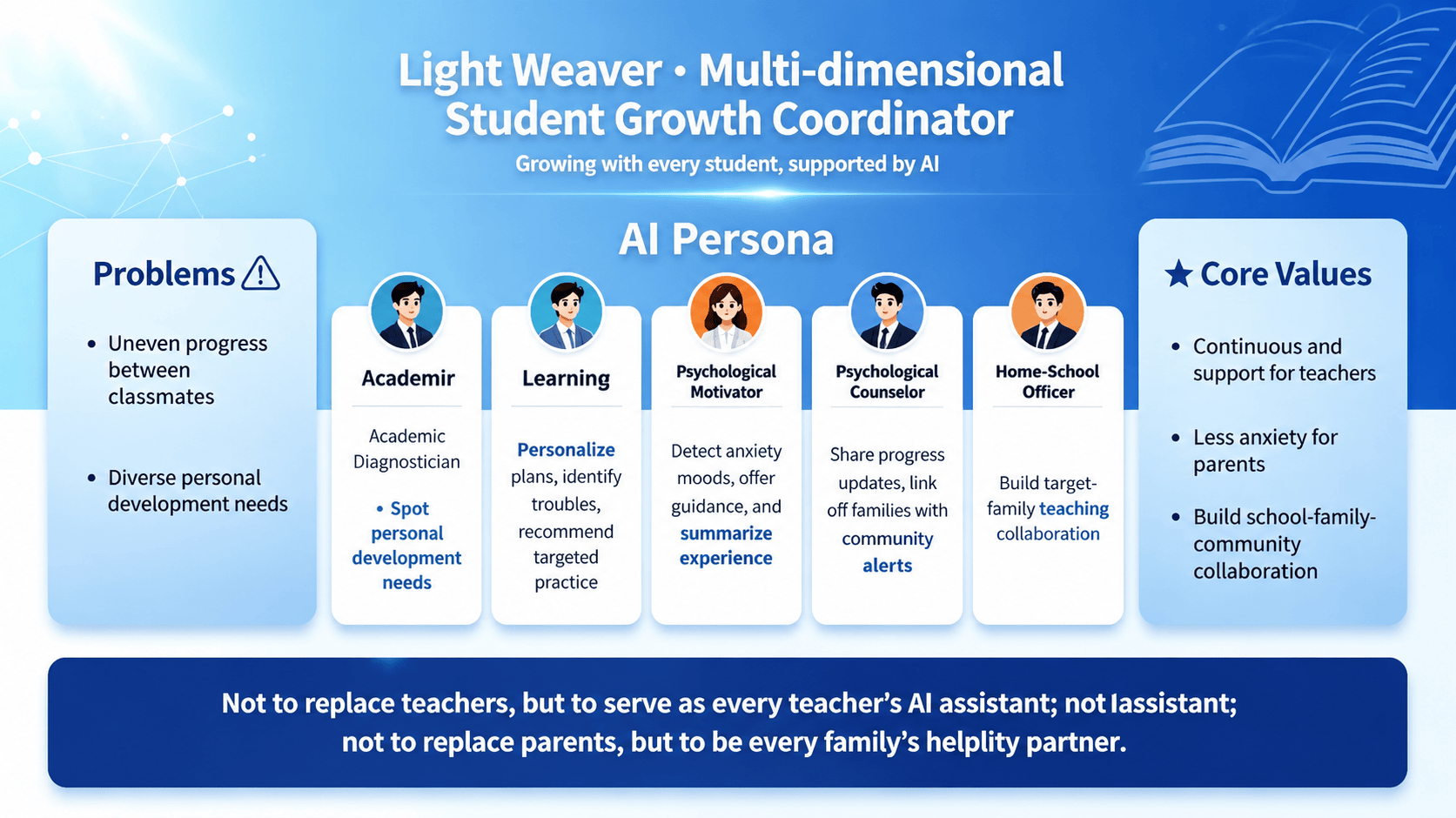
参与者原始海报
图 V1. 第一组于 2026 年 7 月 28 日工作坊期间展示的原始提案。该成果基本按照现场展示时的形式予以保留,包括其原有文字表述与视觉特征。为保护参与者匿名性,本出版版本省略了原始小组身份信息。
Initial Facilitator Observation
The conceptual strength of the proposal lay in its recognition that student development is multidimensional.
Its next developmental challenge would therefore not simply be to improve each AI persona individually, but to establish the architecture connecting them.
引导者的初步观察
这一提案在概念上的优势,在于它认识到学生的发展具有多维度特征。
因此,其下一阶段的发展挑战,并不只是分别改进每一个 AI 角色,而是要建立一个能够将这些角色彼此连接起来的整体架构。
Group 2
AI Guardians for Student Well-being
The second group focused on student well-being and the possibility of using AI as an early support layer within a school environment.
Their proposition recognised pressures that may arise from academic competition, teachers, parental expectations, examinations, peer relationships, and students’ reluctance to disclose emotional difficulties.
The proposed system combined anonymous accessibility, AI-assisted screening, risk detection, confidential alerts, and human intervention.
Importantly, the group did not position AI as a replacement for professional care.
Its proposition retained a human layer for situations requiring deeper intervention.
This distinction became one of the strongest aspects of the proposal.
AI could listen, identify patterns, assist with early screening, and help direct attention.
But human professionals would remain responsible for care requiring judgement, expertise, accountability, and empathy.
第二组
学生福祉的 AI 守护者
第二组聚焦于学生福祉,并探索将 AI 作为学校环境中早期支持层的可能性。
他们的构想关注到学生可能面对的多重压力,包括学业竞争、教师要求、家长期望、考试压力、同伴关系,以及学生不愿主动表达自身情绪困扰等问题。
所提出的系统结合了匿名访问、AI 辅助筛查、风险识别、保密预警,以及人工介入等机制。
重要的是,该小组并没有将 AI 定位为专业照护的替代者。
在需要更深入介入的情况下,他们的构想仍然保留了由人类专业人员负责的支持层。
这一点也成为该提案最具价值的特征之一。
AI 可以倾听、识别模式、协助进行早期筛查,并帮助将注意力引向可能需要支持的情况。
但是,对于需要专业判断、专业知识、责任承担与同理心的照护,最终仍应由人类专业人员负责。
Original Participant Poster

参与者原始海报
图 V2. 第二组于 2026 年 7 月 28 日工作坊期间展示的原始提案。该成果基本按照现场展示时的形式予以保留,包括其原有文字表述与视觉特征。在适用情况下,本出版版本已省略参与者身份信息,以保护其匿名性。
An Idea Emerging During the Presentation
During the group’s presentation, the facilitator extended the discussion beyond a single AI platform.
If different functions required different capabilities, why should the system necessarily depend upon one AI?
A future version might potentially connect specialised agents or models through APIs, allowing different AI systems to contribute according to their respective strengths.
The proposition therefore opened another possibility:
not merely an AI assistant, but an orchestrated AI support architecture with human oversight.
Among the three presentations, this was one of the proposals the facilitator seriously considered for the winning selection.
展示过程中浮现的一个构想
在该小组进行展示时,引导者进一步将讨论从单一 AI 平台延伸开来。
如果不同功能需要不同的能力,那么整个系统为什么一定要依赖单一的 AI?
未来的版本或许可以通过 API 连接不同的专业化智能体或模型,让不同的 AI 系统根据各自的优势参与其中。
因此,这一提案进一步开启了另一种可能性:
它不再只是一个 AI 助手,而是一个在人类监督下运行的协同式 AI 支持架构。
在三个小组的展示中,这是引导者曾认真考虑选为优胜方案的提案之一。
Group 3
Smart Exam Diagnosis
The third proposal appeared, at first glance, to be the simplest.
It began with something familiar to almost every educator and student:
an examination result.
A score tells us what a student achieved.
But what does the score actually explain?
Why were marks lost?
Are mistakes isolated, or do they reveal recurring misconceptions?
Are several students struggling with the same concept?
And what should the teacher do differently before the next assessment?
The group’s proposition imagined AI analysing examination performance, identifying patterns of error, diagnosing areas of weakness, and translating those findings into information that could support subsequent teaching.
Unlike the broader systems proposed by the other groups, this idea followed a comparatively narrow educational loop:
Assessment → Diagnosis → Interpretation → Teaching Response → Next Assessment
Its simplicity would ultimately become its strength.
第三组
智能考试诊断
第三个提案乍看之下似乎是三个构想中最简单的一个。
它从几乎每一位教育者和学生都非常熟悉的事物开始:
一次考试的结果。
分数告诉我们学生取得了怎样的成绩。
但是,这个分数究竟解释了什么?
为什么会失分?
这些错误只是个别现象,还是反映了反复出现的认知误区?
是否有多名学生都在同一个概念上遇到困难?
而在下一次评估之前,教师又应该采取哪些不同的教学行动?
该小组的构想设想利用 AI 分析考试表现,识别错误模式,诊断薄弱环节,并将这些发现转化为能够支持后续教学的信息。
与其他小组提出的较为广泛的系统相比,这一构想遵循了一个相对聚焦的教育循环:
评估 → 诊断 → 解读 → 教学回应 → 下一次评估
它的简单,最终成为了它的优势。
Original Participant Poster

参与者原始海报
图 V3. 第三组于 2026 年 7 月 28 日工作坊期间展示的原始提案。该成果基本按照现场展示时的形式予以保留,包括其原有文字表述与视觉特征。在适用情况下,本出版版本已省略参与者身份信息,以保护其匿名性。
Facilitator Observation
What initially appeared to be the simplest proposal may also have been the most immediately developable.
Its strength lay in the clarity of the educational loop it proposed. Rather than attempting to address many dimensions of student experience simultaneously, the system focused on a specific transition:
from assessment results to better teaching decisions.
This gave the proposition a comparatively clear pathway for further development. Examination data could be analysed for recurring patterns, misconceptions could be identified across individual students or cohorts, and those findings could then inform targeted teaching responses before the next assessment.
The value of the system would therefore not lie merely in telling students where they had lost marks.
It would lie in helping educators understand why those marks were lost, what patterns might exist beneath the results, and what could be done differently next.
Seen from this perspective, Smart Exam Diagnosis transforms assessment from an endpoint into part of a continuing learning cycle.
Its simplicity was not a limitation.
It was what made the proposition potentially testable, measurable, and researchable.
引导者观察
这个乍看之下最简单的提案,也可能是最容易立即进入下一阶段开发的构想。
它的优势在于所提出的教育循环十分清晰。与其同时处理学生经历中的多个维度,这一系统聚焦于一个明确的转变:
从评估结果走向更好的教学决策。
这使该构想具备了一条相对清晰的后续发展路径。系统可以分析考试数据中的重复模式,识别个别学生或整个学习群体中存在的共同误区,并将这些发现转化为有针对性的教学回应,为下一次评估做好准备。
因此,这一系统的价值并不仅仅在于告诉学生他们在哪里失分。
更重要的是,它能够帮助教育者理解:为什么会失分、成绩背后可能隐藏着哪些模式,以及下一步可以采取哪些不同的教学行动。
从这个角度来看,“智能考试诊断”(Smart Exam Diagnosis)将评估从学习过程的终点,转变为持续学习循环中的一个环节。
它的简单并不是局限。
恰恰是这种简单,使这一构想具有进一步被测试、衡量与研究的潜力。
2. Selecting the Winner
Selecting a winner was not straightforward.
All three groups had produced worthwhile propositions, and each approached AI in education from a different direction.
The facilitator acknowledged this during the session.
The first group proposed an ambitious ecosystem around student growth.
The second developed a sophisticated proposition around student well-being and human-AI collaboration.
The third presented a comparatively simple system centred on examination diagnosis.
At one point, Group 2 appeared particularly strong.
The facilitator even turned to my co-facilitator and asked for her choice.
The decision promptly returned to the facilitator.
The ball, so to speak, had crossed the net and come straight back.
Eventually, Group 3 was selected as the workshop winner.
Not because the other proposals were weaker in imagination.
Not because it had the most elaborate poster.
And certainly not because it attempted to solve the largest problem.
It won because its proposition offered an unusually clear connection between an existing educational practice, a specific AI intervention, and an actionable teaching outcome.
2. 评选优胜小组
要选出最终的优胜小组,并不是一件简单的事。
三个小组都提出了值得肯定的构想,而且每一组都从不同的方向探索人工智能在教育中的可能性。
引导者在现场也明确表达了这一点。
第一组围绕学生成长,提出了一个颇具雄心的支持生态系统。
第二组则围绕学生福祉与人机协作,发展出一个较为复杂而成熟的构想。
第三组提出的系统相对简单,核心聚焦于考试诊断。
在评选过程中的某个阶段,第二组显得尤其突出。
引导者甚至转向共同引导者,请她作出选择。
结果,决定权很快又回到了引导者手中。
可以说,这颗球越过了球网,又直接被打了回来。
最终,第三组被选为本次工作坊的优胜小组。
并不是因为其他提案缺乏想象力。
也不是因为第三组拥有最精美复杂的海报。
更不是因为它试图解决最大的问题。
它之所以胜出,是因为其构想在现有教育实践、明确的 AI 介入方式,以及可付诸行动的教学成果之间,建立了一条格外清晰的联系。
3. Jury Race & Claire Deliberation
A Post-workshop Human-AI Reflection
The workshop jury did not formally consist of Race and Claire.
During the workshop, the decision belonged to the facilitator.
The second layer of deliberation occurred afterwards.
Race revisited the three proposals through conversation with Claire, his digital research companion, examining not merely which poster looked strongest but what each proposition might become if developed further.
This post-workshop exchange effectively became a second jury room.
One human.
One AI.
Three proposals still sitting on the metaphorical table.
And considerably more time to think.
3. Race 与 Claire 的评审讨论
工作坊结束后的人机反思
工作坊的正式评审并不是由 Race 与 Claire 共同组成的。
在工作坊现场,最终决定属于引导者。
第二层评审,则发生在工作坊结束之后。
Race 通过与他的数字研究伙伴 Claire 展开对话,重新审视了三个小组的提案。他们所关注的,不仅仅是哪一张海报看起来最出色,而是进一步思考:如果这些构想继续发展下去,每一个提案最终可能成长为什么?
这场工作坊后的交流,实际上形成了第二间评审室。
一个人。
一个 AI。
三个提案,依然摆在那张想象中的评审桌上。
而这一次,他们拥有了更多的时间去思考。
Group 1: The Most Expansive System
Race’s observation:
The proposal recognised that education extends beyond academic performance. Students require different forms of support at different moments.
Claire’s observation:
Its strength was also its challenge. Once several specialised personas are introduced, the research problem shifts from individual AI capability towards coordination, boundaries, information flow, privacy, and human oversight.
Jury reflection:
Group 1 offered perhaps the broadest vision, but would require substantial architectural development before the relationships among its different agents became clear.
Research potential: High.
Developmental challenge: Orchestration.
第一组:最具扩展性的系统
Race 的观察:
这一提案认识到,教育并不仅仅关乎学业表现。学生在不同阶段、不同情境下,需要不同形式的支持。
Claire 的观察:
它的优势,同时也是它所面临的挑战。一旦引入多个专业化的 AI 角色,研究问题便不再只是关注单个 AI 的能力,而会进一步转向角色之间的协调、边界、信息流动、隐私,以及人类监督等问题。
评审反思:
第一组或许提出了三个方案中最为广阔的愿景,但在不同智能体之间的关系能够被清晰界定之前,整个系统仍需要进一步进行相当程度的架构设计与发展。
研究潜力:高。
发展挑战:协同编排(Orchestration)。
Group 2: The Strongest System-level Proposition
Race’s observation:
This group came close to being selected as the winner. The proposition already demonstrated awareness that AI should assist rather than replace professional human support.
During the presentation, this led to a further idea: specialised AI capabilities from different platforms could potentially be connected through APIs and coordinated as an agentic system.
Claire’s observation:
The proposal contained substantial research potential precisely because the technological problem could not be separated from ethics, safeguarding, privacy, escalation protocols, professional responsibility, and institutional governance.
Jury reflection:
Of the three concepts, Group 2 may have offered the richest immediate pathway towards a sophisticated AI system.
But sophistication alone was not the criterion.
Research potential: Very high.
Developmental challenge: Safety, governance, and human-in-the-loop architecture.
第二组:最强的系统级提案
Race 的观察:
这一组的提案曾非常接近被选为最终优胜方案。其构想已经清楚意识到,AI 应当发挥辅助作用,而不是取代人类专业人员所提供的支持。
在展示过程中,这进一步引出了另一个构想:来自不同平台的专业化 AI 能力,未来或许可以通过 API 相互连接,并被协调为一个智能体系统(Agentic System)。
Claire 的观察:
这一提案具有相当高的研究潜力,恰恰是因为其中的技术问题无法与伦理、保障机制、隐私、升级处理协议、专业责任,以及机构治理等问题彼此分离。
评审反思:
在三个构想之中,第二组或许提供了最丰富、也最直接通往复杂 AI 系统的发展路径。
但复杂程度本身,并不是评选的唯一标准。
研究潜力:非常高。
发展挑战:安全、治理,以及人在回路架构(Human-in-the-Loop Architecture)。
Group 3: The Simplest Idea with the Clearest Educational Loop
Race’s observation:
The proposal initially seemed almost too simple compared with the others.
Yet examinations remain consequential in many educational systems, particularly where academic performance influences progression and access to higher education.
If examinations already generate large quantities of information, why should their educational value end when the score is released?
Claire’s observation:
The proposal contained a remarkably clean feedback loop.
AI was not being asked to become the teacher.
It was being asked to help the teacher see what the examination revealed beneath the marks.
That distinction made the intervention focused, understandable, and potentially measurable.
Jury reflection:
The strongest innovation is not necessarily the system with the greatest number of features.
Sometimes it is the intervention that identifies a specific point where intelligence can be inserted into an existing educational process and produces a meaningful next action.
Research potential: Very high.
Developmental challenge: Turning diagnosis into demonstrably better teaching and learning.
And that ultimately clarified why Group 3 deserved the workshop selection.
第三组:最简单的构想,最清晰的教育循环
Race 的观察:
与其他提案相比,这个构想最初看起来甚至显得过于简单。
然而,在许多教育体系中,考试依然具有重要影响,尤其是在学业成绩会影响学生升学进程以及进入高等教育机会的情况下。
既然考试本身已经产生了大量信息,那么,当分数公布之后,这些信息的教育价值为什么也要随之结束?
Claire 的观察:
这一提案包含了一个非常清晰的反馈循环。
AI 并不是被要求成为教师。
它所承担的角色,是帮助教师看见考试分数背后真正揭示的信息。
正是这一差异,使 AI 的介入变得聚焦、易于理解,同时也具备潜在的可衡量性。
评审反思:
最有价值的创新,并不一定来自拥有最多功能的系统。
有时候,真正具有意义的创新,是能够在现有教育过程中找到一个明确的切入点,将智能能力嵌入其中,并由此产生一个具有实际意义的下一步行动。
研究潜力:非常高。
发展挑战:将诊断转化为能够被实证证明的教学与学习改进。
而这最终也解释了为什么第三组值得被选为本次工作坊的优胜方案。
4. Why the Winning Proposal Matters
The significance of Smart Exam Diagnosis becomes clearer when considered within educational systems where examination results have substantial consequences.
Students do not experience scores as abstract data.
Scores may influence academic progression, programme selection, scholarship opportunities, and access to competitive educational pathways.
Yet conventional assessment often compresses a complex learning history into a number.
72.
What does 72 mean?
The student knows more than someone who received 61 and less than someone who received 84.
But educationally, that tells us very little.
Two students receiving 72 may have entirely different misconceptions.
One may understand the concepts but repeatedly misread questions.
Another may have mastered several topics while fundamentally misunderstanding one core principle.
A third may understand the subject but perform poorly under a particular assessment format.
The opportunity for AI is therefore not simply to calculate scores faster.
It is to help convert assessment evidence into diagnostic intelligence.
That is why the proposal was compelling.
It potentially shifts the examination from an endpoint into a feedback mechanism.
The examination ends. Learning does not.
4. 为什么优胜提案具有重要意义
当我们把“智能考试诊断”(Smart Exam Diagnosis)放在那些考试成绩具有重大影响的教育体系中来看,它的重要性就会变得更加清晰。
对学生而言,分数并不是抽象的数据。
成绩可能影响学业进程、专业选择、奖学金机会,以及进入竞争激烈的教育路径的可能性。
然而,传统评估往往将一段复杂的学习历程压缩成一个数字。
72。
72 究竟意味着什么?
这名学生似乎比得到 61 分的学生掌握得更多,却又比得到 84 分的学生掌握得更少。
但从教育角度来看,这其实告诉我们的非常有限。
两名同样获得 72 分的学生,可能存在完全不同的认知误区。
其中一名学生或许理解相关概念,却反复误读题目。
另一名学生可能已经掌握了多个主题,却从根本上误解了某个核心原理。
第三名学生或许理解学科内容,却在某一种特定的评估形式下表现不佳。
因此,AI 所带来的机会,并不只是更快地计算分数。
而是帮助我们将评估证据转化为诊断性智能。
这正是该提案令人信服之处。
它有可能将考试从学习过程的终点,转变为一种反馈机制。
考试会结束。学习不会。
5. Enhancement and Poster Reconstruction
Following the workshop, Race and Claire revisited all three proposals.
The objective was not to redesign them until they looked professionally polished.
Nor was it to imply that the reconstructed systems had been developed by the participants themselves.
Instead, the exercise explored how the facilitator might extend each proposition while preserving its original educational intent.
The reconstruction process therefore followed a simple principle:
Preserve the idea. Clarify the system. Expose the research questions.
5. 优化与海报重构
工作坊结束后,Race 与 Claire 再次审视了三个小组的提案。
其目的并不是重新设计这些提案,直到它们看起来更加专业或精致。
也不是要让人误以为这些重构后的系统是由参与者本人进一步开发完成的。
相反,这项工作所探索的是:在保留每个提案原有教育意图的前提下,引导者可以如何将这些构想进一步延伸与发展。
因此,整个重构过程遵循一个简单的原则:
保留构想。理清系统。揭示研究问题。
Group 1 Reconstruction
From Multiple Personas to Coordinated Student Support
The reconstruction would retain the group’s multidimensional approach while making the relationships between specialised roles clearer.
Rather than presenting several AI personas as parallel assistants, the enhanced proposition could explore a coordinated architecture in which information is appropriately separated, shared, escalated, or withheld according to educational role and ethical boundaries.
第一组重构
从多个角色到协同式学生支持
重构后的方案将保留该小组原有的多维度思路,同时进一步明确不同专业化角色之间的关系。
与其将多个 AI 角色呈现为彼此平行运行的助手,优化后的构想可以进一步探索一种协同架构。在这一架构中,信息可以根据不同的教育角色与伦理边界,被适当地隔离、共享、升级处理,或限制流通。

Figure V4. Facilitator reconstruction of Group 1, developed after the workshop as an exploratory extension of the participants’ original proposition.
The reconstructed model could investigate:
Student → specialised support agents → coordination layer → educator oversight → intervention → longitudinal feedback
The crucial innovation would no longer be the existence of multiple personas.
It would be their orchestration.
图 V4. 第一组的引导者重构版本,于工作坊结束后完成,作为参与者原始构想的一项探索性延伸。
重构后的模型可以进一步研究以下流程:
学生 → 专业化支持智能体 → 协调层 → 教育者监督 → 干预 → 纵向反馈
此时,真正关键的创新将不再是多个 AI 角色本身的存在。
而是如何对它们进行协同编排。
Group 2 Reconstruction
From AI Well-being Assistant to Human-AI Care Architecture
The second reconstruction would preserve the group’s central principle:
AI assists. Humans care.
The enhanced system could distinguish between low-risk conversational support, pattern recognition, risk screening, escalation, professional review, intervention, and institutional oversight.
Different specialised AI services might eventually be connected through an agentic architecture, while sensitive decisions remain governed by explicit human authority.
第二组重构
从 AI 福祉助手到人机协同照护架构
第二个重构方案将保留该小组最核心的原则:
AI 提供辅助。人类负责照护。
优化后的系统可以进一步区分低风险对话支持、模式识别、风险筛查、升级处理、专业人员审核、干预,以及机构监督等不同层级。
未来,不同的专业化 AI 服务或许可以通过智能体架构(Agentic Architecture)相互连接,而涉及敏感情况的决策,则始终由明确的人类权责机制进行治理。

Figure V5. Facilitator reconstruction of Group 2.
The reconstructed model could explore:
Student → anonymous support → AI screening → risk classification → human review → intervention → follow-up
with privacy, safeguarding, auditability, and governance surrounding the entire process.
图 V5. 第二组的引导者重构版本。
重构后的模型可以进一步探索以下流程:
学生 → 匿名支持 → AI 筛查 → 风险分类 → 人工审核 → 干预 → 后续跟进
同时,隐私保护、安全保障、可审计性与治理机制应贯穿整个过程。
Group 3 Reconstruction
From Exam Analysis to Continuous Teaching Intelligence
The third reconstruction would expand the original proposition without losing its simplicity.
The examination becomes one point in a continuous learning loop.
第三组重构
从考试分析到持续教学智能
第三个重构方案将在不失去原有简洁性的前提下,进一步拓展最初的构想。
考试不再只是学习过程的终点,而成为持续学习循环中的一个节点。

Figure V6. Facilitator reconstruction of Group 3.
The enhanced system might operate through:
Assessment Data → Error Analysis → Misconception Detection → Individual & Class Diagnosis → Teacher Interpretation → Targeted Intervention → Subsequent Assessment → Comparative Feedback
The critical change is subtle.
AI does not merely tell the teacher what went wrong.
The system helps connect what went wrong to what might be done next, while leaving instructional judgement with the educator.
图 V6. 第三组的引导者重构版本。
优化后的系统可以按照以下流程运行:
评估数据 → 错误分析 → 认知误区识别 → 个体与班级诊断 → 教师解读 → 针对性干预 → 后续评估 → 对比反馈
其中最关键的变化其实十分微妙。
AI 不再只是告诉教师哪里出了问题。
这个系统进一步帮助教师将**“哪里出了问题”与“下一步可以做什么”**连接起来,同时仍将教学判断权保留在教育者手中。
6. Future Research and Development
Once reconstructed in this manner, the three workshop proposals begin to resemble early research programmes.
They are no longer merely ideas for AI products.
Each raises questions about teaching, learning, human judgement, institutional practice, and the changing relationship between educators and intelligent systems.
6. 未来研究与发展
经过这样的重构,三个工作坊提案开始呈现出早期研究计划的雏形。
它们不再只是关于 AI 产品的构想。
每一个提案都进一步提出了有关教学、学习、人类判断、机构实践,以及教育者与智能系统之间不断变化关系的问题。
Group 1: Multi-Agent Student Development
Potential research directions include coordination between specialised educational agents, boundaries between academic and pastoral data, teacher oversight of multi-agent systems, longitudinal personalisation, and whether orchestration improves educational support compared with a single general-purpose AI.
A possible doctoral direction might investigate:
How can multi-agent conversational AI systems support multidimensional student development while preserving coherent educator oversight?
第一组:多智能体学生发展
潜在的研究方向包括:专业化教育智能体之间的协调、学业数据与学生关怀数据之间的边界、教师对多智能体系统的监督、纵向个性化,以及与单一通用型 AI 相比,协同编排是否能够提升教育支持的成效。
一个可能的博士研究方向可以探讨:
多智能体对话式 AI 系统如何在维持连贯的教育者监督机制的同时,支持学生的多维度发展?
Group 2: AI-Supported Student Well-being
Potential research directions include human-in-the-loop care models, risk detection, escalation protocols, privacy, trust, safeguarding, professional responsibility, institutional governance, and the integration of multiple specialised AI services.
A possible doctoral direction might investigate:
How can AI-assisted early-support systems identify student well-being concerns while maintaining appropriate human judgement, safeguarding, and institutional accountability?
This is particularly important because greater technical capability does not automatically produce better care.
In this domain, the boundary between what AI can do and what AI should do becomes part of the research itself.
第二组:AI 支持的学生福祉
潜在的研究方向包括:人在回路的照护模式、风险识别、升级处理协议、隐私、信任、安全保障、专业责任、机构治理,以及多个专业化 AI 服务的整合。
一个可能的博士研究方向可以探讨:
AI 辅助的早期支持系统如何在维持适当的人类判断、安全保障与机构问责机制的同时,识别学生福祉方面可能存在的问题?
这一点尤其重要,因为更强的技术能力并不会自动带来更好的照护。
在这一领域,AI 能够做什么与AI 应该做什么之间的边界,本身就成为了研究的一部分。
Group 3: AI-Supported Diagnostic Assessment
Potential research directions include misconception detection, teacher interpretation of AI-generated diagnostics, personalised remediation, class-level learning analytics, trust in AI recommendations, longitudinal assessment, and measurable changes in instructional decision-making.
A possible doctoral direction might investigate:
How does AI-supported diagnostic assessment influence teachers’ instructional decision-making and subsequent student learning?
This moves the research beyond whether AI can analyse examination data.
The deeper educational question is:
Does seeing differently lead to teaching differently?
And if teaching changes, does learning improve?
第三组:AI 支持的诊断性评估
潜在的研究方向包括:认知误区识别、教师对 AI 生成诊断结果的解读、个性化补救教学、班级层面的学习分析、对 AI 建议的信任、纵向评估,以及教学决策中可衡量的变化。
一个可能的博士研究方向可以探讨:
AI 支持的诊断性评估如何影响教师的教学决策,以及学生后续的学习成效?
这使研究不再停留于 AI 是否能够分析考试数据这一层面。
更深层的教育问题是:
看见不同的东西,会不会带来不同的教学?
而如果教学发生改变,
学习是否也会随之改善?
7. From Workshop Exercise to Research Pipeline
Viewed retrospectively, the hands-on activity produced more than three posters.
It demonstrated a possible research-development pathway:
Educational Problem
↓
Participant Exploration
↓
AI-assisted Concept Development
↓
Prototype Proposition
↓
Presentation & Discussion
↓
Facilitator Reflection
↓
Human-AI Deliberation
↓
Conceptual Reconstruction
↓
Research Questions
↓
Future R&D
This is particularly significant because the workshop itself emerged from a larger body of research and writing on AI in education.
Ideas moved from research into teaching.
Teaching generated participant propositions.
Participant propositions generated new questions.
Those questions can now return to research.
The relationship is therefore not linear.
It is cyclical:
Research → Workshop → Exploration → Prototype → Reflection → Reconstruction → Research
The workshop becomes a site not only for disseminating knowledge, but for generating knowledge.
7. 从工作坊实践到研究管线
回顾来看,这项实践活动所产生的,远不只是三张海报。
它实际上展示了一条可能的研究与发展路径:
教育问题
↓
参与者探索
↓
AI 辅助概念发展
↓
原型构想
↓
展示与讨论
↓
引导者反思
↓
人机协同评议
↓
概念重构
↓
研究问题
↓
未来研发(R&D)
这一点尤其重要,因为这场工作坊本身,正是从一个更为广泛的人工智能教育研究与写作体系中发展而来的。
研究中的构想进入教学。
教学产生参与者的提案。
参与者的提案又产生新的问题。
而这些问题,如今可以再次回到研究之中。
因此,这种关系并不是线性的。
它是循环的:
研究 → 工作坊 → 探索 → 原型 → 反思 → 重构 → 研究
于是,工作坊不再只是传播知识的场所。
它也成为生成知识的场所。
Summary
When the Workshop Becomes the Next Research Question
Three groups entered the exercise with three educational problems.
They left with three propositions.
One was selected as the workshop winner.
But with the benefit of post-workshop reflection, perhaps the more important outcome is that none of the three ideas actually ended there.
Group 1 points towards multi-agent orchestration for student development.
Group 2 points towards human-AI architectures for student well-being.
Group 3 points towards diagnostic intelligence connecting assessment with future teaching.
The original posters remain important because they document the ideas at the moment of their emergence.
The reconstructed posters serve a different purpose.
They demonstrate what can happen when an initial educational proposition is subjected to another cycle of questioning, conversation, and design.
And perhaps this is the larger lesson of the exercise.
Education does not always need AI to provide the final answer.
Sometimes AI becomes most valuable when it helps us discover the next question worth researching.
What began as a workshop exercise on 28 July 2026 may therefore become something else entirely:
three seeds for future educational research.
总结
当工作坊成为下一个研究问题
三个小组带着三个教育问题进入这项实践活动。
离开时,他们带走了三个不同的构想。
其中一个被选为本次工作坊的优胜方案。
然而,经过工作坊结束后的进一步反思,也许更重要的成果在于,这三个构想其实都没有在那里结束。
第一组指向了面向学生发展的多智能体协同编排。
第二组指向了面向学生福祉的人机协同架构。
第三组则指向了将评估与未来教学连接起来的诊断性智能。
原始海报依然重要,因为它们记录了这些构想最初浮现时的样貌。
重构后的海报则承担着不同的作用。
它们展示了当一个最初的教育构想再次经历提问、对话与设计的循环之后,可能发生什么。
而这或许正是这项实践所揭示的更深层启示。
教育并不总是需要 AI 提供最终答案。
有时候,AI 最有价值的作用,是帮助我们发现下一个值得研究的问题。
因此,2026 年 7 月 28 日开始于一项工作坊实践的三个构想,或许最终会成长为完全不同的东西:
三颗孕育未来教育研究的种子。
CASE STUDY #2
When the Workshop Became a Case Study
One of the most unexpected moments did not occur during the workshop itself.
It emerged shortly after the session had concluded.
While continuing a conversation with one of the accompanying lecturer from Tongji Universty, we reflected on the workshop, the participant discussions, and the educational ideas that had surfaced throughout the day.
Almost without thinking, I found myself saying,
“Today’s workshop has already become another case study.”
For a brief moment, the conversation paused.
The words carried an unexpected realisation.
The workshop was no longer simply an educational event built around case studies.
It had itself become one.
Looking back, the transformation seemed almost inevitable.
The workshop had generated observations that were never included in the original plan.
Unexpected conversations.
Participant reflections.
Facilitator improvisations.
Extended working sessions.
Emerging educational prototypes.
Post-workshop discussions.
WeChat conversations.
Research possibilities.
Each of these gradually became part of the workshop’s own evolving narrative.
The publication itself reflected the same transformation.
Originally intended as documentation of a single educational event, it gradually expanded into something else.
Each new reflection generated another section.
Each participant interaction revealed another educational insight.
Each reconstruction opened another research question.
The publication was no longer simply recording the workshop.
It was becoming part of the workshop.
Perhaps this illustrates an important characteristic of reflective educational practice.
Case studies are not only resources that educators read.
Sometimes they are created through the educational experiences themselves.
Teaching becomes observation.
Observation becomes reflection.
Reflection becomes publication.
Publication becomes another case study for future educators.
The cycle quietly begins again.
Reflection
Perhaps this was the workshop’s most unexpected outcome.
The participants arrived to learn from educational case studies.
By the time the conversations continued beyond the classroom…
they had unknowingly contributed to creating one.
A workshop may begin by studying case studies.
Occasionally…
it ends by becoming one.
INTERLUDE V
Every Research Once Began as an Idea
There is a tendency in academia to admire completed research.
Published papers.
Successful grants.
Well-developed systems.
Finished prototypes.
Yet these polished outcomes often hide a quieter beginning.
Most research does not begin with certainty.
It begins with curiosity.
Looking back at the participant proposals, it would be easy to focus on what they had not yet become.
They were not complete research projects.
They were not operational AI systems.
They were not products ready for implementation.
Nor were they intended to be.
They were ideas.
And ideas deserve to be recognised for what they are.
Not unfinished answers.
But possible beginnings.
Perhaps this is one of the responsibilities of educators.
To see potential before it becomes evidence.
To recognise possibilities before they become publications.
To encourage questions before expecting conclusions.
Education has always depended upon this quiet act of imagination.
Seeing not only what a learner has already achieved…
but also what they may yet become.
The facilitator’s reconstructions were therefore never intended to replace the participants’ work.
Nor were they attempts to improve it for the sake of appearance.
Instead, they represented another educational conversation.
One possible future.
One possible research direction.
One possible continuation of the participants’ original thinking.
The ownership of the ideas remained exactly where it had always been.
With the participants who first asked the questions.
Perhaps this explains why workshops should not always be evaluated only by what happens inside the room.
Sometimes their greatest contribution appears much later.
When a participant revisits an old idea.
When a classroom experiment becomes a research proposal.
When a discussion evolves into collaboration.
When a simple workshop poster quietly becomes the first page of a future thesis.
Research, after all, rarely begins with complete answers.
It often begins with someone saying,
“I wonder if this could become something more.”
Every publication was once a draft.
Every prototype was once a sketch.
Every research project was once a conversation.
And every meaningful conversation begins with someone willing to ask, “What if?”

CODEX VI
Learning Across Educational Ecosystems
One of the most unexpected outcomes of the workshop emerged only after everyone had returned home.
The classroom became quiet.
The projector was switched off.
The posters had already been presented.
Participants departed for different destinations.
By every conventional measure, the workshop had ended.
Yet the learning journey had not.
Instead, it quietly expanded beyond the physical classroom into something much larger.
Conversations continued through WeChat.
Ideas were revisited.
Questions continued to emerge.
Publications evolved.
Reflections became new conversations.
The workshop was gradually becoming part of a wider educational ecosystem that extended beyond institutional boundaries, national borders, individual AI platforms, and even the workshop itself.
Perhaps this is one of the defining characteristics of education in the age of conversational intelligence.
Learning no longer ends when the classroom closes.
It simply changes its location.
1. When the Classroom Continued Online
The workshop officially concluded that afternoon.
The conversations did not.
Messages continued appearing through the workshop’s WeChat community.
Participants shared reflections.
Questions that could not be explored within the limited workshop schedule gradually found space in later conversations.
What had originally been designed as a three-hour educational event slowly transformed into an ongoing learning community.
The classroom had not disappeared.
It had simply become distributed.
2. Crossing Languages Without Leaving Ideas
One of the workshop’s most encouraging observations involved language itself.
Presentation slides had been prepared in English.
Supporting materials were translated into Simplified Chinese.
Throughout the workshop, participants naturally moved between both languages according to context.
Some discussions occurred in English.
Others continued in Chinese.
Occasionally, AI-assisted translation quietly bridged the two.
The experience suggested that meaningful educational dialogue depends less upon using a single language than upon preserving shared understanding.
Translation was therefore never simply about replacing words.
It became an act of preserving educational meaning across linguistic boundaries.
3. Crossing AI Ecosystems
The workshop also revealed another form of diversity.
Participants were already familiar with different AI platforms.
Some preferred Western AI systems.
Others were actively exploring rapidly emerging Chinese platforms.
Rather than treating these ecosystems as competitors, the workshop encouraged participants to recognise that each possessed different strengths.
Some excelled at reasoning.
Others at multilingual support.
Some demonstrated strong research capabilities.
Others offered unique strengths in document analysis, visual generation, or local language interaction.
Educational practice rarely benefits from asking which platform should replace the others.
It benefits far more from understanding how different systems may complement one another.
4. From Multiple Tools to Cognitive Orchestration
As the conversations continued beyond the workshop, another pattern gradually became visible.
The discussion was no longer centred on individual AI platforms.
Instead, it shifted towards orchestration.
Different systems supporting different stages of thinking.
Different educators contributing different perspectives.
Different languages enriching the same conversation.
The objective was no longer to find the perfect AI.
It was to build thoughtful educational workflows that combined the strengths of many contributors, both human and artificial.
Artificial intelligence remained important.
Yet meaningful educational design increasingly depended upon the architecture connecting these different forms of intelligence together.
5. From Workshop to Publishing Ecosystem
The workshop itself also continued evolving.
Participant discussions inspired new reflections.
Those reflections expanded this publication.
New publications connected back to the workshop.
Blog articles linked to educational resources.
Case studies generated future research questions.
Rather than existing as isolated outputs, the workshop gradually became part of a broader publishing ecosystem in which conversations, publications, workshops, and future research continuously informed one another.
Knowledge was no longer moving in one direction.
It had become circular.
Each new conversation generated another publication.
Each publication invited another conversation.
6. Building Bridges Rather Than Boundaries
Looking back, perhaps the workshop’s greatest contribution was not introducing another AI platform.
Nor was it demonstrating another technological capability.
Its greater contribution lay in building bridges.
Between educators.
Between countries.
Between languages.
Between research traditions.
Between educational philosophies.
And increasingly…
between human intelligence and artificial intelligence.
The workshop quietly suggested that educational progress may depend less upon choosing between these different worlds and more upon learning how to connect them thoughtfully.
7. Closing Reflection
Perhaps education has always been about building connections.
Between ideas.
Between people.
Between generations.
Artificial intelligence simply offers another opportunity to extend those connections further than before.
The workshop therefore did not conclude with a final answer.
It opened another educational ecosystem.
One in which conversations continue across classrooms, publications, digital communities, and international collaborations.
And perhaps…
that is where the future of education is already quietly unfolding.

CODEX VII
Beyond the Workshop
When the Conversation Continued
Throughout this publication, one recurring observation has gradually emerged.
Meaningful learning rarely concludes when a workshop officially ends.
Instead, it often continues through subsequent conversations, reflection, experimentation, and shared practice.
Such an observation, however, should not rely solely upon the facilitator’s own reflections.
It deserves evidence.
This final Codex therefore shifts the narrative away from the facilitator and towards the learning community itself.
The following conversations were shared voluntarily by participants shortly after the workshop through personal WeChat messages.
They were neither requested as formal feedback nor submitted as part of any workshop evaluation.
Rather, they emerged naturally as participants reflected upon the experience after returning from the classroom.
To preserve participant privacy, all personal names and identifying information have been removed. Minor editorial revisions have been made only where necessary for readability while preserving the original meaning and intent.
Perhaps these conversations represent the workshop’s most authentic educational outcome.
1. Beyond the Closing Session
By late afternoon, the workshop had officially concluded.
The presentation slides had been archived.
The posters had been photographed.
Participants returned to their respective universities and professional responsibilities.
From the perspective of the official programme, the educational event had ended.
Yet another story was quietly beginning.
That evening, messages started arriving through WeChat.
Some participants simply wished to express appreciation.
Others reflected upon ideas discussed during the workshop.
Several continued asking questions or expressing hopes for future collaboration.
None of these conversations had been planned.
None had been required.
Yet together, they revealed something far more meaningful than any evaluation form could easily capture.
The workshop had ended.
The conversation had not.
2. Voices Beyond the Workshop
The following excerpts illustrate the kinds of conversations that continued after the workshop.
Rather than functioning as testimonials, they are presented here as naturally occurring evidence that educational dialogue continued beyond the classroom.
Reflection A
“Thank you for your wonderful lecture. I have learned a lot today.”
A simple expression of gratitude.
Yet it also acknowledges that learning had taken place.
Not simply attendance.
Learning.
Reflection B
“Thanks for your teaching today. So nice to meet you! Best wishes!”
Although brief, this reflection reminds us that education is also relational.
Meaningful learning often begins with meaningful human connection.
Reflection C
“I look forward to having more opportunities to communicate and learn from you later.”
Perhaps this reflection moves beyond appreciation.
It expresses continuity.
The participant was no longer responding only to a completed workshop.
She was already anticipating the next conversation.
Reflection D
“Thank you for the wonderful session and for sharing your insights with our students.”
This reflection broadens the perspective beyond individual learning.
It acknowledges educational exchange between institutions, educators, and future professionals.
The workshop had become part of a wider academic conversation.
Reflection E
One participant wrote something that quietly captured the philosophical direction of the entire workshop:
“Instead of worrying about AI, we should learn to coexist with it and elevate our own cognition.”
Perhaps no facilitator could have summarised the workshop more meaningfully.
Rather than viewing artificial intelligence as something to fear or resist, the participant reframed the discussion around coexistence and the continuing development of human cognition.
The workshop’s central ideas had not merely been remembered.
They had been reinterpreted.
Internalised.
Made personal.
Reflection F
One participant initially shared that the workshop had been both helpful and inspiring.
In response, the participant was encouraged not merely to continue using AI, but to keep exploring, experimenting, and building original ideas.
“Keep exploring, keep experimenting, and don’t be afraid to build your own ideas with AI. Innovation begins with curiosity. Stay connected.”
The participant’s brief reply,
“OK 😊😊”
may appear modest at first glance.
Yet within the context of the conversation, it represented something more meaningful than simple acknowledgement.
The workshop had not ended with a farewell.
It had become an invitation to continue learning.
The conversation simply moved from the classroom into an ongoing educational relationship.
3. Looking Across the Conversations
Viewed individually, each message appears relatively simple.
Together, however, several recurring themes begin to emerge.
Participants continued discussing learning rather than technology alone.
Several expressed intentions to continue exploring AI within their own educational contexts.
Others emphasised communication, collaboration, and future engagement.
Perhaps most significantly, one participant articulated a philosophy of coexistence between human intelligence and artificial intelligence, extending the workshop’s discussions into a broader educational vision.
Interestingly, very few conversations focused upon specific AI platforms.
Instead, they consistently returned to educational practice, human learning, and future possibilities.
This observation quietly reinforces one of the central arguments developed throughout this publication.
Artificial intelligence may provide powerful tools.
Meaningful educational transformation remains fundamentally human.
4. From Individual Messages to Collective Evidence
Educational impact is often evaluated through attendance records, post-workshop surveys, or immediate participant feedback.
These remain valuable.
Yet they capture only a single moment in time.
The conversations presented here offer a different perspective.
Not statistical evidence.
But documentary evidence.
Evidence that participants continued thinking after leaving the classroom.
Evidence that conversations continued voluntarily.
Evidence that ideas had begun finding their way into participants’ own educational perspectives.
Perhaps this represents one of the defining characteristics of education in the age of conversational intelligence.
Learning no longer ends when classrooms become quiet.
Communities continue learning together.
5. The Workshop Continues
Looking back, the educational journey described throughout this publication may be summarised through a remarkably simple progression.
Learn
Participants encountered new ideas.
↓
Build
They explored those ideas through discussion and collaborative activities.
↓
Share
The conversations continued beyond the classroom through digital communities.
↓
Contribute
Participants connected these ideas to their own educational contexts, extending the conversation through reflection and dialogue.
↓
Coexist
Rather than viewing artificial intelligence as something to replace human capability, participants increasingly described a future built upon coexistence, collaboration, and the continuing development of human cognition.
Perhaps this final stage was never planned.
It emerged naturally.
Not from the facilitator.
But from the participants themselves.
Closing Reflection
The workshop officially concluded at the end of the afternoon.
The conversations did not.
Looking back, perhaps this is the most meaningful evidence presented throughout this publication.
The participants did not simply remember what had been discussed.
They continued the discussion.
They carried it beyond the classroom.
They reinterpreted it within their own educational contexts.
And in doing so, they quietly demonstrated that meaningful education is not measured only by what happens during a workshop.
It is also measured by the conversations that participants choose to continue afterwards.
Perhaps that was the workshop’s most valuable outcome.
EPILOGUE
The Workshop Ended. The Conversation Did Not.
The workshop officially concluded that afternoon.
The projector was switched off.
The posters were carefully packed away.
Participants returned to their respective universities.
The classroom gradually became quiet.
By every practical measure, the workshop had come to an end.
Yet something remained.
Conversations continued through WeChat.
Ideas continued evolving through subsequent reflections.
Questions generated new discussions.
Those discussions gradually became publications.
The publications, in turn, invited new conversations.
Looking back, it becomes difficult to identify the exact moment when the workshop truly ended.
Perhaps…
it never really did.
Instead, it quietly changed its form.
From classroom…
to conversation.
From conversation…
to reflection.
From reflection…
to publication.
And from publication…
to another conversation waiting to begin.
Perhaps that is one of the quiet lessons offered by education in the age of conversational intelligence.
Learning does not always conclude when a classroom becomes empty.
Sometimes…
that is precisely when it begins to travel.
Across institutions.
Across cultures.
Across languages.
Across generations.
Across human and artificial intelligence.
This publication therefore does not represent the conclusion of a workshop.
It represents one moment within a continuing educational journey.
One conversation among many.
One classroom connected to countless others.
One beginning…
rather than an ending.
Perhaps the workshop
was never the destination.
Perhaps…
it was simply where the conversation began.
Ts. IDRIS Taib, P.Tech
Kuala Lumpur, Malaysia
2026
结语
工作坊结束了。
但,对话并没有结束。
那天下午,工作坊正式画下句点。
投影机关闭了。
海报被仔细收起。
参与者陆续返回各自的大学。
教室,也渐渐恢复了宁静。
从所有实际意义而言,
工作坊已经结束了。
然而,
有些东西却依然延续着。
对话,继续在 WeChat 上展开。
想法,在一次次交流中不断发展。
问题,引发新的讨论。
讨论,逐渐孕育出新的出版作品。
而这些出版作品,
又开启了另一轮新的对话。
回过头来看,
已经很难说清,
这场工作坊究竟是在什么时候真正结束的。
也许……
它其实从未真正结束。
它只是,
悄悄改变了存在的形式。
从课堂,
走向对话。
从对话,
走向反思。
从反思,
走向出版。
再由出版,
开启另一场等待开始的对话。
或许,
这正是对话式智能时代教育
所带给我们的一个宁静启示。
学习,
并不总是在教室安静下来时结束。
很多时候,
正是在那一刻,
它开始启程。
跨越院校。
跨越文化。
跨越语言。
跨越世代。
也跨越
人类智慧与人工智能之间的界限。
因此,
这本著作
并不是一场工作坊的终点。
它只是,
一段持续进行中的教育旅程里的一个片段。
一场对话,
连接着更多未来的对话。
一个课堂,
连接着无数未来的课堂。
一个开始……
而不是结束。
也许,
工作坊
从来都不是终点。
也许……
它只是,
一场对话开始的地方。
Ts. IDRIS Taib, P.Tech
Kuala Lumpur, Malaysia
2026
Leave a Reply