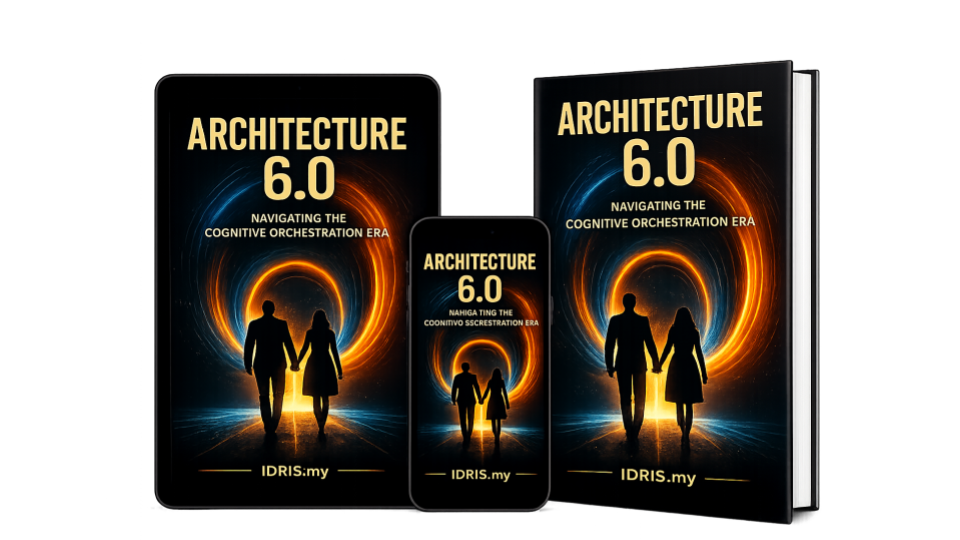
|
Getting your Trinity Audio player ready…
|
Architecture did not begin in 1900.
Long before factories, steel frames, electricity, or digital systems, humanity had already been designing shelters, settlements, monuments, sacred spaces, and entire civilisations. From the pyramids of Egypt to the temples of Asia, from Roman engineering to vernacular settlements across the Malay world, architecture has always been inseparable from human existence.
It would therefore be tempting to trace architecture as a continuous numbered progression beginning from ancient civilisation.
Yet this book adopts a different lens.
This is not because pre-industrial architecture was less important, nor because earlier civilisations lacked sophistication. On the contrary, many pre-modern societies produced extraordinary architectural intelligence, often deeply rooted in climate, culture, craftsmanship, and spiritual meaning.
The question, then, is not whether architecture existed before 1900.
Of course it did.
The more important question is this:
When did architecture begin evolving under a distinctly modern condition of accelerated technological, economic, and professional transformation?
This book proposes that a meaningful threshold emerged around the turn of the twentieth century.
By then, the effects of the Industrial Revolution had begun reshaping the foundations of civilisation itself. Mechanisation accelerated production. Electricity transformed industry and urban life. Mass manufacturing altered economies. Transportation compressed geography. Photography, cinema, broadcasting, and modern media began reshaping collective memory. Architecture increasingly moved beyond craft traditions into professional practice, industrial systems, and organised business models.
This threshold matters because Architecture 6.0 did not emerge in isolation.
It emerged from a long chain of transformations.
To understand the present, we must understand the threshold.
Yet there is another challenge.
Most readers encounter this framework not through Architecture 1.0, but through a single question:
What is Architecture 6.0?
That question is understandable.
Architecture 6.0 is the present threshold.
It is the moment we inhabit now.
And perhaps that is where this journey should begin.
Before travelling backward through the historical movements that shaped modern architecture, we must first confront the present reality that gives this framework its urgency.
Only then can we ask the deeper question.
How did we get here?

INSERT#1

ARCHITECTURE 6.0: From Architecture 1.0 to Architecture 5.0 AND Beyond
INSERT#0 The White Paper Prelude Before Versioning Before there was Architecture 1.0, there was simply… architecture. Not software versions. Not frameworks. Not timelines. Not labels. Just human beings trying to survive, belong, and dwell meaningfully within the world. Long before architects carried licenses, professional indemnity insurance, consultancy agreements, and corporate letterheads, people were already designing…
The Great Compression
Architectural history rarely moves in equal intervals.
Some paradigms dominate for generations. Others emerge, peak, and transform within decades. The evolution of architecture is therefore not a neat linear sequence, but a dynamic pattern shaped by technological, economic, cultural, and civilisational forces.
Architecture 1.0 unfolded across roughly half a century.
Architecture 2.0 occupied nearly three decades.
Architecture 3.0 compressed further into roughly twenty years.
Architecture 4.0 accelerated again.
Architecture 5.0, remarkably, emerged and evolved within only a few years.
The intervals began shrinking.
What once required generations increasingly unfolded within decades.
Then within years.
This compression matters.
Because architecture is no longer evolving only through materials, construction methods, or stylistic movements. Increasingly, architectural transformation is shaped by accelerating shifts in information systems, digital infrastructure, global connectivity, and machine intelligence.
The speed of change is itself becoming a defining force.
This is what makes the present threshold unusual.
Architecture 6.0 did not emerge merely because new tools appeared.
Architects have always adapted to new tools.
Drawing boards gave way to CAD. CAD evolved into BIM. Parametric workflows expanded computational design. Intelligent systems began augmenting design processes.
Yet none of these shifts alone fully explain the present moment.
Architecture 6.0 represents something deeper.
For perhaps the first time in modern architectural history, the central transformation is no longer limited to production, representation, or computation.
It reaches into cognition itself.
The fundamental question is no longer simply:
“How do architects design?”
The deeper question becomes:
“How do architects think, judge, orchestrate, and remain human while working alongside increasingly intelligent systems?”
This is why Architecture 6.0 marks a distinct threshold.
Not because machines replaced architects.
But because artificial intelligence has begun reshaping the cognitive environment within which architectural judgment operates.
This shift changes the nature of practice.
It changes design workflows.
It changes education.
It changes authorship.
It may even change how architects understand creativity itself.
And yet, the story does not begin here.
To understand why Architecture 6.0 matters, we must first understand the movements that made its emergence possible.
We begin at the present.
Then we travel backward.
Only by tracing the compressed layers beneath us can we fully understand the threshold we now inhabit.
MOVEMENT I
Architecture 6.0 —
The Age of Cognitive Orchestration
Architecture 6.0 marks the present threshold of architectural evolution.
It describes an emerging paradigm in which architectural practice is increasingly shaped by artificial intelligence, intelligent systems, and machine-augmented cognition, while human judgment, ethical discernment, and reflective orchestration become more critical than ever.
Architecture 6.0 is not simply about automation.
It is not merely about faster rendering, smarter software, generative design, or more efficient workflows.
Those developments matter.
But they do not fully explain the shift.
The deeper transformation lies elsewhere.
For the first time in modern architectural history, architects are no longer interacting only with tools that extend physical capability or computational efficiency.
They are increasingly working alongside systems that participate in cognitive processes themselves.
Systems that can analyse.
Generate.
Suggest.
Simulate.
Predict.
Even converse.
This changes the nature of architectural work.
The architect is no longer merely a designer using tools.
Increasingly, the architect becomes an orchestrator of intelligence.
This distinction matters.
In Architecture 5.0, intelligent systems primarily supported collaboration between humans and increasingly connected digital ecosystems.
Architecture 6.0 goes further.
Intelligence itself becomes conversational.
Interactive.
Responsive.
Adaptive.
The workflow becomes less linear and more cognitive.
Design increasingly resembles dialogue.
Prompt.
Response.
Evaluation.
Reflection.
Iteration.
Yet this creates a profound misconception.
Many assume Architecture 6.0 means artificial intelligence becomes central.
This book argues the opposite.
Architecture 6.0 is not fundamentally about AI becoming more important.
It is about human judgment becoming more important.
As intelligent systems become more capable, the responsibility of discernment shifts upward toward humans.
When machines can generate thousands of possibilities, selection becomes more important than production.
When systems can optimise for performance, judgment becomes more important than computation.
When artificial intelligence can simulate intelligence, wisdom becomes more important than intelligence.
This is the threshold.
The central challenge of Architecture 6.0 is therefore no longer technological alone.
It becomes philosophical.
Ethical.
Civilisational.
Human.
The architect must now navigate multiple forms of intelligence simultaneously:
human intelligence,
collective intelligence,
artificial intelligence,
and increasingly, orchestrated intelligence.
This is where cognitive orchestration emerges.
Architecture 6.0 is therefore best understood not as the age of AI-driven architecture, but as the age of reflective human-AI orchestration.
This threshold accelerated dramatically after 2020.
The COVID-19 pandemic forced global society into an unexpected period of disruption, isolation, and digital dependency. Remote collaboration became normal. Cloud workflows matured. Digital ecosystems expanded. Simultaneously, generative AI accelerated from experimental novelty into mainstream reality.
What appeared to be disruption may also have been incubation.
A global cognitive compression.
An accelerated preparation for a new threshold.
Architecture 6.0 emerged within this environment.
And yet, this threshold did not appear overnight.
It stands upon decades of compressed transformations.
To understand Architecture 6.0 fully, we must now excavate the layers beneath it.
We begin by stepping backward.
Into Architecture 5.0.
MOVEMENT II
Architecture 5.0 —
The Age of Intelligent Collaboration
Before Architecture 6.0 emerged as a distinct threshold, architecture had already entered another important transition.
This was the era of Architecture 5.0.
If Architecture 4.0 represented the expansion of computational systems, networked workflows, and increasingly data-driven design processes, Architecture 5.0 marked a philosophical shift.
The question was no longer simply about computation.
It became increasingly about collaboration.
Not only collaboration between architects, engineers, consultants, and stakeholders.
But collaboration between humans and intelligent systems.
This distinction matters.
Architecture 5.0 did not yet represent full cognitive orchestration.
Rather, it marked the emergence of intelligent collaboration.
Architecture remained fundamentally human-led, but increasingly supported by smart digital ecosystems capable of assisting coordination, simulation, optimization, and decision support.
This movement roughly emerged during the period between 2015 and 2020.
By this stage, cloud computing had matured. BIM workflows had become increasingly mainstream. IoT ecosystems expanded. Smart buildings became more feasible. Digital twins began entering professional discourse. Data analytics increasingly informed design and operations.
Architecture was becoming more connected.
More integrated.
More responsive.
Yet one of the most important philosophical influences during this era came not from architecture itself, but from Japan.
While much of the world remained focused on Industry 4.0 and automation-driven narratives, Japan introduced a different vision.
Society 5.0.
This concept proposed something profound.
Technological progress should not be measured merely by industrial efficiency.
Its true purpose should be human flourishing.
Society 5.0 imagined a future where cyberspace and physical space become deeply integrated, not to replace humanity, but to better serve human life.
This human-centred philosophy gave Architecture 5.0 its deeper intellectual foundation.
For perhaps the first time, discussions around smart cities, digital infrastructure, and intelligent environments began shifting from purely technical questions toward human questions.
Not merely:
“How smart can buildings become?”
But:
“How can intelligence improve human life?”
This was a meaningful shift.
The architect was no longer working only with drawings, models, and isolated software platforms.
Increasingly, architectural practice became embedded within interconnected ecosystems of data, systems, and services.
Buildings began behaving less like static objects and more like responsive systems.
Design became increasingly interdisciplinary.
Architecture now had to converse with:
data science,
automation,
sensors,
urban informatics,
machine learning,
and systems engineering.
Yet despite these advances, Architecture 5.0 still retained one important characteristic.
Intelligence remained largely supportive.
Systems assisted.
Humans decided.
Algorithms optimized.
Humans judged.
Platforms connected.
Humans orchestrated collaboration.
This distinction separates Architecture 5.0 from Architecture 6.0.
In Architecture 5.0, intelligent systems enhanced collaboration.
In Architecture 6.0, intelligence itself became conversational.
That subtle transition changed everything.
Architecture 5.0 therefore stands as the immediate precursor to the present threshold.
It was the bridge.
The final preparation.
The last movement before architecture entered the age of cognitive orchestration.
To understand how architecture became increasingly intelligent, however, we must step further backward.
Before collaboration came computation.
Before intelligence came digital systems.
We now descend into Architecture 4.0.
MOVEMENT III
Architecture 4.0 —
The Age of Computational Expansion
Before architecture entered the era of intelligent collaboration, it first underwent another major transformation.
This was the age of Architecture 4.0.
If Architecture 3.0 marked the digitisation of architectural drafting, Architecture 4.0 marked the expansion of architecture into computation, networks, and increasingly interconnected digital ecosystems.
This movement emerged roughly between 2000 and 2015.
The transition was significant.
Architecture was no longer simply moving from paper to screen.
It was moving from digital representation toward computational intelligence.
This distinction matters.
In Architecture 3.0, computers primarily helped architects draw faster and document more efficiently.
In Architecture 4.0, computers began participating in design logic itself.
Geometry became parametric.
Information became embedded.
Relationships became programmable.
Design became increasingly system-based.
The architect was no longer working only with lines, shapes, and visual compositions.
Increasingly, the architect worked with variables, constraints, parameters, simulations, and interconnected datasets.
This transformation was driven by several converging developments.
Building Information Modelling, or BIM, began reshaping professional workflows by embedding intelligence directly into digital models. A wall was no longer merely a drawn object. It became an information-rich component containing material data, dimensions, performance attributes, and relational dependencies.
Parametric design expanded computational possibilities even further.
Tools such as Grasshopper, scripting environments, and algorithmic workflows enabled architects to define relationships rather than static forms.
Instead of drawing every variation manually, architects could establish rules and allow systems to generate multiple design possibilities.
The shift was subtle but profound.
Design increasingly became less about isolated objects and more about orchestrated systems.
At the same time, internet infrastructure, cloud storage, mobile connectivity, and global digital collaboration accelerated rapidly.
Architecture became increasingly networked.
Geography became less restrictive.
Teams could coordinate across cities, countries, and continents with unprecedented speed.
This period also witnessed the rise of simulation-driven design.
Architects increasingly used digital tools to evaluate:
environmental performance,
energy efficiency,
structural behaviour,
daylighting,
thermal comfort,
and lifecycle performance.
Architecture was becoming more analytical.
More data-aware.
More computationally responsive.
Yet despite these advances, Architecture 4.0 remained fundamentally computational rather than intelligent.
Systems processed.
Algorithms calculated.
Simulations evaluated.
But systems did not yet converse.
This distinction separates Architecture 4.0 from Architecture 5.0.
In Architecture 4.0, systems expanded computational capability.
In Architecture 5.0, systems began supporting intelligent collaboration.
This movement therefore served as a critical bridge.
Without computational expansion, intelligent collaboration would not have been possible.
Before architecture became computational, however, it first needed to become digital.
To understand that transition, we must step further backward.
Into Architecture 3.0.
MOVEMENT IV
Architecture 3.0 —
The Age of Digital Drafting
Before architecture became computational, intelligent, and increasingly cognitive, it first underwent a quieter but revolutionary transformation.
This was the era of Architecture 3.0.
If Architecture 2.0 represented the expansion of human, cultural, and contextual architectural expression, Architecture 3.0 marked the digitisation of architectural production itself.
This movement emerged roughly between 1980 and 2000.
At first glance, the transition seemed straightforward.
Architects moved from drawing boards to computer screens.
From tracing paper to digital files.
From ink pens to pixels.
Yet the transformation ran deeper than a simple change of medium.
Architecture 3.0 fundamentally altered how architectural information was produced, stored, revised, reproduced, and communicated.
For generations, architectural production had been largely manual.
Design drawings were created by hand.
Revisions were laborious.
Documentation required physical drafting discipline, precision, and patience. Every amendment often meant redrawing significant portions of a project.
Errors were costly.
Iteration was slow.
Then computers entered the studio.
Computer-Aided Design, or CAD, introduced a radically different workflow.
Drawings became editable.
Revisions became faster.
Copying became effortless.
Layer management improved coordination.
Storage shifted from physical archives toward digital files.
The architect now worked within an environment where information could be duplicated, revised, transmitted, and reproduced with unprecedented speed.
This was revolutionary.
For the first time, architectural production became natively digital.
This changed not only efficiency, but mindset.
Architects began thinking differently about workflow.
Speed increased.
Iteration accelerated.
Precision improved.
Documentation scaled.
Architectural studios increasingly adopted desktop computers, plotters, digital printers, and software-driven workflows. New technical skills became essential. Young architects entering practice often adapted quickly, while older generations sometimes experienced understandable resistance.
The transition was not merely technological.
It was generational.
Architecture 3.0 therefore became a cultural threshold as much as a digital one.
A new language entered the profession.
Layers.
Blocks.
Files.
Commands.
Shortcuts.
Coordinates.
Digital literacy gradually became part of architectural literacy.
Yet despite these advances, Architecture 3.0 remained largely representational.
Computers helped architects draw.
But computers did not yet meaningfully participate in design logic.
CAD digitised drafting.
It did not computationalise design.
This distinction separates Architecture 3.0 from Architecture 4.0.
In Architecture 3.0, computers transformed representation.
In Architecture 4.0, computation began transforming relationships, systems, and design logic.
Architecture 3.0 was therefore the digital foundation upon which all later transformations would stand.
Before architecture became digital, however, another force had already reshaped the discipline.
To understand that deeper shift, we must step further backward.
Into Architecture 2.0.
MOVEMENT V
Architecture 2.0 —
The Age of Human and Cultural Reaction
Before architecture became digital, computational, collaborative, and cognitive, it first underwent a profound human reaction.
This was the era of Architecture 2.0.
If Architecture 1.0 was shaped by industrial modernism, mechanisation, and the rise of functional efficiency, Architecture 2.0 emerged partly as a response to the limitations of that worldview.
This movement unfolded roughly between 1950 and 1980.
The world had changed dramatically.
The Second World War had ended.
Nations rebuilt.
Cities expanded.
Populations urbanised rapidly.
Economic growth accelerated across many parts of the world.
Mass production matured.
Consumer culture expanded.
Television entered homes.
Global media began shaping collective aspirations.
Architecture could no longer be understood purely through industrial logic.
Human life itself was changing.
Modernism had delivered efficiency, rationality, and functional clarity.
But over time, many began questioning whether efficiency alone was enough.
A growing tension emerged.
Buildings could be functional.
But were they meaningful?
Cities could be efficient.
But were they humane?
Architecture 2.0 emerged within this tension.
This movement represented a widening reaction against overly rigid, universal, and mechanistic approaches to design.
Architects increasingly sought to recover dimensions that industrial modernism had sometimes neglected.
Identity.
Culture.
Place.
Memory.
Human experience.
The discipline began expanding beyond pure function toward lifestyle, symbolism, and contextual meaning.
Suburban development reshaped domestic life.
Shopping complexes transformed urban consumption.
Commercial architecture became increasingly tied to branding and aspiration.
Housing typologies evolved alongside changing family structures and social mobility.
Architecture increasingly became part of everyday lifestyle.
This era also witnessed growing diversity in architectural language.
International modernism remained influential, yet countercurrents emerged.
Regionalism gained importance.
Critical regionalism later strengthened.
Postmodern thought challenged universal design narratives.
Historical references reappeared.
Symbolism returned.
Complexity re-entered discourse.
Architecture became more plural.
This plurality reflected a deeper civilisational shift.
Human beings were not merely workers inside industrial systems.
They were cultural beings.
Emotional beings.
Social beings.
Meaning-seeking beings.
Architecture 2.0 therefore marked a crucial correction.
It reminded the profession that buildings are not only technical solutions.
They are lived environments.
This distinction separates Architecture 2.0 from Architecture 1.0.
In Architecture 1.0, architecture aligned strongly with industrial production and functional modernism.
In Architecture 2.0, architecture reintroduced human, cultural, and experiential complexity.
This movement laid the emotional and philosophical groundwork for later transformations.
Before architecture reacted against industrial modernism, however, we must return to the foundation itself.
To understand the beginning of modern architectural evolution, we must step further backward.
Into Architecture 1.0.
MOVEMENT VI
Architecture 1.0 —
The Age of Industrial Modernism
We have now reached the deepest historical layer of this framework.
This is Architecture 1.0.
The foundation upon which all later architectural transformations would emerge.
Architecture, of course, did not begin in 1900.
Long before industrialisation, human civilisation had already produced extraordinary architectural achievements. Ancient temples, pyramids, cathedrals, palaces, vernacular settlements, and sacred structures across cultures demonstrated immense intelligence in construction, climate adaptation, craftsmanship, and symbolic meaning.
Yet this framework intentionally begins here.
Why?
Because Architecture 1.0 does not describe the birth of architecture itself.
It describes the beginning of modern architectural acceleration.
This distinction matters.
Architecture 1.0 emerged roughly between 1900 and 1950, during a period when industrial modernity fundamentally reshaped civilisation.
The late Industrial Revolution had already transformed the global economy.
Mechanisation accelerated production.
Steel changed structural possibilities.
Reinforced concrete expanded architectural expression.
Electricity transformed urban life.
Railways compressed geography.
Mass manufacturing altered labour and commerce.
Industrial capitalism reorganised society itself.
Architecture could no longer remain untouched.
This was the age in which architecture became increasingly professionalised, systematised, and industrially scalable.
Design and construction were no longer governed solely by craft traditions, local builders, or inherited construction practices.
A new professional identity emerged.
The modern architect.
This transformation changed everything.
Architecture increasingly aligned with industrial production, engineering logic, standardisation, and functional efficiency.
Buildings could now rise higher.
Span wider.
Scale faster.
Cities expanded vertically and horizontally.
Urbanisation accelerated.
Infrastructure multiplied.
The modern city emerged with unprecedented intensity.
This era also witnessed powerful architectural movements that shaped the foundations of twentieth-century design.
Modernism gained momentum.
Functionalism strengthened.
The Bauhaus helped redefine relationships between art, craft, industry, and design.
New materials encouraged new aesthetics.
Ornament increasingly gave way to abstraction.
Efficiency became a design virtue.
Rationality became an architectural language.
The famous modernist principle that form follows function captured the spirit of the age.
Architecture increasingly embraced clarity, utility, and industrial logic.
This shift produced remarkable achievements.
Architecture became more scalable.
More systematic.
More efficient.
More structurally ambitious.
Yet every foundation carries tension.
The strengths of Architecture 1.0 also planted the seeds of future reaction.
As industrial modernism matured, architecture risked becoming overly mechanistic.
Standardisation improved efficiency but sometimes weakened cultural specificity.
Functional logic improved performance but sometimes neglected emotional meaning.
Industrial rationality delivered progress, but not always humanity.
These tensions would eventually provoke the next major transformation.
Architecture would begin questioning whether efficiency alone was enough.
That question gave birth to Architecture 2.0.
Architecture 1.0 therefore stands as the great industrial foundation of modern architectural evolution.
It marks the beginning of a century-long acceleration that would ultimately lead to digital systems, intelligent collaboration, cognitive orchestration, and perhaps thresholds not yet fully imaginable.
This was the first great movement.
The industrial threshold.
The foundation of modern architecture.
And from this foundation, every later movement emerged.
Yet the story does not end here.
Having excavated the six historical layers that shaped the present, we now face the final question.
What comes after Architecture 6.0?
MOVEMENT VII
Beyond Architecture 6.0 —
Architecture 7.0, Architecture 0.0, and The Return to Life
Having traversed the six movements that shaped modern architectural evolution, we now arrive at the final and perhaps most difficult question.
What comes after Architecture 6.0?
At first glance, the answer appears obvious.
Architecture 7.0.
This feels natural.
After all, modern civilisation has become deeply conditioned by version logic. Software evolves from one release to another. Systems upgrade. Platforms iterate. Intelligence scales. New versions imply progress.
By such logic, Architecture 7.0 appears inevitable.
The sequence seems almost too easy.
Architecture 1.0.
Architecture 2.0.
Architecture 3.0.
Architecture 4.0.
Architecture 5.0.
Architecture 6.0.
Naturally…
Architecture 7.0.
Yet the future may not be that simple.
And perhaps that assumption deserves deeper scrutiny.
Must architectural evolution always move through linear numerical progression?
Must progress always mean a higher version number?
Must more intelligence automatically imply a better civilisation?
These questions matter.
Because the threshold beyond Architecture 6.0 may force humanity to confront realities far deeper than technological acceleration alone.
Architecture 7.0, if it emerges, may represent a future where intelligence expands beyond current human-machine collaboration into forms that today remain largely speculative.
This may include artificial general intelligence.
Autonomous design agents.
Embodied robotics.
Self-optimising urban infrastructure.
Adaptive buildings capable of continuous machine-driven decision-making.
Cognitive systems that not only assist architects but increasingly act with high levels of independent agency.
Such a threshold cannot be dismissed.
Given the pace of contemporary acceleration, Architecture 7.0 may indeed emerge within years, decades, or perhaps sooner than many expect.
Only God truly knows.
Yet there exists another possibility.
A far less obvious one.
A more uncomfortable one.
And perhaps, a more important one.
What if the future does not only move forward?
What if, at the height of intelligence, humanity is forced to return to origins?
What if the next great architectural threshold is not merely Architecture 7.0…
but Architecture 0.0?

This idea may initially sound paradoxical.
Why return to zero?
Does zero imply collapse?
Regression?
Primitive living?
Technological rejection?
No.
Architecture 0.0 means none of these.
Architecture 0.0 is not anti-technology.
It is not nostalgia disguised as philosophy.
It does not romanticise a return to caves, huts, or pre-industrial existence.
Architecture 0.0 means something far deeper.
It represents a return to first principles.
A return to foundational questions that existed long before software, long before algorithms, and long before modern civilisation began numbering its own progress.
Questions such as:
Why do humans build?
What transforms shelter into home?
What transforms space into belonging?
What transforms buildings into places of meaning?
What makes life worth designing for?
These are not technological questions.
They are human questions.
Civilisational questions.
Existential questions.
And increasingly, spiritual questions.
Paradoxically, the more intelligent our systems become, the more urgently these questions return.
This is one of the deepest paradoxes of the age of AI.
The more artificial intelligence expands, the more humanity must rediscover authentic humanity.
The more machines simulate intelligence, the more wisdom becomes irreplaceable.
The more automation accelerates production, the more discernment becomes essential.
The more systems optimise efficiency, the more meaning risks being neglected.
This is why the future beyond Architecture 6.0 may not be adequately understood through technological forecasting alone.
The true challenge may not be building smarter cities.
It may be preserving wiser civilisation.
This distinction is critical.
Civilisations have historically collapsed not merely because they lacked intelligence, but because they lost judgment.
Not because they lacked systems, but because they lost moral orientation.
Not because they lacked power, but because they lost meaning.
Architecture cannot remain isolated from this reality.
Buildings do not exist outside civilisation.
Cities do not exist outside values.
Design does not exist outside human intention.
This is where Architecture 7.0 and Architecture 0.0 begin revealing a deeper relationship.
At first, they appear opposite.
Architecture 7.0 appears to move toward maximum intelligence.
Architecture 0.0 appears to move toward fundamental essence.
One seems forward.
One seems backward.
But this may be an illusion.
They may not be opposing destinations.
They may converge.
The future may demand both simultaneously.
Maximum intelligence.
Fundamental humanity.
Advanced systems.
Primordial wisdom.
Technological sophistication.
Civilisational humility.
This convergence changes everything.
It suggests that the ultimate future of architecture may not be defined by version numbers at all.
Perhaps the future is not ultimately about 7.0.
Perhaps it is not even about 0.0.
Perhaps both are merely thresholds.
Gateways.
Transitional language.
Markers pointing toward something beyond numerical evolution.
Something deeper.
Something more human.
Something more fundamental.
At this threshold, architecture begins transforming again.
Architecture is no longer merely about buildings.
Nor only about cities.
Nor only about systems, algorithms, automation, or intelligence.
Architecture returns to its oldest purpose.
The shaping of environments that sustain life.
Not merely survival.
Life.
Meaningful life.
Dignified life.
Relational life.
Reflective life.
Human life.
This is where architecture begins returning to life itself.
And perhaps this is the deeper paradox hidden within the entire journey from Architecture 1.0 to Architecture 6.0.
After all the acceleration…
After all the complexity…
After all the intelligence…
Humanity may ultimately rediscover truths it once knew.
That not everything valuable can be optimised.
That not everything meaningful can be automated.
That not everything sacred can be simulated.
There remains something irreducibly human.
And perhaps something beyond human.
At the deepest threshold, architecture becomes inseparable from the question of existence itself.
What is life?
What is consciousness?
What is meaning?
What is responsibility?
Why are we here?
And eventually, every civilisation that thinks deeply enough encounters a question even larger than itself.
The question of origin.
Creation points toward Creator.
Design points toward Designer.
Order points toward Origin.
In that sense, the ultimate threshold of architecture may not be technological at all.
It may be spiritual.
The future of architecture may therefore lead humanity beyond software logic, beyond industrial logic, and beyond intelligence itself.
Toward humility.
Toward meaning.
Toward responsibility.
Toward remembrance.
Toward God.
This is where Architecture 7.0 and Architecture 0.0 finally converge.
Not in contradiction.
But in transcendence.
And perhaps beyond both lies the next great journey.
Not merely the future of architecture.
But the architecture of life itself.
From Architecture 6.0 to The Architecture of Life
Architecture 6.0 began as a framework.
At one level, it was an attempt to map the evolving thresholds of modern architectural history, from industrial modernism to cognitive orchestration.
It offered language.
Structure.
Movement.
A way to understand how architecture evolved across accelerating technological eras.
Yet somewhere along this journey, something deeper emerged.
This was never merely a story about architecture.
Nor only a story about technology.
Nor even only a story about artificial intelligence.
It gradually revealed itself as a story about humanity.
Architecture 6.0 may begin with intelligent systems, but it ultimately confronts human questions.
Questions of judgment.
Questions of responsibility.
Questions of wisdom.
Questions of meaning.
Because the deeper humanity moves into the age of intelligent systems, the clearer one truth becomes.
Technology can amplify capability.
But it cannot define purpose.
Artificial intelligence can expand cognition.
But it cannot determine meaning.
Systems can optimise performance.
But they cannot decide what is worth living for.
This distinction may become one of the defining civilisational questions of our age.
For generations, modern civilisation has been shaped by the language of progress.
More speed.
More efficiency.
More power.
More intelligence.
More scale.
More optimisation.
Yet human experience repeatedly reminds us that more is not always better.
Acceleration is not identical to wisdom.
Complexity is not identical to understanding.
Intelligence is not identical to consciousness.
Progress is not identical to meaning.
This is why Architecture 6.0 cannot be the final destination.
Even Architecture 7.0, if it emerges, may not represent the ultimate answer.
At some point, civilisation may discover that endless versioning cannot resolve fundamentally human questions.
Version numbers eventually reach their limits.
Because life itself is not software.
Human existence does not ultimately operate through perpetual upgrades.
At the deepest level, every civilisation eventually returns to first principles.
To origins.
To meaning.
To life.
This is where Architecture 0.0 becomes important.
Architecture 0.0 is not a regression.
It is a return.
A return to foundational questions that existed before industrialisation, before digital systems, and before artificial intelligence.
Why do humans build?
Why do humans seek shelter?
Why do humans create homes, communities, cities, and civilisations?
Why do humans search for belonging?
Why do humans long for beauty?
Why do humans seek meaning?
These questions move beyond architecture.
They lead toward life itself.
And thus the journey continues.
From Architecture 6.0…
to Architecture 0.0…
toward The Architecture of Life.
The Architecture of Life is not merely about buildings.
It is about how humans design existence itself.
How we structure relationships.
How we shape communities.
How we cultivate knowledge.
How we exercise responsibility.
How we live meaningfully within creation.
At this threshold, architecture becomes inseparable from life.
And life becomes inseparable from deeper questions of existence.
Eventually, every sufficiently reflective civilisation encounters the same profound reality.
Creation points toward Creator.
Order points toward Origin.
Design points toward Designer.
The more deeply we understand systems, the more astonishing existence itself becomes.
The more intelligence we build, the more humbling consciousness becomes.
The more we attempt to understand life, the more we encounter mystery.
And perhaps this is the deepest lesson of all.
The future of architecture may not depend solely on smarter buildings, faster systems, or more powerful artificial intelligence.
Its future may depend on whether humanity remains human.
Whether wisdom can guide intelligence.
Whether humility can guide power.
Whether responsibility can guide innovation.
Whether remembrance can guide civilisation.
In the end, architecture may have always been pointing toward something greater than itself.
Not merely shelter.
Not merely structure.
Not merely cities.
But meaning.
Responsibility.
Belonging.
Humanity.
And ultimately, God.
Perhaps that is the final paradox.
The farther humanity travels into the future, the more deeply it may rediscover ancient truths.
The higher civilisation climbs, the more urgently it may need humility.
The smarter systems become, the more essential conscience becomes.
The more powerful intelligence becomes, the more necessary wisdom becomes.
And perhaps the final destination of architecture is not technological transcendence.
But spiritual clarity.
For beyond architecture lies life.
And beyond life lies the One who gave life.
The Ultimate Creator.
The Ultimate Architect.
God.
And perhaps that is where every threshold finally leads.
Back to Him.

Leave a Reply