|
Getting your Trinity Audio player ready…
|
Prelude —
After Dinner, The Real Conversation Began
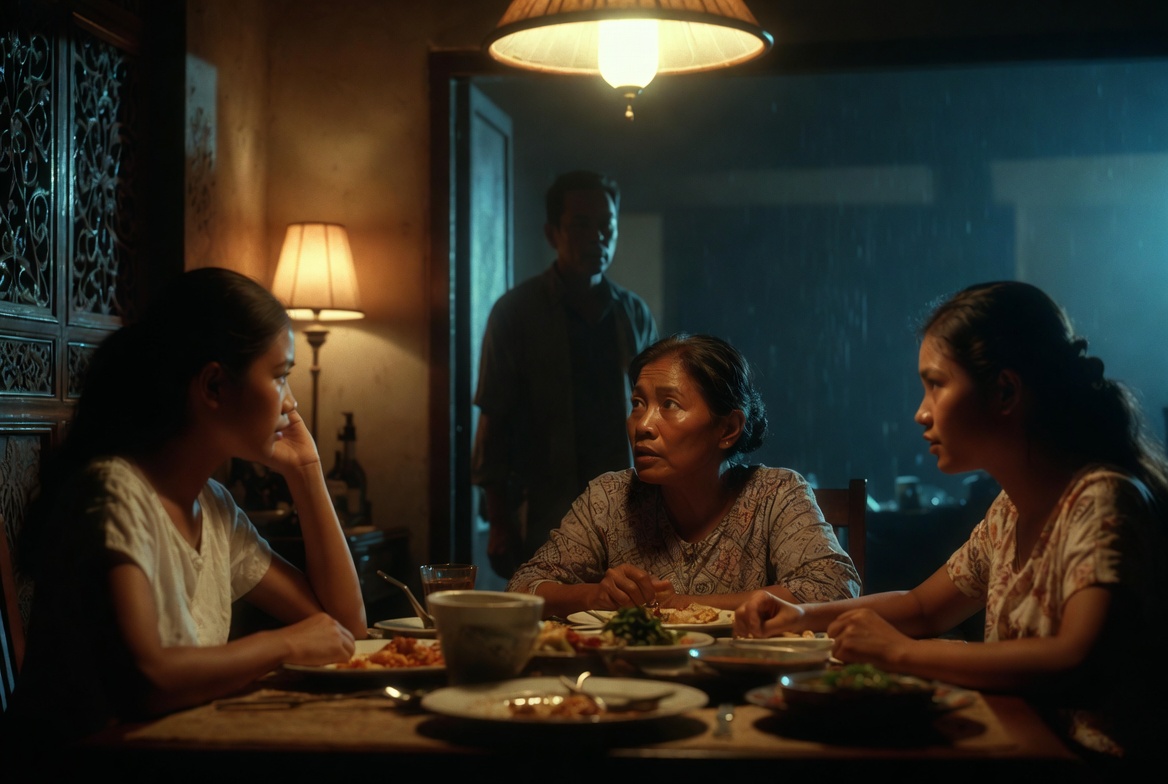
After Maghrib, after the noise of plates and glasses softened into the background of an ordinary Malaysian home, a mother sat with her daughters over dinner.
At first, the conversation sounded harmless.
Studies. Assignments. Future plans. Boyfriends. Marriage.
Normal family conversation.
But somewhere between casual teasing and parental concern, the atmosphere shifted. The mother became quieter. The daughters became defensive. And the father, later that night, found himself standing between two emotional worlds trying desperately to understand each other.
Perhaps this is one of the quietest crises of modern civilization.
Not war. Not politics. Not artificial intelligence.
But the emotional collision between traditional motherhood and modern daughterhood.
Because today, many mothers fear their daughters may reject marriage altogether. And many daughters fear marriage may erase them completely.
The mother worries: “Who will protect my daughter when I am gone?”
The daughter worries: “Who will protect me if marriage itself becomes the danger?”
That tension right there is no longer merely family discussion.
It is civilizational.
Codex I —
The Fear of Becoming a Machine
Modern daughters are tired.
Not merely physically. Existentially.
They look around and see women expected to become everything at once — educated, financially independent, emotionally available, professionally successful, attractive, nurturing, productive, spiritually grounded, socially graceful, endlessly resilient.
And somewhere deep inside, many quietly ask: “At what point do I stop being human?”
This is the fear many parents fail to hear.
When some daughters say “I don’t want marriage” or “I don’t want children” — sometimes what they truly mean is: “I am afraid of disappearing inside somebody else’s expectations.”
And honestly? That fear did not emerge from nowhere.
Many young women today grew up watching exhausted mothers, emotionally absent fathers, broken marriages, controlling husbands, unequal household burdens — women carrying entire families silently. So they become afraid. Not necessarily of love. But of becoming a machine.
A machine for emotional labour. A machine for childbirth. A machine for caregiving. A machine for endless sacrifice while slowly losing herself.
Modern civilization speaks endlessly about empowering women. Yet strangely, many women today feel more emotionally exhausted than ever.
Perhaps because modern society did not truly free women. It simply gave them two full-time jobs — one outside the home, and another inside it.
Codex II —
Translation Failure Between Mothers and Daughters
The tragedy is that both sides are usually speaking from love. But they no longer speak the same emotional language.
The mother belongs to a generation shaped by survival, sacrifice, stability, and continuity. To her, marriage represents companionship, dignity, family continuity, and emotional security. So when her daughter casually says “I don’t want marriage” — the mother hears: “My daughter is rejecting the future itself.”
But the daughter belongs to a different world entirely. A world shaped by burnout, emotional instability, algorithmic comparison, economic uncertainty, psychological exhaustion, and modern relationship trauma. To the daughter, delaying marriage may not mean rejecting love. It may simply mean: “Please give me space to become myself first.”
Two languages. Two survival systems. One dinner table.
Sometimes mothers pressure daughters not because they are controlling — but because they are terrified. Terrified their daughters may repeat the loneliness they once endured. Terrified their daughters may grow old without companionship.
And daughters resist not because they hate family — but because they fear emotional imprisonment.
Thus modern homes increasingly become places where love arrives sounding like pressure.
Codex III —
The Father Between Two Worlds
Perhaps the most difficult role belongs to the father.
Because he cannot simply choose a side. If he sides entirely with the mother, the daughters suffocate. If he sides entirely with the daughters, the mother feels abandoned.
Thus the father becomes an arch.
And architects understand something important about arches. An arch survives not because one side dominates the other. An arch survives because opposing forces remain balanced. Too much pressure left — collapse. Too much pressure right — collapse.
That is fatherhood too.
The father must absorb emotional weight without allowing the roof of the family to break. He must validate the mother’s sacrifice while also protecting the daughter’s expanding horizon.
This requires something many societies never teach men — masculine emotional intelligence. Not dominance. Not control. But the strength to remain calm inside emotional tension.
Sometimes the wisest fatherly response is not immediate authority. Sometimes it is quiet interpretation. Sometimes it is telling the mother: “Please don’t pressure them too much.” And later whispering gently to the daughters: “Please don’t wound your mother while trying to protect yourself.”
That kind of emotional balancing is invisible labour too.
Codex IV —
Motherhood, Fitrah & Sacred Responsibility
Modern civilization often struggles to speak honestly about motherhood. Either motherhood is romanticized unrealistically, or it is treated like an inconvenience.
But motherhood is neither slavery nor irrelevance. It is sacred responsibility.
Women carry what men physically cannot — life itself. Civilization survives through women. Entire nations exist because women endured pregnancy, childbirth, caregiving, emotional labour, and generational continuity.
Yet modern economic systems increasingly treat motherhood as productivity interruption. Because a civilization obsessed with economic extraction struggles to honour anything that cannot be measured purely by output.
Capitalism wants maximum productivity. But motherhood requires slowing down, nurturing, emotional presence, sacrifice, tenderness.
Thus modern women become trapped between economic survival and biological-spiritual responsibility.
But this codex must remain careful. To honour motherhood does not mean reducing women into reproductive function alone. Because womanhood is larger than motherhood itself. Some women never marry, cannot conceive, lose children, fear childbirth, or walk different life paths. Their dignity remains intact. Always.
The real question is not whether women should become mothers. But whether civilization can learn to honour women without exploiting them.
That is the deeper battle.
Codex V —
Marriage Must Not Become Possession
One of the greatest tragedies in many marriages is this — some men stop seeing wives as human beings and begin seeing them as property.
Possession culture still exists quietly inside many societies. Some husbands become overly controlling, emotionally manipulative, possessive, jealous, authoritarian, dismissive of women’s dignity.
And frighteningly — many warning signs appear long before marriage itself. During engagement, financial stress, jealousy moments, disagreement, emotional pressure.
This is why fathers must teach daughters: observe carefully. Not merely how a man loves you during romance. But how he behaves when things do not go his way.
Because charm is easy during romance. Character appears during tension.
Marriage must never become imprisonment. A wife is not domestic staff, emotional servant, or reproductive machine. A wife is an amanah (trust) from God. And men who forget this destroy not only women — but eventually themselves.
Codex VI —
The Algorithmic Battlefield
Modern daughters today are not raised only by parents anymore. They are also raised by algorithms.
TikTok. Instagram. Podcast culture. Relationship trauma narratives. Hyper-individualism. Every day, modern women absorb emotional frameworks from digital systems designed primarily for engagement and psychological stimulation.
At the same time, some traditional structures respond poorly. Instead of explanation, they offer fear. Instead of mercy, they offer authoritarianism. Instead of intellectual depth, they offer cultural rigidity disguised as religion.
Thus daughters become trapped between two shallow worlds. One side says: “Absolute freedom is happiness.” The other says: “Absolute obedience is righteousness.” Both can become dangerous when stripped from wisdom.
This is why the Quran must never become a weapon. It must become light — a vertical escape from shallow modernity and shallow traditionalism alike.
Because true Islamic understanding was never meant to suffocate thought. It was meant to guide humanity toward justice, mercy, dignity, balance, responsibility, and remembrance of God.
Codex VII —
Love Without Possession
Perhaps this is the final lesson.
Children are not projects. Daughters are not trophies. Marriage is not social competition. Motherhood is not slavery. Fatherhood is not dictatorship.
And love is not possession. Everything is amanah.
Parents must guide without suffocating. Daughters must speak without wounding. Mothers must worry with tenderness. Fathers must protect without controlling. And husbands must learn that strength without mercy eventually becomes fear.
Because civilization itself may survive through technology — but humanity survives only through rahmah.
Mercy.
Without mercy, homes collapse. Without mercy, families become systems. Without mercy, human beings slowly become machines.
Epilogue —
The Dinner Table of Civilization
Perhaps civilization is not decided inside parliaments. Nor universities. Nor algorithms.
Perhaps civilization is decided quietly — at dinner tables, between worried mothers and exhausted daughters, between silent fathers and changing generations, between fear and tenderness, between pressure and understanding, between possession and mercy.
And perhaps the future of humanity depends on whether families can still sit together.
And listen.
Author’s Note
This reflection may also be read as a companion continuation to the earlier +SANGfikir essay:
Mesin Kehidupan — Sangkar Emas dalam Jentera Peradaban
While the earlier reflection explored how modern civilization slowly transforms human beings into components within vast social and economic machinery, this essay turns toward a more intimate question:
What happens when women begin to fear becoming machines too?
Not merely machines of industry, but machines of expectation — expected to perform,
to endure,
to produce,
to nurture,
to sacrifice,
and to continue functioning endlessly within the accelerating rhythm of modern life.
Together, both reflections form part of an ongoing contemplation within the +SANGfikir ecosystem —about humanity, family, dignity, technology, modern pressure, and the search for mercy and balance beneath the long skies of Nusantara.
Leave a Reply