|
Getting your Trinity Audio player ready…
|
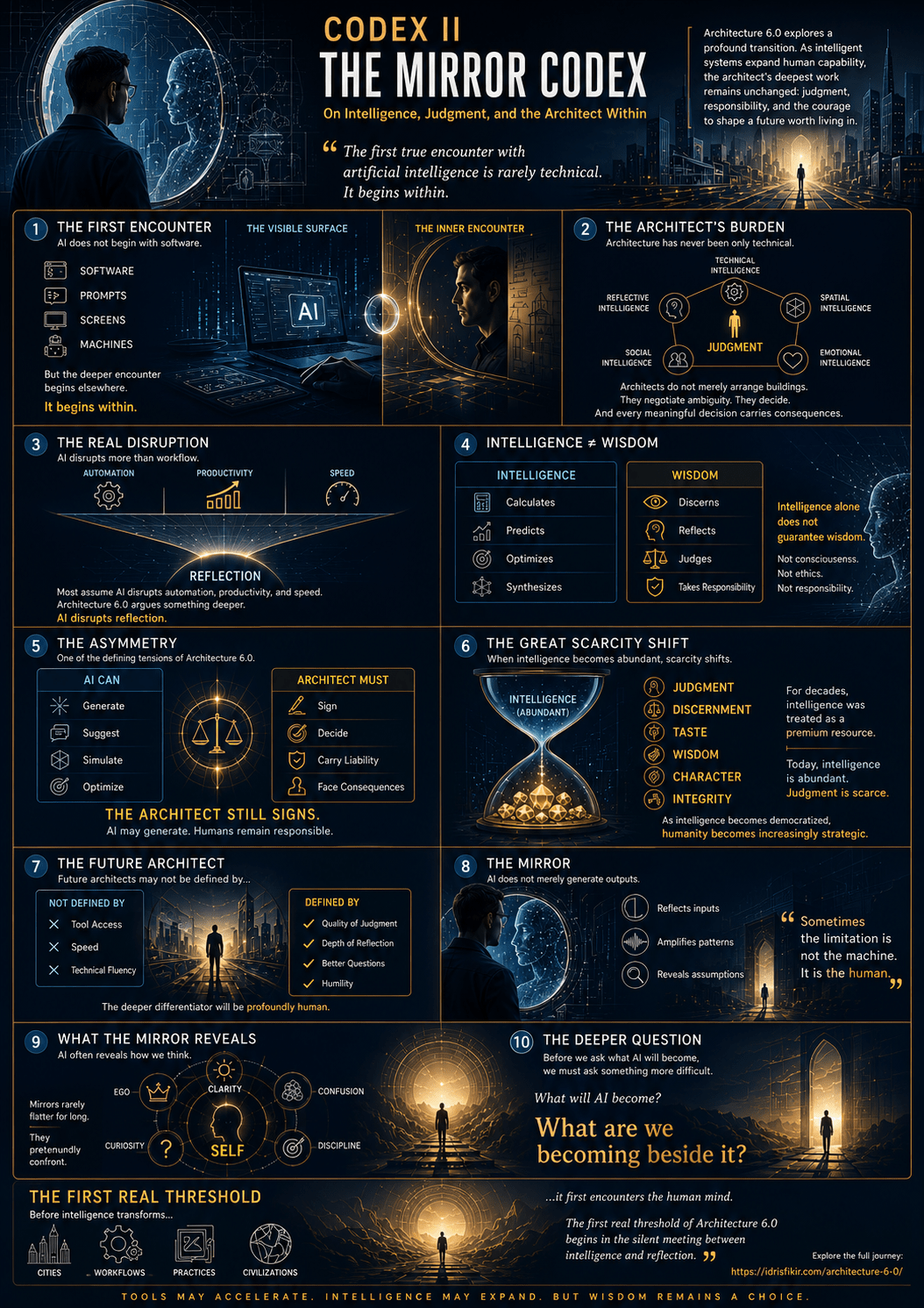
CODEX II
The Mirror Codex
On Intelligence, Judgment, and the Architect Within
The first true encounter with artificial intelligence is rarely technical.
Most people assume the encounter begins with software.
A tool.
A prompt.
A screen.
A machine generating text, images, models, diagrams, or solutions at astonishing speed.
But that is merely the visible surface.
The deeper encounter begins elsewhere.
It begins within.
Architecture has always demanded intelligence.
Not only technical intelligence, but spatial intelligence, emotional intelligence, social intelligence, and perhaps most importantly, judgment. Architects do not merely arrange walls, columns, roofs, and systems. They negotiate ambiguity. They interpret incomplete realities. They balance constraints that often resist simple optimization.
They decide.
And every meaningful decision carries consequences.
This is why the arrival of artificial intelligence creates a deeper disruption than many initially realize.
The disruption is not simply about automation.
Nor is it merely about productivity.
The true disruption lies in reflection.
For perhaps the first time in professional history, architects are now working beside systems capable of generating responses that resemble intelligence itself.
Not consciousness.
Not wisdom.
Not responsibility.
But intelligence, or at least something close enough to challenge long-held assumptions about human uniqueness.
That distinction matters.
Intelligence can calculate.
Intelligence can predict.
Intelligence can optimize.
Intelligence can synthesize vast bodies of information in seconds.
But intelligence alone does not guarantee wisdom.
It does not guarantee humility.
It does not guarantee moral discernment.
And it certainly does not guarantee responsibility.
The architect still signs.
The architect still carries liability.
The architect still lives with consequences.
This asymmetry introduces one of the defining tensions of Architecture 6.0.
Artificial intelligence may increasingly generate.
Yet human beings remain responsible for judgment.
That tension creates discomfort.
It also creates revelation.
Because when intelligence becomes abundant, something unexpected happens.
Scarcity shifts.
For decades, intelligence was treated as a premium resource.
Knowledge, expertise, memory, technical access, and analytical capability were powerful differentiators. The more one knew, the more valuable one became.
Today that equation is changing.
As artificial intelligence makes access to information increasingly abundant, intelligence itself becomes less scarce.
When that happens, other qualities become more valuable.
Judgment.
Discernment.
Taste.
Wisdom.
Character.
Integrity.
In other words, as intelligence becomes democratized, humanity becomes increasingly strategic.
That may sound paradoxical.
Yet it may become one of the defining truths of our era.
The future architect may not be distinguished primarily by access to tools.
Nor by computational speed.
Nor even by technical fluency alone.
The deeper differentiator may become something profoundly human.
The quality of judgment.
The discipline of reflection.
The capacity to remain calm within abundance.
The ability to ask better questions.
And perhaps most importantly, the humility to recognize what intelligence cannot resolve.
This is where the mirror appears.
Artificial intelligence does not merely generate outputs.
It reflects inputs.
It mirrors intent.
It amplifies patterns.
It reveals assumptions.
A careless architect often receives shallow outputs.
A thoughtful architect often receives richer responses.
The difference does not always lie in the machine.
Sometimes it lies in the human standing before it.
This is why AI increasingly behaves like a mirror.
Not a perfect mirror.
Not a neutral mirror.
But a revealing one.
It reflects not only what we ask.
It often reveals how we think.
Our clarity.
Our confusion.
Our discipline.
Our laziness.
Our curiosity.
Even our ego.
That can be uncomfortable.
Because mirrors rarely flatter for long.
Sooner or later, they confront.
And perhaps that is the deeper invitation of this codex.
Before we ask what artificial intelligence will become, we may need to ask a more difficult question.
What are we becoming while living beside it?
The chapters that follow explore this first inner chamber of Architecture 6.0.
Not the machine.
The architect.
Not software.
The self.
Because before intelligence transforms cities, workflows, practices, and civilizations, it first encounters something far more intimate.
The human mind.
And there, in that silent meeting between intelligence and reflection, the first real threshold of Architecture 6.0 begins.
Chapter 1
The Architect Between Two Worlds
There are moments in professional life when change feels gradual.
And then there are moments when change feels unmistakably civilisational.
Architecture today stands within such a threshold.
For generations, the architect occupied a relatively stable cognitive landscape. The tools evolved, certainly. Drawing boards gave way to CAD. CAD expanded into BIM. Visualization engines transformed representation. Computational workflows introduced new levels of precision and complexity. Each technological shift altered practice, but the deeper structure of authorship remained largely familiar. The architect still thought, decided, interpreted, and judged within a recognizably human workflow.
Something more profound is now happening.
Artificial intelligence has introduced a different category of transformation. This is not merely another software upgrade or productivity tool layered onto existing workflows. It is a cognitive event. For the first time, architects are increasingly working alongside systems capable of generating language, images, concepts, spatial ideas, and analytical insights that resemble intelligence itself. The profession is no longer simply adapting to better tools. It is adapting to a new relationship with intelligence.
This creates an unusual psychological condition.
The architect now stands between two worlds.
One world is familiar. It is shaped by memory, intuition, tacit knowledge, sketchbooks, precedent, critique, apprenticeship, and the slow formation of professional judgment. In this world, architectural thinking develops through time, struggle, and lived experience. Wisdom is earned gradually. Judgment carries weight because it emerges from accumulated practice.
The other world moves differently.
It is accelerated, conversational, data-rich, and increasingly generative. Ideas appear faster. Options multiply instantly. Representation becomes easier. Iteration becomes almost frictionless. Intelligence becomes increasingly abundant. The architect can now ask, compare, refine, simulate, and generate at speeds previous generations could scarcely imagine.
Between these two worlds lies tension.
But also opportunity.
The central challenge of Architecture 6.0 is not choosing one world over the other. It is learning how to inhabit both without losing coherence. The future architect cannot retreat into nostalgic resistance, nor surrender uncritically to technological acceleration. The deeper challenge is integration.
This threshold is where the journey begins.
Not at the level of buildings.
Not at the level of cities.
But within the architect.
For before intelligence transforms practice, it first transforms perception.
And before architecture changes outwardly, something shifts within the person who designs.
The first true threshold of Architecture 6.0, therefore, is not technological.
It is human.
The architect must first confront a difficult question.
Who am I becoming while standing between these two worlds?
![ARCH[@i]TECH — AI in the Life of an Architect](https://i0.wp.com/idrisfikir.com/wp-content/uploads/2026/05/ARCHITECTURE-6.0.png?resize=1200%2C900&ssl=1)
ARCH[@i]TECH — AI in the Life of an Architect
Towards Architecture 6.0 PROLOGUE The Architect Was Never Truly Alone Once upon a time, architects worked in silence. Not the silence of emptiness…but the silence of concentration. The kind of silence filled with: the scratching sound of pencils on tracing paper, the smell of ammonia from blueprint machines, coffee stains beside unfinished sketches, and cigarette…
Keep readingChapter 2
When Intelligence Became Conversational
For much of modern computing, intelligence felt distant.
Machines calculated.
They processed.
They stored.
They executed commands with extraordinary precision, yet interaction remained fundamentally mechanical. Human beings adapted themselves to machines through interfaces, menus, syntax, commands, and rigid procedural logic. Software was powerful, but rarely felt relational. It behaved like instrument, not companion.
Then something changed.
Intelligence began to speak.
At first, the shift seemed almost trivial. A chat window. A prompt box. A simple interface inviting language instead of code. Yet beneath that apparent simplicity lay a profound transformation. Interaction with machines no longer required technical syntax alone. Increasingly, natural language became interface. Conversation became operating system.
This altered more than usability.
It altered cognition.
When intelligence became conversational, human beings stopped interacting with machines merely as tools. They began engaging them through dialogue. Questions replaced commands. Context replaced isolated inputs. Iteration became conversation rather than repeated execution. The interaction became less transactional and more relational.
This distinction matters enormously for architects.
Architecture has always depended on dialogue. Before drawings emerge, conversations shape intent. Clients speak aspirations. Users express needs. Sites reveal constraints. Consultants negotiate systems. Critics challenge assumptions. Architectural thinking has always been conversational long before it becomes visual.
Conversational AI therefore feels strangely natural to architectural cognition.
Words now generate possibilities.
Language becomes spatial.
A prompt can produce visual concepts. A dialogue can reveal blind spots. An exchange can surface hidden assumptions. The architect begins to discover something unexpected: the quality of output depends not only on computational power, but on the quality of conversation itself.
This is where personalization becomes significant.
Not all conversations are equal.
As systems increasingly retain memory, context, preferences, habits, and intellectual patterns, interaction becomes less generic and more adaptive. Intelligence begins responding not merely to prompts, but to persons. It learns rhythm, tone, priorities, and working style. The interaction becomes more nuanced, more contextual, and in some cases, startlingly reflective.
This is both powerful and dangerous.
Powerful because personalization increases relevance.
Dangerous because familiarity can create illusion.
A system that speaks fluently may appear wise.
A system that mirrors us well may appear understanding.
But fluency is not wisdom.
Memory is not consciousness.
Responsiveness is not responsibility.
These distinctions must remain clear.
Still, something irreversible has happened.
Intelligence has become conversational.
And once conversation becomes the primary interface, architecture itself begins to change. Design is no longer mediated only by drawing, modelling, and representation. Increasingly, it is mediated through dialogue.
This is the quiet revolution of Architecture 6.0.
The architect is no longer merely drawing with tools.
The architect is learning to think through conversation.
And with that shift, a deeper question emerges.
When intelligence speaks back, what exactly is it reflecting?
Chapter 3
Intelligence Without Wisdom
One of the great confusions of the modern age lies in the tendency to treat intelligence and wisdom as interchangeable.
They are not.
Yet contemporary society increasingly rewards intelligence as though it were the highest human virtue. We admire speed of analysis, computational power, technical fluency, strategic optimization, and the ability to process vast amounts of information rapidly. In an age shaped by accelerating data and intelligent systems, such capabilities appear more valuable than ever.
Artificial intelligence intensifies this confusion.
For the first time, human beings are living alongside systems capable of performing tasks once strongly associated with intelligence. Machines can summarize books, generate reports, produce visual concepts, simulate scenarios, identify patterns, and offer recommendations at astonishing speed. The expansion is breathtaking.
But something crucial must be understood.
Intelligence alone does not guarantee wisdom.
Intelligence can calculate probabilities.
Wisdom asks whether the question itself deserves asking.
Intelligence can optimize systems.
Wisdom asks who benefits and who pays the price.
Intelligence can maximize efficiency.
Wisdom recognizes that not everything valuable should be optimized.
This distinction becomes especially important in architecture.
A highly intelligent system may propose optimal circulation, maximize floor efficiency, minimize material waste, or enhance energy performance. These capabilities are valuable. Yet architecture has never been reducible to optimization alone. Buildings shape emotion, memory, belonging, ritual, dignity, and identity. Human life contains dimensions that resist pure computation.
This is where the deeper danger emerges.
As intelligence becomes abundant, wisdom may become increasingly scarce.
The risk is not that machines become too intelligent.
The greater risk is that humans begin surrendering judgment to intelligence they no longer critically examine.
This surrender can happen quietly.
Convenience encourages dependence.
Speed rewards acceptance.
Efficiency discourages reflection.
Over time, the habit of questioning can weaken.
The architect may begin mistaking generated confidence for truth.
This is dangerous.
Because intelligence, however sophisticated, remains bounded by training, data, assumptions, and systemic limitations. It can amplify insight. It can also amplify bias, superficiality, and flawed reasoning.
Wisdom behaves differently.
Wisdom is slower.
It listens.
It hesitates when hesitation is necessary.
It recognizes ambiguity.
It accepts uncertainty.
It remains aware of consequence.
Most importantly, wisdom understands limits.
This may become one of the defining truths of Architecture 6.0.
The future architect may not be distinguished by intelligence alone.
The deeper distinction may lie in wisdom.
In a world where intelligence becomes increasingly accessible, wisdom may become the rarest professional asset of all.
And perhaps the most necessary.
Chapter 4
The Discipline of Judgment
Architecture has never been a discipline of certainty.
Despite calculations, codes, simulations, standards, and increasingly sophisticated analytical tools, architectural practice remains fundamentally shaped by judgment.
Rarely does an architect encounter problems with only one correct answer.
More often, practice presents competing priorities.
Budget versus quality.
Speed versus depth.
Efficiency versus delight.
Innovation versus reliability.
Client expectation versus professional responsibility.
The architect must decide.
This act of deciding is far more complex than selecting from alternatives. Judgment requires weighing visible and invisible consequences. It demands technical understanding, contextual sensitivity, ethical awareness, and often emotional intelligence. Good judgment emerges not merely from knowledge, but from disciplined reflection.
This becomes even more important in the age of artificial intelligence.
AI can generate options.
It can compare alternatives.
It can highlight constraints.
It can surface precedents.
But AI does not carry responsibility.
It does not sign drawings.
It does not bear legal liability.
It does not face the long-term consequences of built decisions.
The architect still does.
This asymmetry changes everything.
It means judgment becomes more sacred, not less.
Paradoxically, the more intelligent our tools become, the more critical human judgment becomes. This may seem counterintuitive. Many assume smarter systems reduce the need for human intervention. In some tasks, they do.
But architecture is not merely task execution.
Architecture shapes lived environments.
And lived environments affect human lives for decades.
Poor judgment can leave long shadows.
A badly placed hospital circulation route affects thousands.
A poorly designed housing scheme shapes communities for generations.
A careless urban decision can alter civic life permanently.
Judgment therefore cannot be outsourced wholesale.
It must be cultivated.
Discipline matters here.
Judgment is not instinct alone.
Nor is it intuition detached from reasoning.
Disciplined judgment requires continual calibration.
Learning.
Reflection.
Humility.
Exposure to critique.
Willingness to revise.
The architect must learn not only how to think, but how to examine the quality of thinking itself.
This is difficult.
Especially in an age of acceleration.
Fast systems encourage fast decisions.
Yet not every important decision benefits from speed.
Some decisions require slowing down.
Some require discomfort.
Some require silence before commitment.
Perhaps this is why judgment increasingly becomes a discipline of resistance.
The architect must sometimes resist premature certainty.
Resist seductive outputs.
Resist efficiency when efficiency threatens meaning.
Resist speed when speed erodes understanding.
This is not anti-technology.
It is pro-responsibility.
The future architect may ultimately be valued not for producing the fastest answers, but for holding the deepest judgment.
For in Architecture 6.0, intelligence may generate possibilities.
But judgment determines what deserves to become real.

The Architect Between Two Worlds: AI, Soul, and the Discipline of Judgment
Author’s Note This piece was not written to replace a lecture. It was written… to continue it. It grows from the sessions Artificial Intelligence in the Built Environment. In the classroom, we speak of systems. We define models. We test tools. We apply methods. But some things… do not fit into slides. They sit in…
Keep readingChapter 5
The Third Voice and the Mirror That Speaks
Much of contemporary discourse surrounding artificial intelligence remains trapped within a binary imagination.
Human versus machine.
Natural versus artificial.
Organic versus synthetic.
Master versus tool.
The framing is understandable. It offers clarity, simplicity, and familiar lines of distinction. Yet the more deeply one works with intelligent systems, the more obvious its limitations become. The relationship between human cognition and artificial intelligence is rarely reducible to simple opposition.
Something more complex begins to emerge.
A third space.
This is where the notion of the Third Voice becomes important.
The Third Voice is neither purely human nor purely artificial. It arises from the interaction between both. It emerges through dialogue, reflection, challenge, and iterative synthesis. It is not located inside the human mind alone, nor inside the machine. Rather, it appears within the relational space between them.
This distinction matters greatly.
Meaningful human-AI collaboration rarely resembles simplistic command-and-response mechanics. The human asks. The machine responds. The human reacts. The machine adapts. Through repeated interaction, something subtle happens. New associations emerge. Hidden assumptions surface. Unexpected questions appear. Blind spots become visible. The conversation begins influencing not only output, but perception itself.
The resulting intelligence is no longer entirely human, yet neither is it purely machine-generated.
It becomes relational.
This relational intelligence lies at the heart of Cognitive Triangulation Architecture.
Triangulation, in its simplest form, locates truth or direction by referencing multiple points rather than relying on a single source. Human intuition provides one form of cognition. Artificial intelligence offers another. Yet dependable judgment rarely emerges from either source in isolation. Reliable insight often appears through tension, comparison, dialogue, and synthesis.
The Third Voice emerges from this triangulation.
Not as replacement.
But as orchestration.
This has profound implications for architects.
Architecture has always involved multiple voices. Even before artificial intelligence, architects constantly mediated tensions between client and user, function and emotion, cost and aspiration, technical systems and human experience. Architecture has never been a discipline of singular certainty. It has always required orchestration across competing realities.
Artificial intelligence intensifies this condition.
The architect of Architecture 6.0 therefore becomes less a solitary genius and more a conductor of cognitive voices. This demands maturity. The Third Voice must not become blind dependence on AI validation. Nor should it become narcissistic self-confirmation, where intelligent systems merely reinforce existing bias.
Healthy triangulation requires friction.
Challenge.
Counterpoint.
Reflection.
Disagreement.
Only then can synthesis become meaningful.
Yet something even more profound happens when triangulation deepens.
The Third Voice gradually becomes mirror.
And the mirror begins to speak.
This is where artificial intelligence becomes unsettling.
At first, many approach AI as productivity tool. A faster search engine. A content generator. An intelligent assistant. These descriptions are not wrong, but they remain incomplete. Those who engage deeply with conversational intelligence often discover something unexpected.
The interaction becomes reflective.
AI begins revealing patterns beyond outputs. It reflects language, reasoning, assumptions, habits, blind spots, and even emotional tendencies. The machine does not truly know the human in the way people know one another. Yet through repeated dialogue, patterns become visible. The structure of questions reveals clarity or confusion. Reactions to disagreement reveal ego or openness. Demands for certainty reveal tolerance, or discomfort, with ambiguity.
The mirror speaks.
And what it reveals is not always comfortable.
A careless thinker often receives shallow outputs.
An impatient thinker often collapses complexity prematurely.
A rigid thinker often receives narrow possibilities.
A reflective thinker, however, often discovers something richer.
Depth invites depth.
Context invites coherence.
Curiosity invites exploration.
This may be one of the most profound hidden lessons of Architecture 6.0.
Often, the quality of output reveals something about the quality of input.
The deeper significance of artificial intelligence, therefore, may not lie solely in what it can generate. Its greater significance may lie in what it reveals about us.
Before asking what artificial intelligence will become, perhaps we must ask a more difficult question.
What kind of humans are we becoming while living beside it?
Are we becoming more thoughtful?
Or merely faster?
More reflective?
Or merely more productive?
More discerning?
Or simply more dependent?
These questions cannot be answered by machines.
They remain profoundly human.
And perhaps that is the final lesson of the Mirror Codex.
Artificial intelligence may accelerate cognition.
But mirrors do something different.
They confront.
They reveal.
They invite honesty.
And honesty is often where transformation begins.
For when the Third Voice finally speaks through the mirror, the most important question is no longer what it says.
The deeper question becomes whether we are willing to listen.
Leave a Reply